
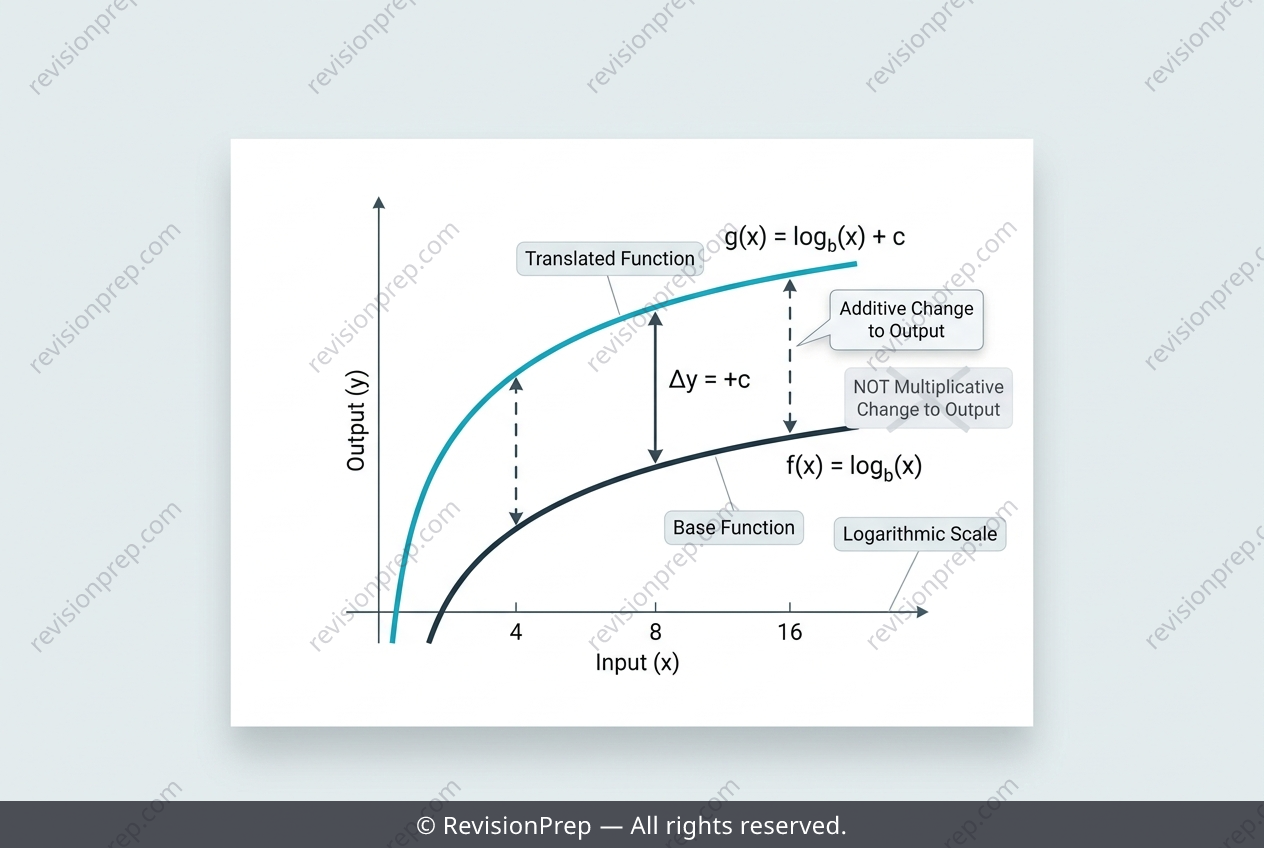
Maths: Adding, Not Multiplying — Log Shifts
A vertical translation shifts a graph straight up or down without changing its shape—and in logarithmic functions, this simple move carries a surprisingly deep meaning. When you add a constant to a logarithmic function like f(x) = log₂(x), you are not scaling the output; you are adding a fixed amount to every single value. This is the core idea behind the loudness model in this exercise: the amplifier’s effect is modelled by g(x) = log₂(x) + 3, a shift upward by 3 units, not a multiplication. Why does this distinction matter? Because logarithms turn multiplicative changes in the input into additive changes in the output. Here, adding 3 dB to the loudness corresponds to a constant vertical shift, while multiplying the loudness would require a different transformation entirely. By comparing values like f(4) and g(4), you see that the difference is always 3, but the ratio g(x)/f(x) changes with x—so the engineer’s claim of “multiplying by 3” is false. This concept connects the visual graph shift to the algebraic relationship g(x) − f(x) = 3, and it also warns against extrapolating beyond the given domain, as the model is only valid for 0 < x ≤ 16. Understanding vertical translations in logs helps you interpret real-world data where additive changes are often more meaningful than multiplicative ones.
Start practising IB questions today
150,000+ IB-styled questions, criteria-mapped and instantly accessible.