
Maths: Completing the Square — Unlocking the Parabola
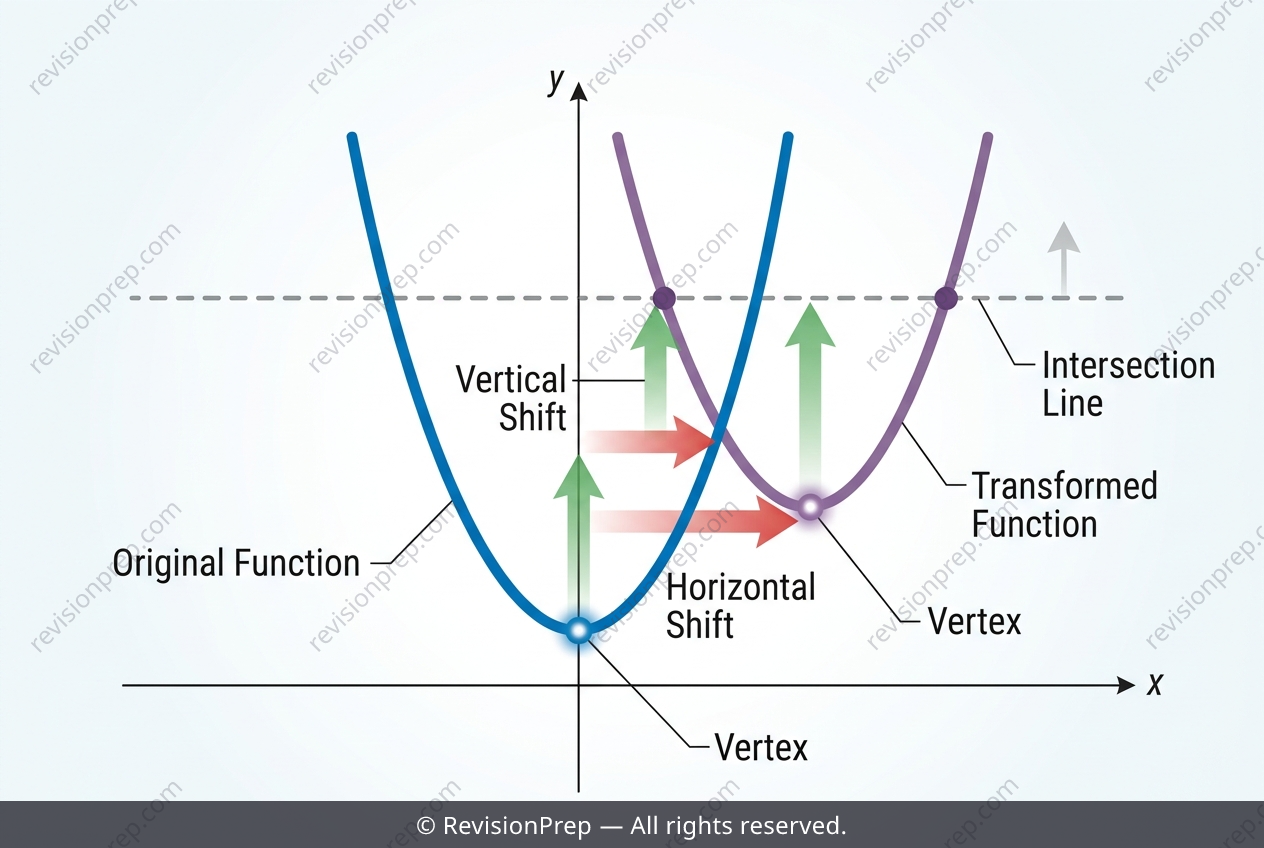
Completing the square is the key that unlocks the geometry hiding inside any quadratic equation. When you rewrite a function like f(x) = x² – 4x + 7 into the form (x – h)² + k, you are not just rearranging symbols—you are revealing the parabola’s vertex at (h, k) and its exact shape. This transformation matters because it turns a seemingly abstract algebraic expression into a visual, predictable curve, allowing you to sketch graphs, locate maxima or minima, and understand how shifts in the equation correspond to shifts on the coordinate plane. The real power emerges when you apply transformations to the completed-square form. Replacing x with (x – 3) shifts the graph horizontally, while adding a constant outside the square moves it vertically. Each change to the equation maps directly to a movement of the vertex, and the structure of (x – h)² + k tells you everything about the range: since the squared term is always non-negative, the vertex represents the absolute minimum (for an upward-opening parabola). Consequently, a horizontal line y = m will intersect the curve at exactly two points only when m lies strictly above that minimum value—a condition that falls straight out of the completed-square expression. Understanding this connection between algebraic form and graphical behaviour is foundational for tackling more complex function transformations.
Start practising IB questions today
150,000+ IB-styled questions, criteria-mapped and instantly accessible.