
Maths: Exponential Decay — Asymptotes and Logarithms
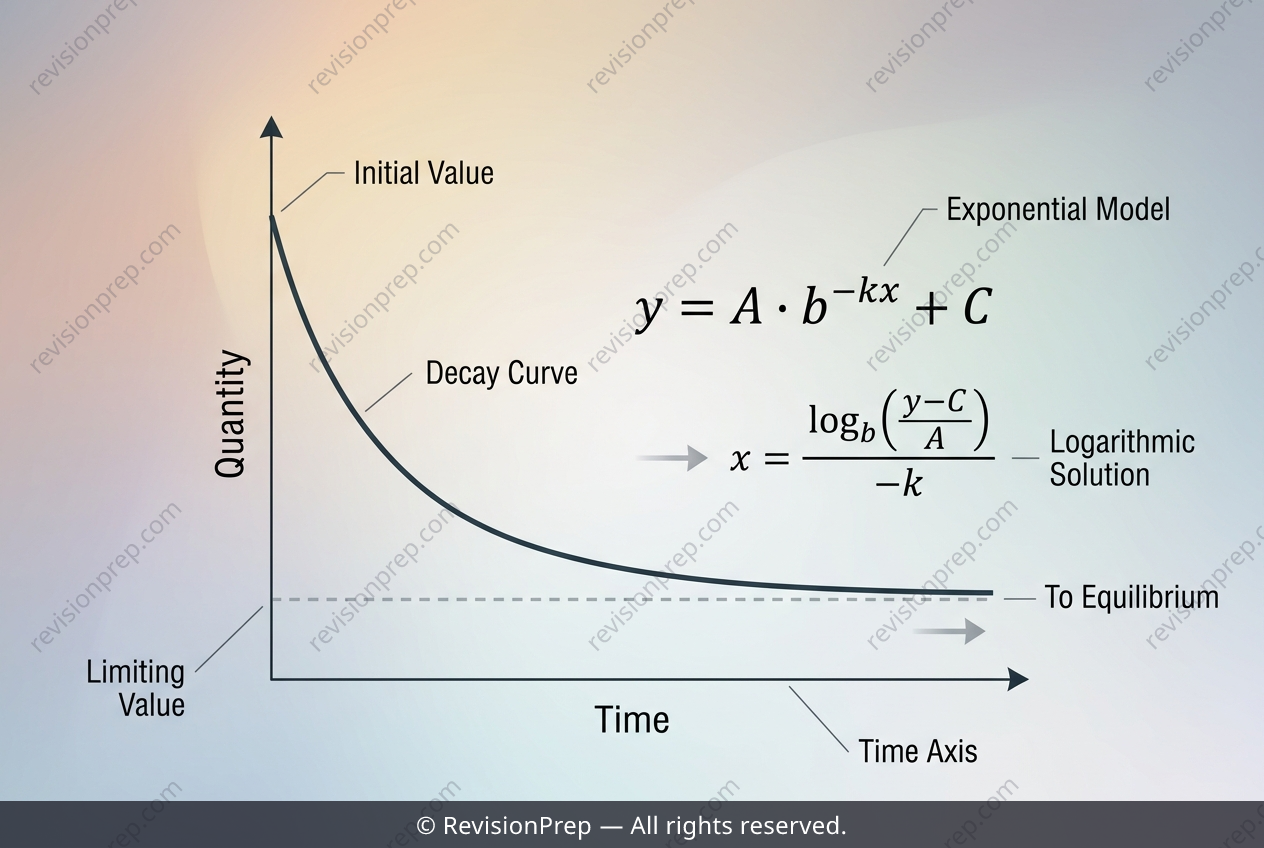
Exponential decay describes how a quantity diminishes over time at a rate proportional to its current value—think of a hot drink cooling, a drug leaving the bloodstream, or sound fading in a hall. In the equation T = 80 · 5^(−0.4t) + 20, the term 80 · 5^(−0.4t) represents the decaying excess above a baseline, while the constant 20 acts as a horizontal asymptote: the temperature approaches 20 °C but never quite reaches it in finite time. This structure is central to understanding asymptotic behavior—the idea that a function can get arbitrarily close to a value without ever touching it. The power of this model lies in how its parts connect. At t = 0, the exponent is zero, so the decay term equals its initial coefficient (80), giving the starting temperature. As t grows, the base 5 raised to a negative exponent shrinks rapidly, pulling T toward the asymptote. Solving for when T equals a specific value—like 35 °C—requires isolating the exponential term and then applying logarithms, since the unknown sits in the exponent. The exact solution emerges as a ratio of logarithms, revealing how the decay rate and base jointly determine the time to reach any threshold. This interplay between exponential functions and their logarithmic inverses is what makes such models so powerful for predicting real-world behavior.
Start practising IB questions today
150,000+ IB-styled questions, criteria-mapped and instantly accessible.