
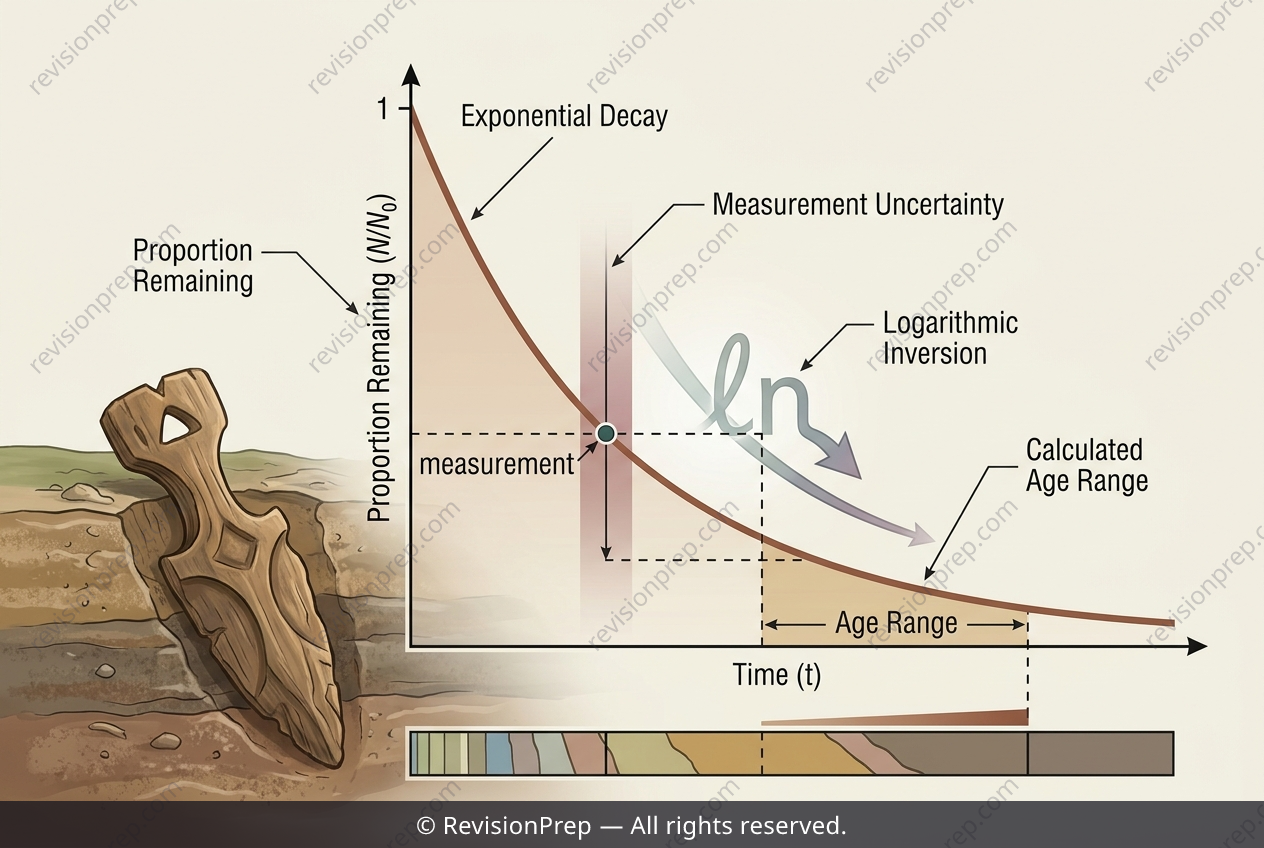
Maths: How Carbon Dating Turns Decay into Age
Exponential decay isn’t just a formula—it’s a way of reading time locked inside matter. When a museum curator measures the fraction of carbon-14 left in a wooden artifact, that single number, N/N₀, quietly encodes thousands of years of history. The model N/N₀ = e^(−0.000121t) links the remaining proportion to elapsed time t through a constant decay rate. Taking the natural logarithm of both sides unlocks t directly: t = ln(N/N₀) / (−0.000121). This rearrangement turns a measurement into an age. But measurements are never perfect. A ±3% uncertainty in the measured fraction doesn’t just shift the answer slightly—it creates a range of possible ages. Because the logarithm is nonlinear, a symmetric error in N/N₀ produces an asymmetric spread in t. A larger fraction (0.612 × 1.03) means less decay, so a younger age; a smaller fraction (0.612 × 0.97) means more decay, so an older age. This connection between measurement error and output uncertainty is the heart of real-world modeling. It shows why logarithms aren’t just algebraic tools—they’re the bridge between a raw reading and the story it tells about the past.
Start practising IB questions today
150,000+ IB-styled questions, criteria-mapped and instantly accessible.