
Maths: How Change-of-Base Finds a Range
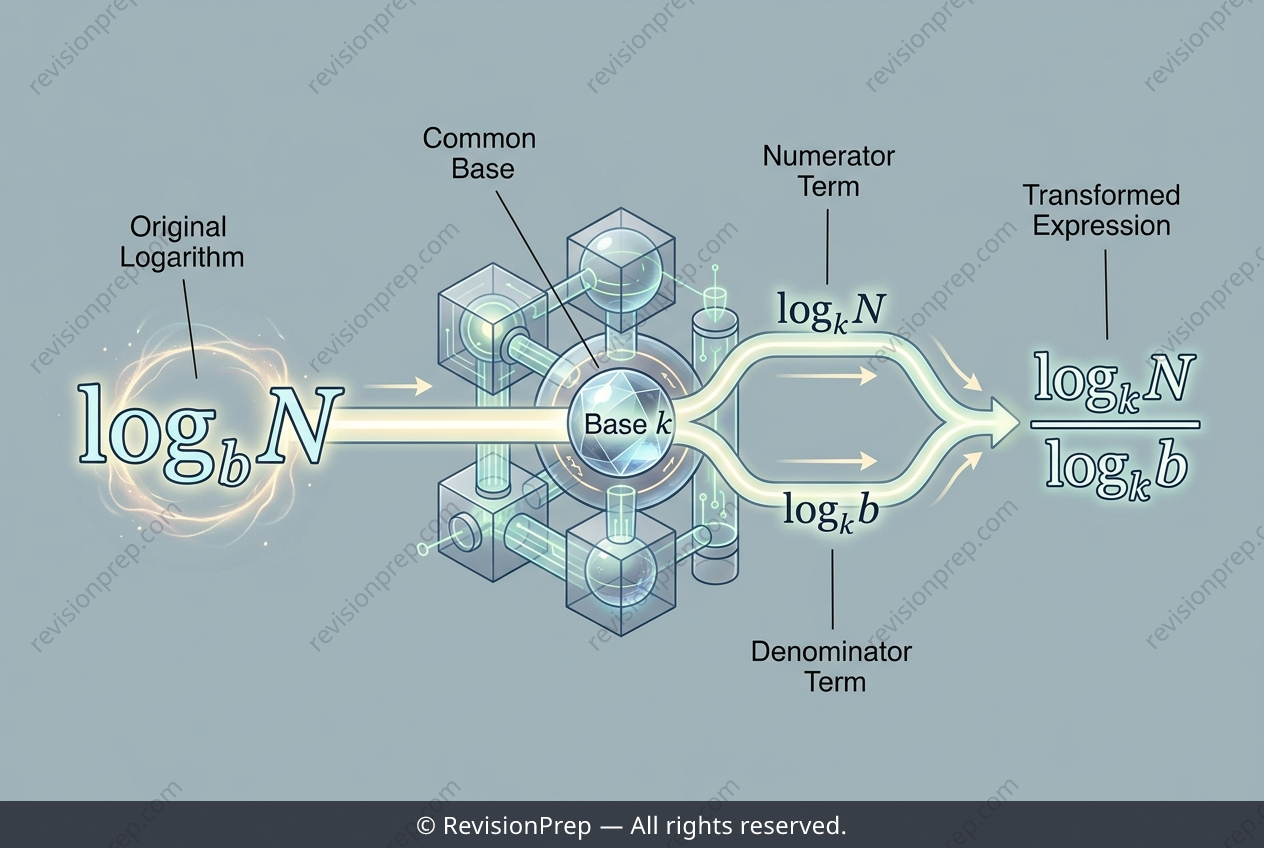
Logarithms let us measure numbers by their exponents, but what happens when the base isn’t convenient? The change-of-base law is the bridge that lets you rewrite any logarithm in terms of a base you already understand—like base 2. Instead of memorising a new table for every possible base, you can express logb 8 as log2 8 divided by log2 b. Since log2 8 equals 3, this collapses to the simple relationship logb 8 = 3 / log2 b. This formula is more than a shortcut—it reveals how logarithms behave as the base changes. Because log2 b grows as b increases, the fraction 3 / log2 b shrinks, meaning larger bases produce smaller log values for the same number. That inverse relationship lets you predict not just specific values, but entire ranges: for example, knowing when logb 8 exceeds 2 becomes a matter of comparing log2 b to 1.5, which translates directly into a boundary for b. Understanding this single law turns scattered table entries into one coherent, flexible tool for solving exponential and logarithmic problems across any base.
Start practising IB questions today
150,000+ IB-styled questions, criteria-mapped and instantly accessible.