
Maths: How Logarithms Linearise Exponentials
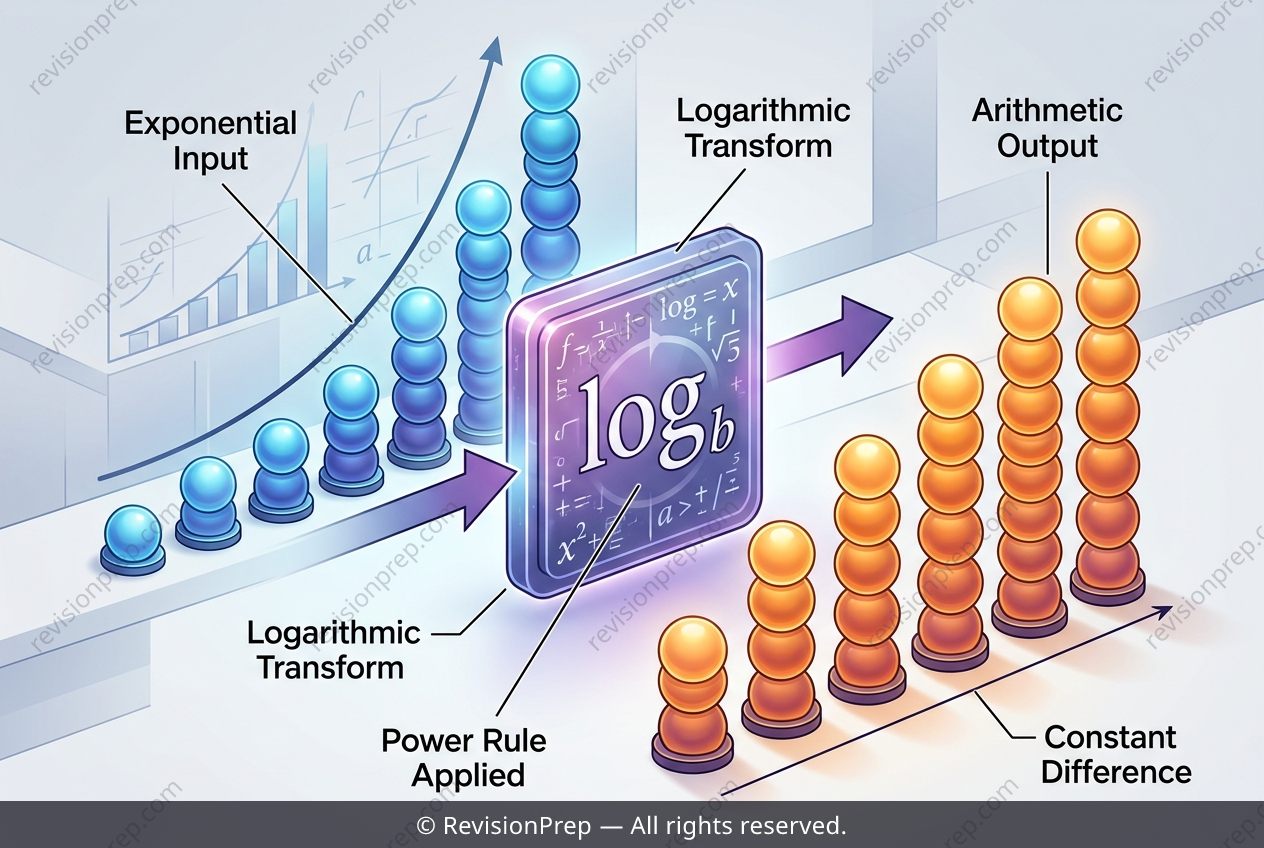
Logarithms can feel like a puzzle of rules, but when you see them in action, they reveal a beautiful structure hiding inside exponential sequences. In this question, the sequence Tₙ = log₃(4ⁿ) is plotted against n, and the first four terms—log₃(4), log₃(16), log₃(64), log₃(256)—look scattered until you apply the power law: log₃(4ⁿ) = n·log₃(4). Suddenly, each term is just a multiple of the same base value, turning the sequence into an arithmetic one with a constant common difference of log₃(4). That single step transforms a list of numbers into a straight line on the grid. The key relationship here is that logarithms convert multiplication into addition, and powers into products. When you subtract consecutive terms, the quotient law collapses the ratio 4ⁿ / 4ⁿ⁻¹ into simply 4, so the difference between any two neighbouring terms is always log₃(4)—exactly the common difference from part (a). This connection between the sequence’s step size and the log of the base is why logarithms are so powerful: they linearise exponential growth. By understanding how the power, quotient, and change-of-base laws interlock, you can move fluidly between exponential forms and their linear logarithmic counterparts, making problems like finding when Tₙ equals a specific value straightforward.
Start practising IB questions today
150,000+ IB-styled questions, criteria-mapped and instantly accessible.