
Maths: How Scaling Changes Area by Orders of Magnitude
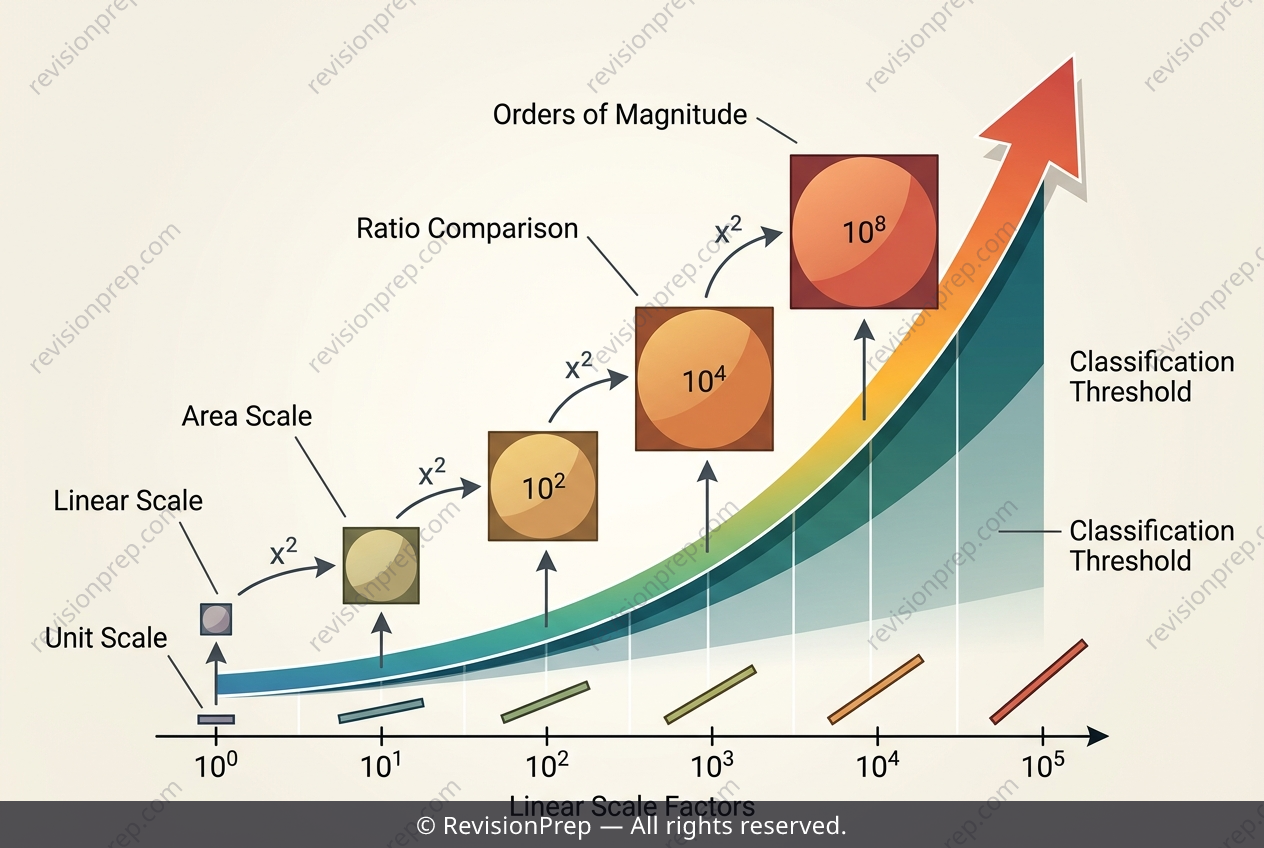
Orders of magnitude and geometric scaling explain how quantities that differ hugely in size can still be compared through a single, tidy ratio. When a shape's linear dimensions are scaled, its area does not scale in the same proportion — it grows with the square of the radius. This is why the relationship A = πr² matters so much: doubling a radius multiplies the area by four, and scaling a radius by a factor of ten multiplies the area by a hundred. Working with values in scientific notation makes these comparisons manageable, since squaring a term like a × 10ⁿ means squaring the coefficient and doubling the exponent. In the satellite example, comparing two circular coverage zones means forming the ratio of their areas, cancelling π, and simplifying the powers of ten. The resulting order of magnitude then speaks for itself: a ratio can be checked directly against a required threshold, showing whether one zone is genuinely larger by the necessary factor.
Start practising IB questions today
150,000+ IB-styled questions, criteria-mapped and instantly accessible.