
Maths: Logarithm Laws — Rules, Powers and Equations
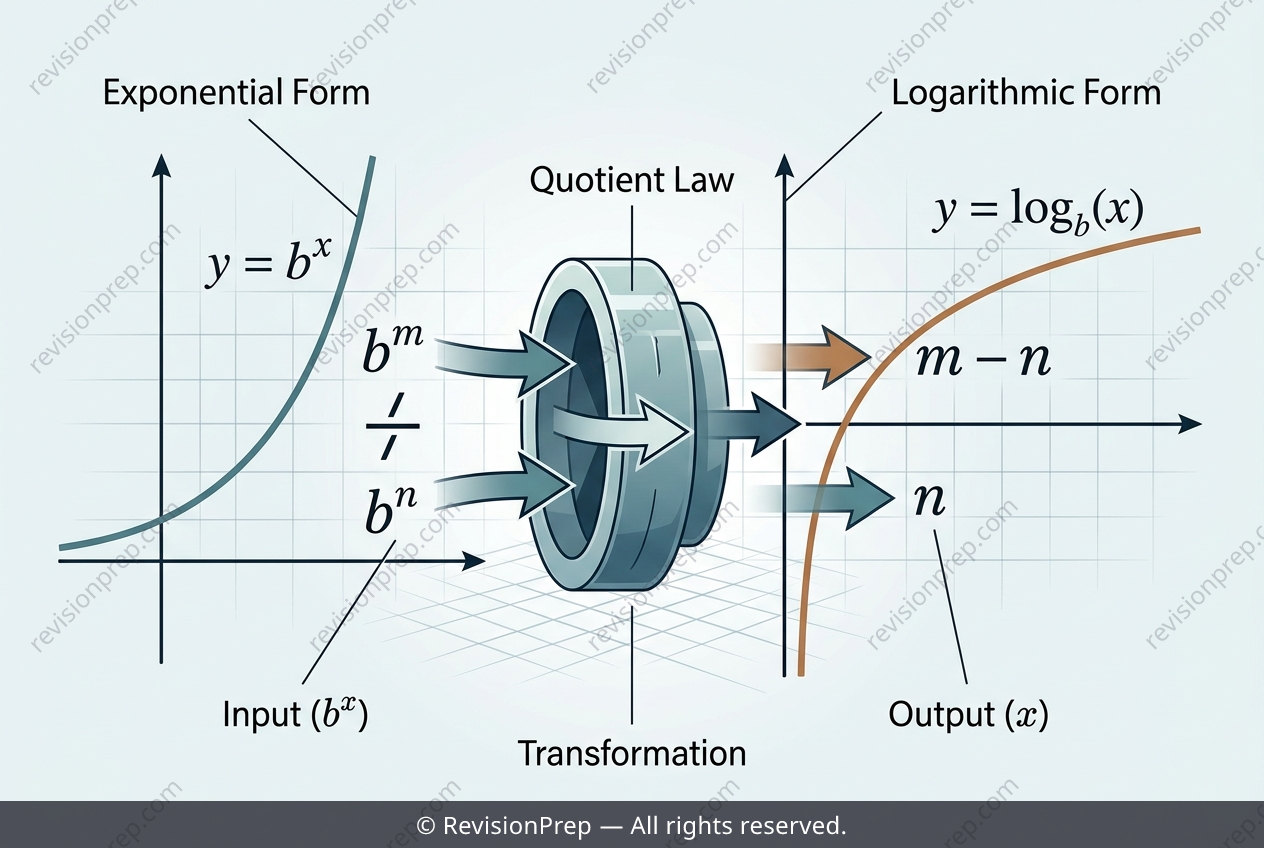
Logarithms are the mathematical operation that answers the question: “To what exponent must a given base be raised to produce a certain number?” In the extended Mathematics syllabus, the laws of logarithms transform multiplicative relationships into additive ones, turning complex expressions into simple arithmetic. This makes them indispensable for solving exponential equations, modelling growth and decay, and simplifying calculations across science and finance. The core mechanism rests on two foundational ideas: the quotient law, which states that logb(m/n) = logb(m) − logb(n), and the identity logb(b^k) = k. Together, they allow you to rewrite expressions like log_b(b^m / b^n) directly as m − n, because each logarithm of a power of the base collapses to its exponent. This same logic applies when solving equations: by expressing numbers as powers of the base (e.g., 81 = 3⁴), you can isolate the unknown logarithm and then convert back to an exponential form. Crucially, the argument of a logarithm must always be positive, so any solution must be checked against this domain restriction. Understanding these connections turns seemingly abstract rules into a powerful, flexible tool for algebraic manipulation.
Start practising IB questions today
150,000+ IB-styled questions, criteria-mapped and instantly accessible.