
Maths: Logarithms — Domain, Range and Reflection
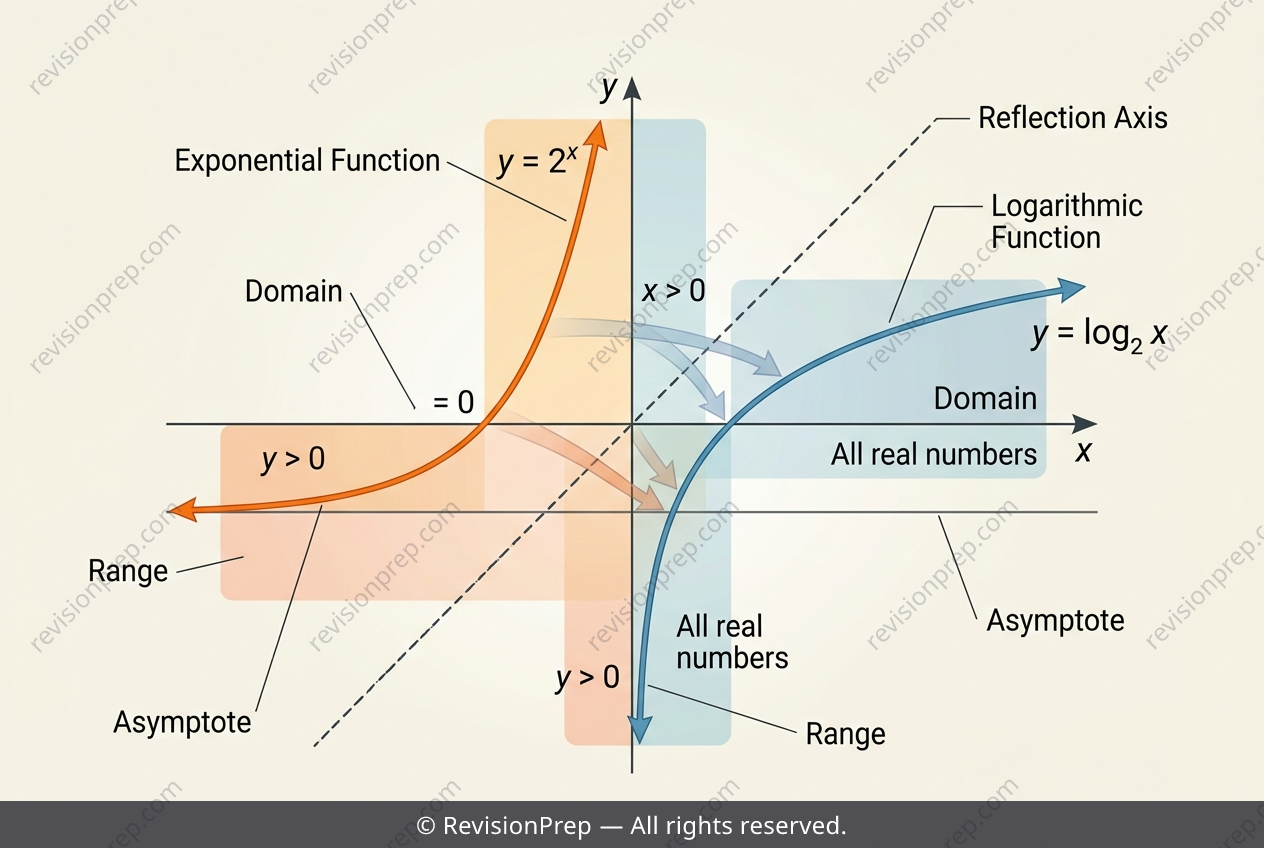
Logarithmic functions are the mirror images of exponential functions, and understanding that reflection is the key to mastering their graphs. When you see y = log₂x, you are really asking, “2 raised to what power gives me x?” This inverse relationship means that every property of the exponential function has a flipped counterpart in the logarithm—and nowhere is that clearer than in its domain and range. The domain of a logarithm is not all real numbers; it is strictly positive inputs (x > 0), because you cannot raise 2 to any power and get zero or a negative number. The range, however, is the entire set of real numbers (y ∈ ℝ). As x grows larger, the logarithm grows without bound, but as x approaches zero from the right, the output plunges toward negative infinity. This asymmetry—a restricted input but an unrestricted output—is the defining characteristic that separates logarithmic graphs from polynomial or rational ones. Recognizing this domain-range pair not only helps you sketch the curve but also reveals why logarithms are essential for modelling phenomena that span orders of magnitude, from sound intensity to earthquake scales.
Start practising IB questions today
150,000+ IB-styled questions, criteria-mapped and instantly accessible.