
Maths: Modelling Earthquake Energy with Logarithms
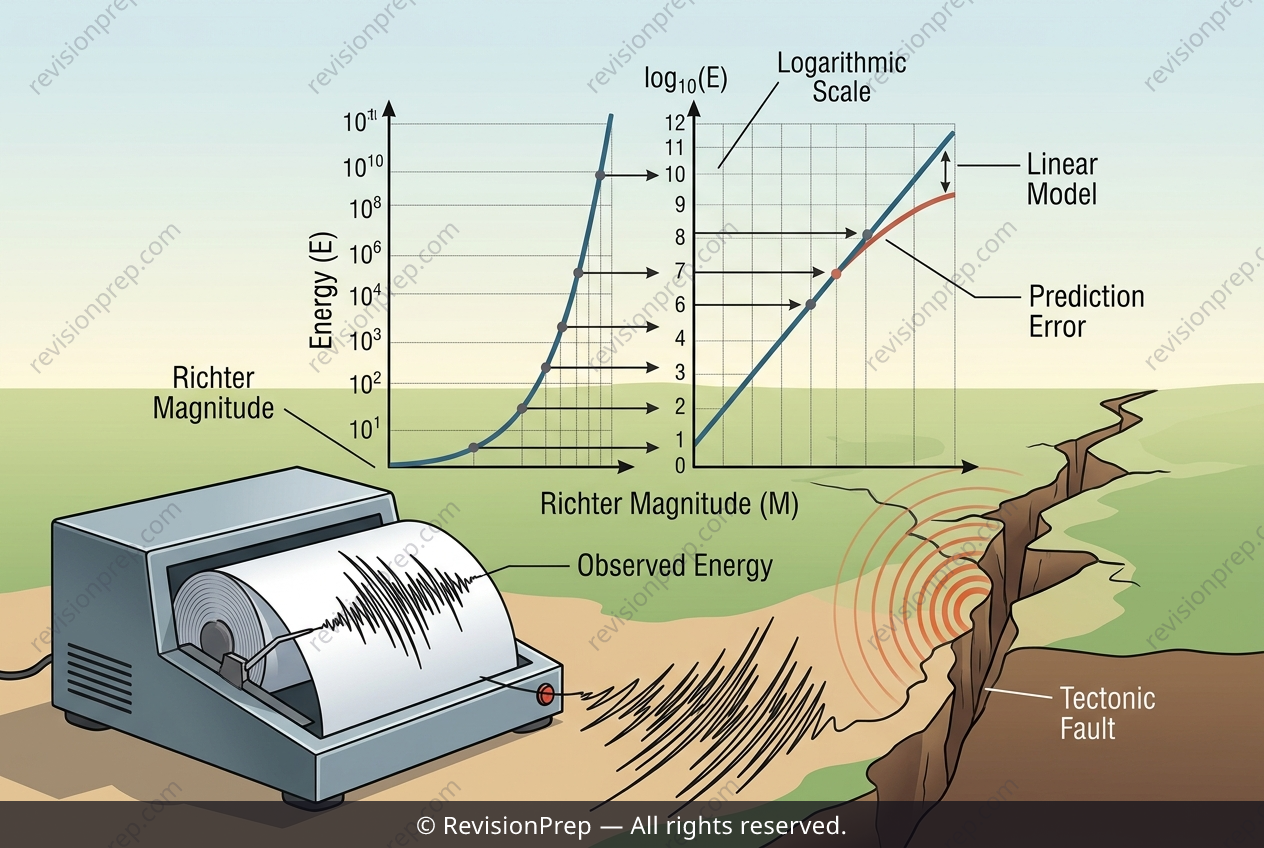
When an earthquake strikes, the energy it unleashes spans such an enormous range that a linear scale simply cannot capture it. That is why scientists use a logarithmic model, here expressed as log₁₀(E) = 4.4 + 1.5M, where E is energy in joules and M is Richter magnitude. This single equation condenses a million-fold change in energy into a manageable, straight-line relationship on a log-linear graph. The power of this model lies in its ability to predict—but prediction demands scrutiny. By substituting magnitudes like 4.0, 6.0, and 8.0, you generate expected log₁₀(E) values, then convert them back to actual energies. Comparing these predictions against observed data reveals percentage errors, exposing how well the model fits reality. Notice how errors grow at the extremes, hinting at the model’s limitations. Crucially, the structure itself—where each unit increase in M multiplies E by 10^1.5—shows why extrapolation beyond the observed range (here, 0 ≤ M ≤ 9) becomes increasingly unreliable. Understanding this balance between elegant prediction and real-world deviation is the heart of mathematical modeling.
Start practising IB questions today
150,000+ IB-styled questions, criteria-mapped and instantly accessible.