
Maths: One Quadratic, a Drone’s Entire Flight Path
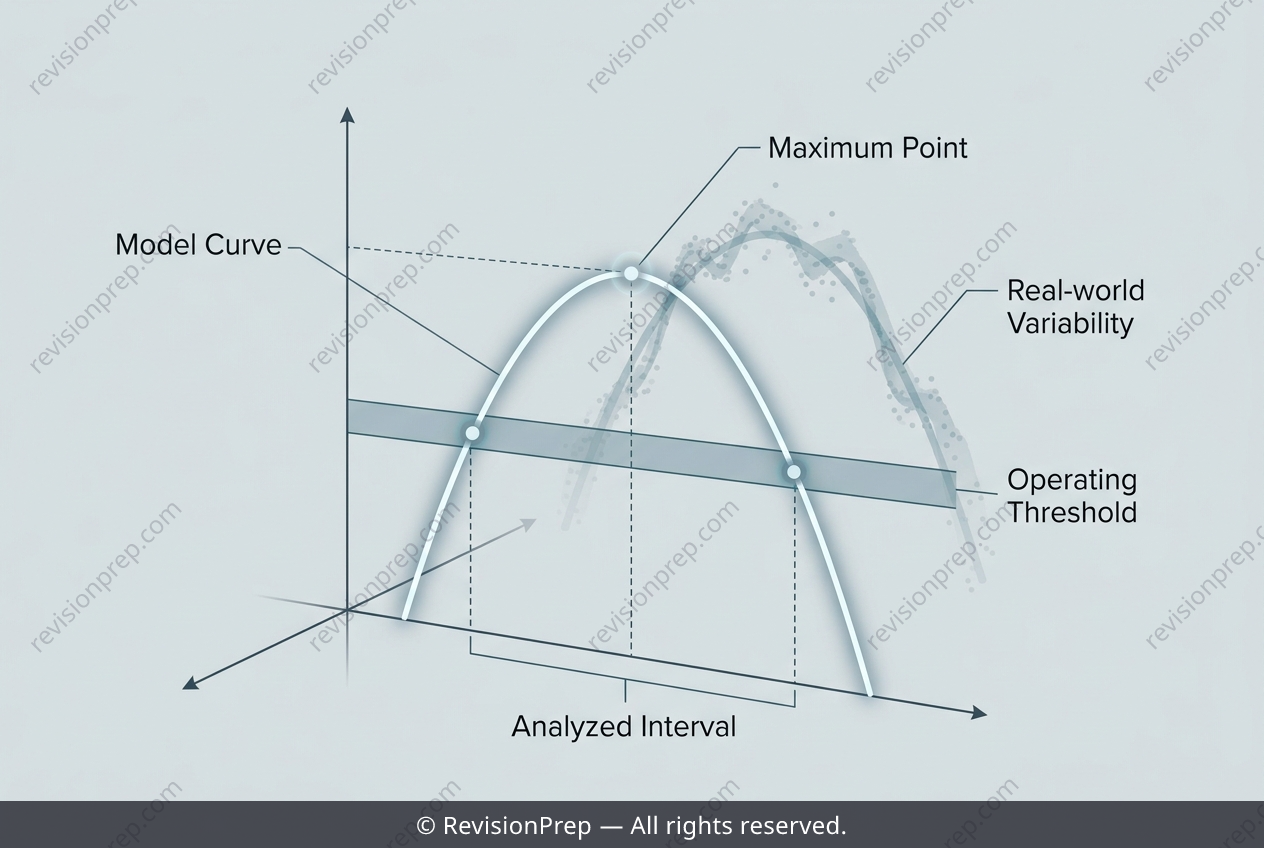
Quadratic functions are more than just curves on a page—they are powerful tools for modelling real-world motion, such as the rise and fall of a drone’s flight path. When a situation involves an object being launched, thrown, or projected, its height over time often follows a quadratic relationship of the form h(t) = at² + bt + c. Here, the coefficient a determines whether the parabola opens upward (minimum point) or downward (maximum point), while the vertex represents the peak or trough of the motion. In the case of a drone, the negative a value tells us the height increases, reaches a single highest point, and then decreases—capturing the entire arc of flight in one equation. Understanding this model allows us to extract meaningful insights: the time of maximum height comes from the axis of symmetry, t = -b/(2a), and substituting that time back into the function gives the maximum height itself. But quadratics also help answer practical questions about safety limits. By setting h(t) ≥ a threshold, we can solve a quadratic inequality to find the interval of time during which the object stays above that level. The roots of the corresponding equation mark the boundaries of that interval, and their difference gives the total duration of safe operation. This connection between the parabola’s shape, its vertex, and its roots is what turns a simple formula into a predictive tool for decision-making—whether for drone regulations, projectile design, or any scenario where timing and height matter.
Start practising IB questions today
150,000+ IB-styled questions, criteria-mapped and instantly accessible.