
Maths: Patterns, Rules and Arithmetic Sequences
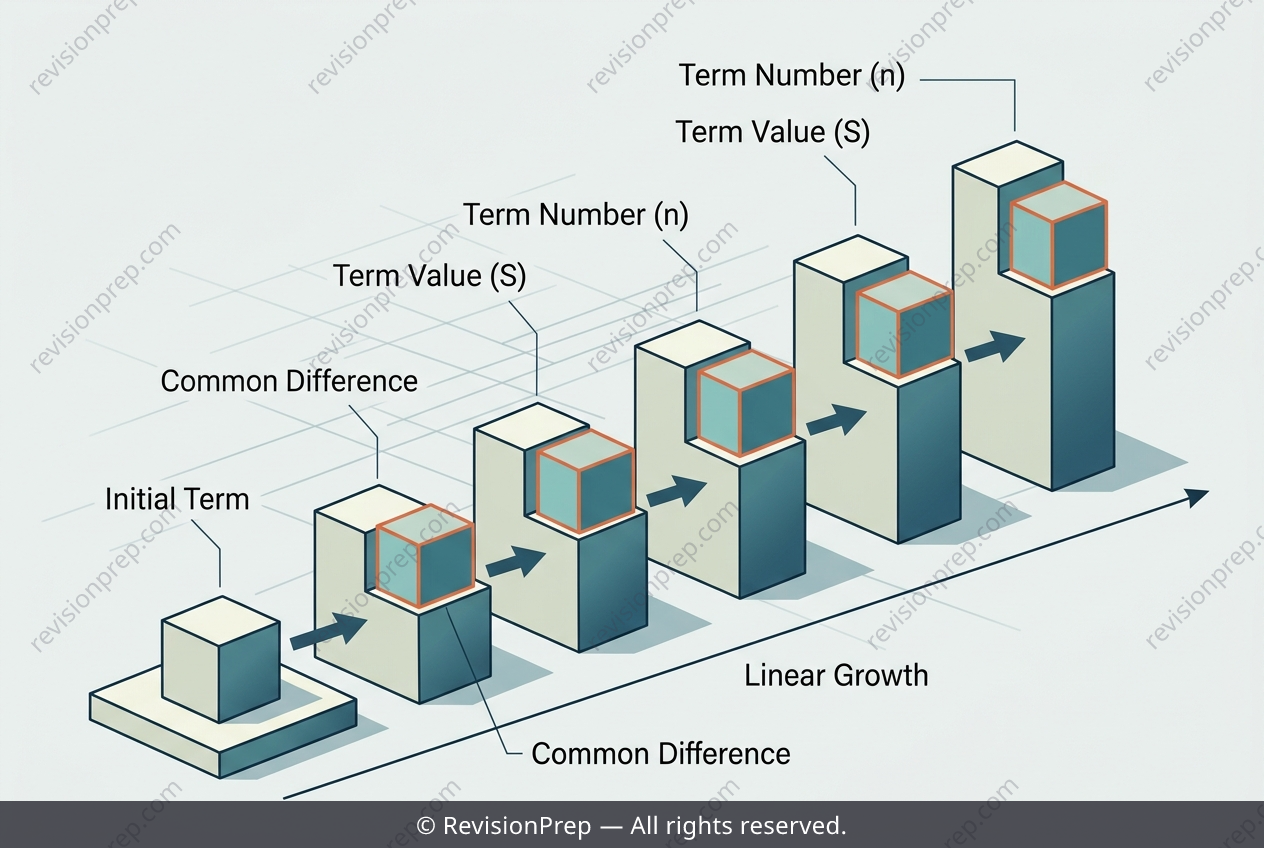
Arithmetic sequences are one of the most intuitive yet powerful ideas in mathematics: they describe patterns where each term increases by a constant amount. In this L-shape square pattern, the number of squares forms just such a sequence, and the goal is to move from spotting the pattern to expressing it as a precise rule. The core relationship here is linear: if the common difference between consecutive terms is a, then the nth term can always be written as S = an + b, where b is the starting offset. This simple formula connects the visual pattern directly to algebra, turning a diagram into an equation you can evaluate for any figure number. Why does this matter? Because linear functions and arithmetic sequences are everywhere—from calculating interest to predicting costs. In this problem, the marking scheme highlights two key steps: first, identifying the common difference (which gives you a), and second, using one known point (like Figure 1) to solve for b. Once you have S = 2n + 1, you can test claims about large figures, like whether Figure 23 exceeds a certain threshold. The scheme also shows the importance of checking not just the target figure but the one before it, to confirm you’ve found the first figure meeting the condition. This interplay between pattern recognition, formula construction, and verification is the heart of working with sequences.
Start practising IB questions today
150,000+ IB-styled questions, criteria-mapped and instantly accessible.