
Maths: Quadratic Sequences — Patterns, Rules and Models
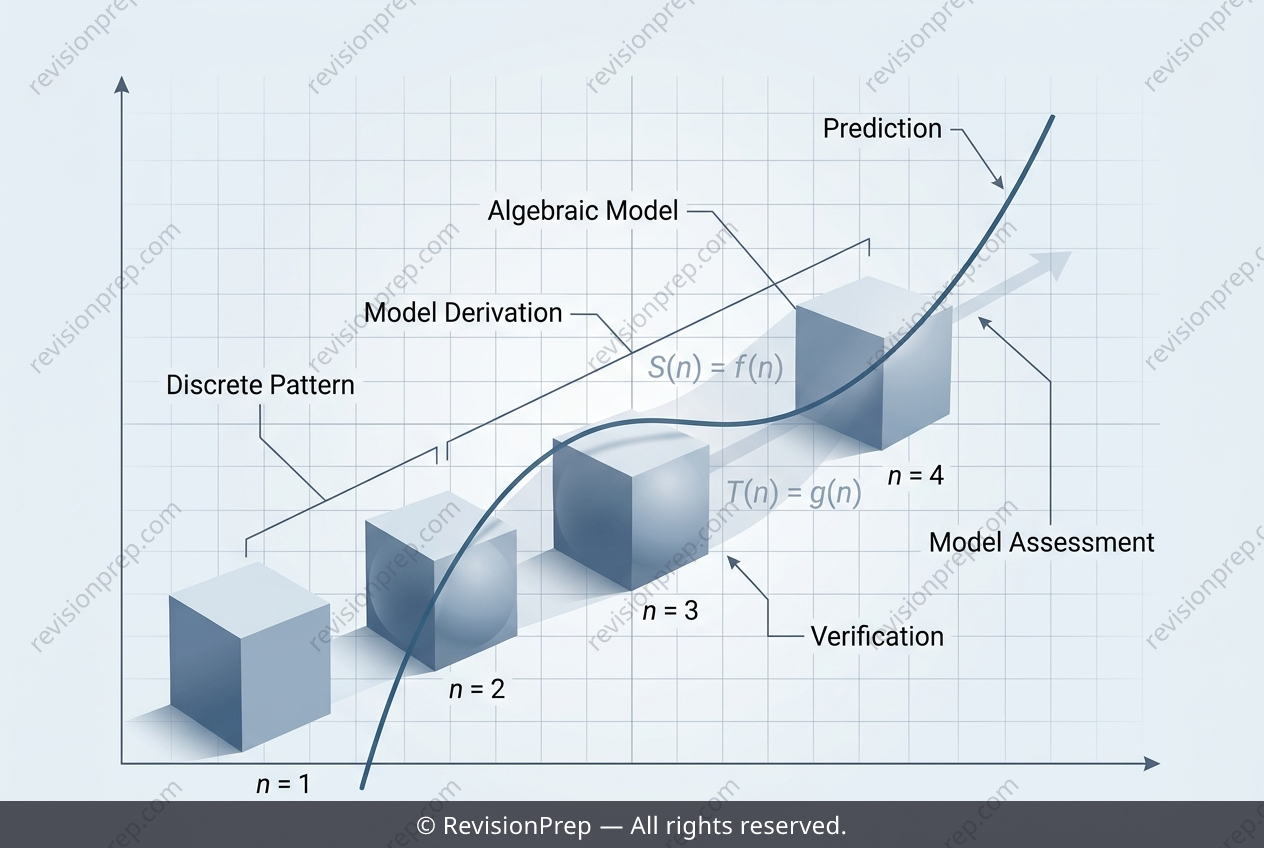
Patterns in sequences often hide deeper mathematical structures, and this is where polynomial models come into play. In this exercise, you explore how the number of squares in an L-shaped figure grows, starting with the sequence 3, 7, 13, 21. The key insight is that while the first differences (4, 6, 8) increase steadily, the second difference remains constant at 2—a hallmark of quadratic growth. This allows you to predict future terms by extending the difference pattern, but it also sets the stage for testing proposed formulas. The real power of this topic lies in verifying and refining models. A student’s claim that S = 2n² + n can be checked by substituting n = 3 and n = 4, revealing a mismatch with the observed values—a reminder that a formula must fit all given data, not just a few. When moving to cumulative totals T(n), you use a cubic expression T(n) = an³ + bn², solving simultaneous equations from the first two terms to find constants. However, testing these constants against later terms exposes the model’s limitations, showing that mathematical modeling is an iterative process of derivation, verification, and critical assessment of reliability.
Start practising IB questions today
150,000+ IB-styled questions, criteria-mapped and instantly accessible.