
Maths: Second Differences and Quadratic Rules
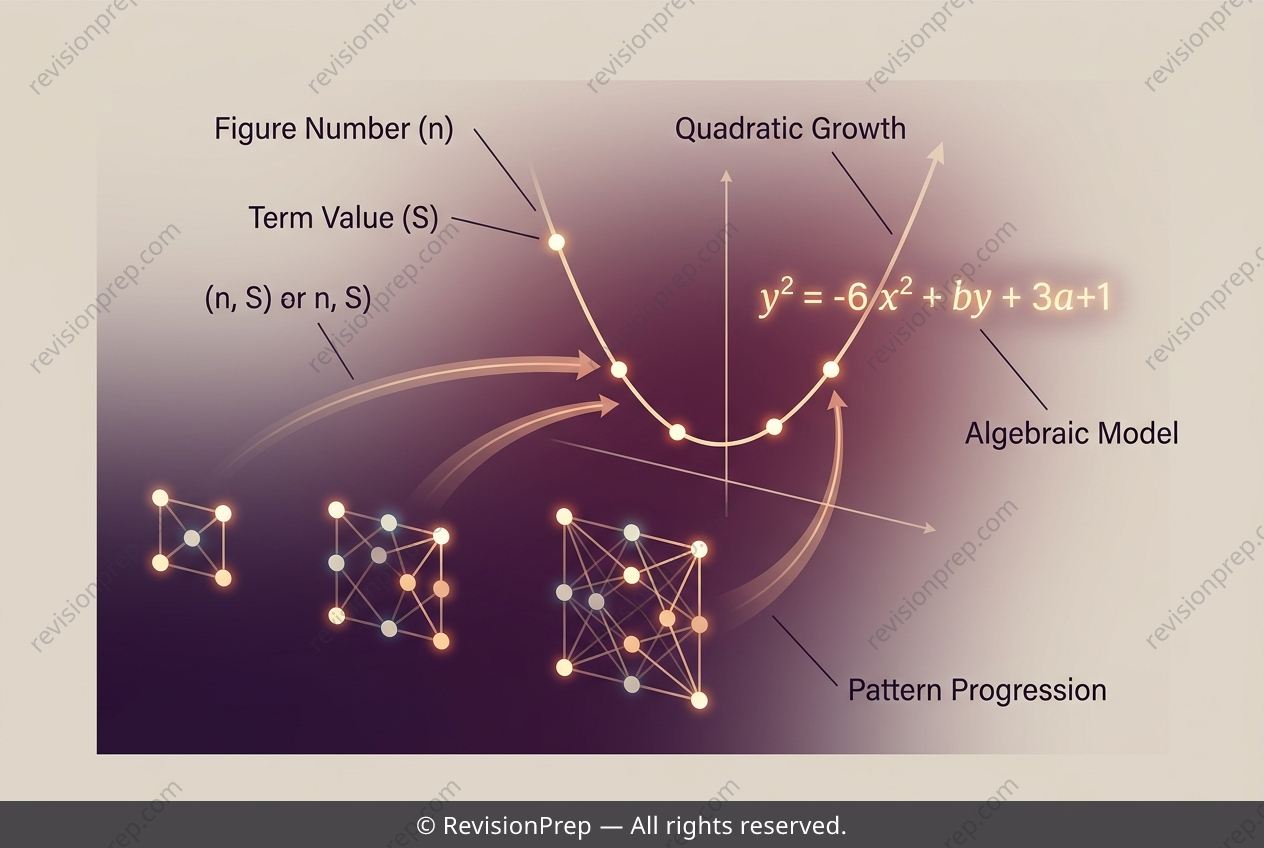
Quadratic sequences often hide in plain sight—like in this L-shaped pattern of unit squares, where the number of squares grows in a way that isn’t simply linear. At first glance, the differences between consecutive terms (4, 6, 8, …) increase by a steady 2, which signals that a second difference is constant. That constancy is the fingerprint of a quadratic relationship, meaning the rule for the number of squares, S, can be written as S = an² + bn + c. Here, the second difference being 2 directly gives a = 1, because the second difference equals 2a. From there, substituting any two known figure numbers lets you solve for b and c, tying the pattern’s growth to a clean algebraic formula. Why does this matter? Because recognising quadratic behaviour lets you predict any figure’s square count without drawing it. The formula connects the figure number, n, to the total squares, S, and once you have it, you can test claims about very large figures—like whether Figure 50 exceeds a certain count. The mechanism is simple: first differences reveal linear growth, second differences reveal quadratic growth, and the coefficients of the rule encode that structure. Understanding this bridge between patterns and functions turns a visual puzzle into a powerful predictive tool.
Start practising IB questions today
150,000+ IB-styled questions, criteria-mapped and instantly accessible.