
Maths: Solving Compound Interest with Logarithms
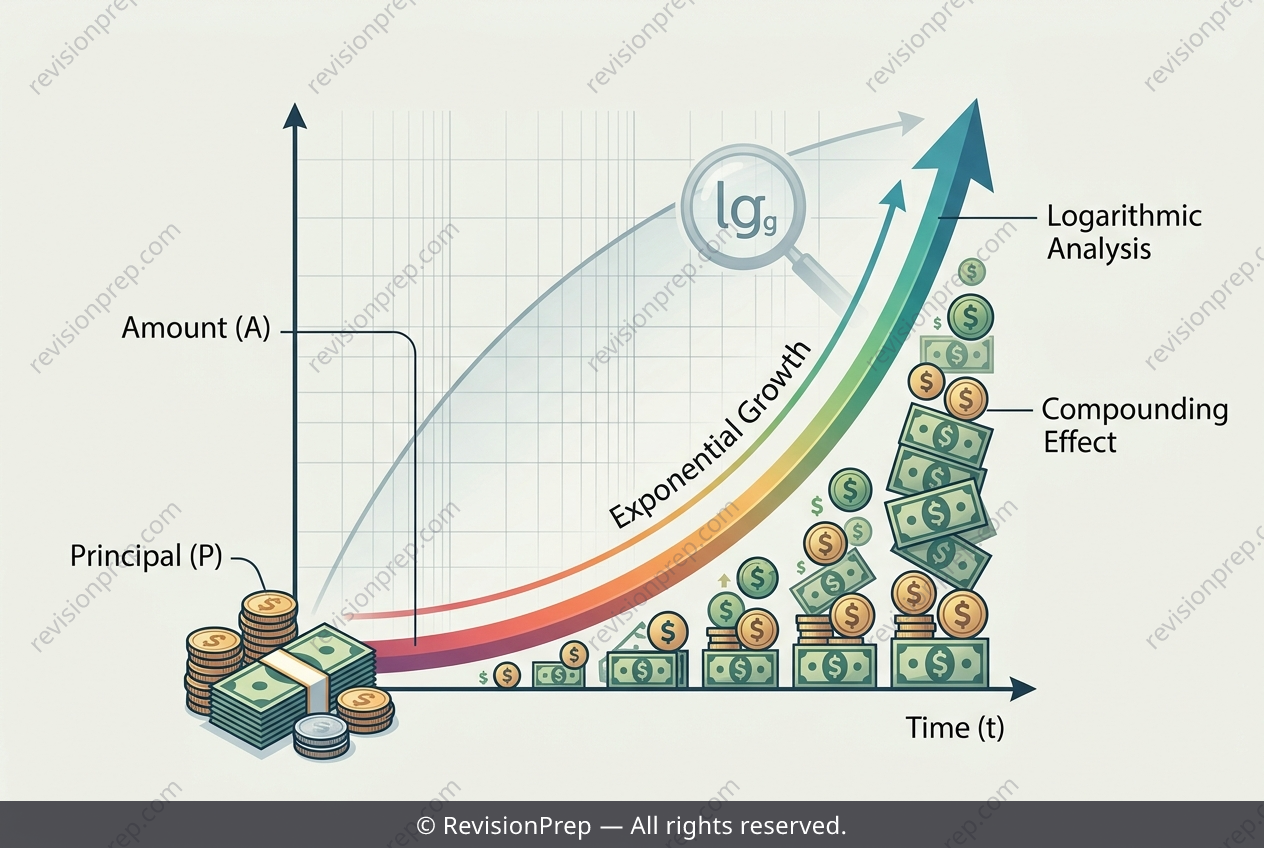
Logarithms turn exponential growth into something we can measure, compare, and solve. In this context, they let us answer a practical financial question: how long does it take an investment to reach a target value under compound interest? The core idea is that while exponential growth multiplies a principal by a fixed factor each period, logarithms “undo” that multiplication, revealing the number of periods needed to achieve a given multiplier. Here, the compound interest formula A = P(1 + r/n)^(nt) ties together four variables: the starting principal P, the annual rate r, the compounding frequency n, and time t. By substituting known values, you can compute the future amount directly. But when the goal is to find t—say, when the balance must reach a specific sum—you isolate the exponential term, then take logarithms of both sides. This converts the exponent into a coefficient, allowing you to solve for t. The relationship between the base (1 + r/n) and the target ratio (A/P) is what makes logarithmic analysis so powerful: it links growth rate, time, and final value in one elegant equation.
Start practising IB questions today
150,000+ IB-styled questions, criteria-mapped and instantly accessible.