
Maths: Solving Exponential Decay with Logarithms
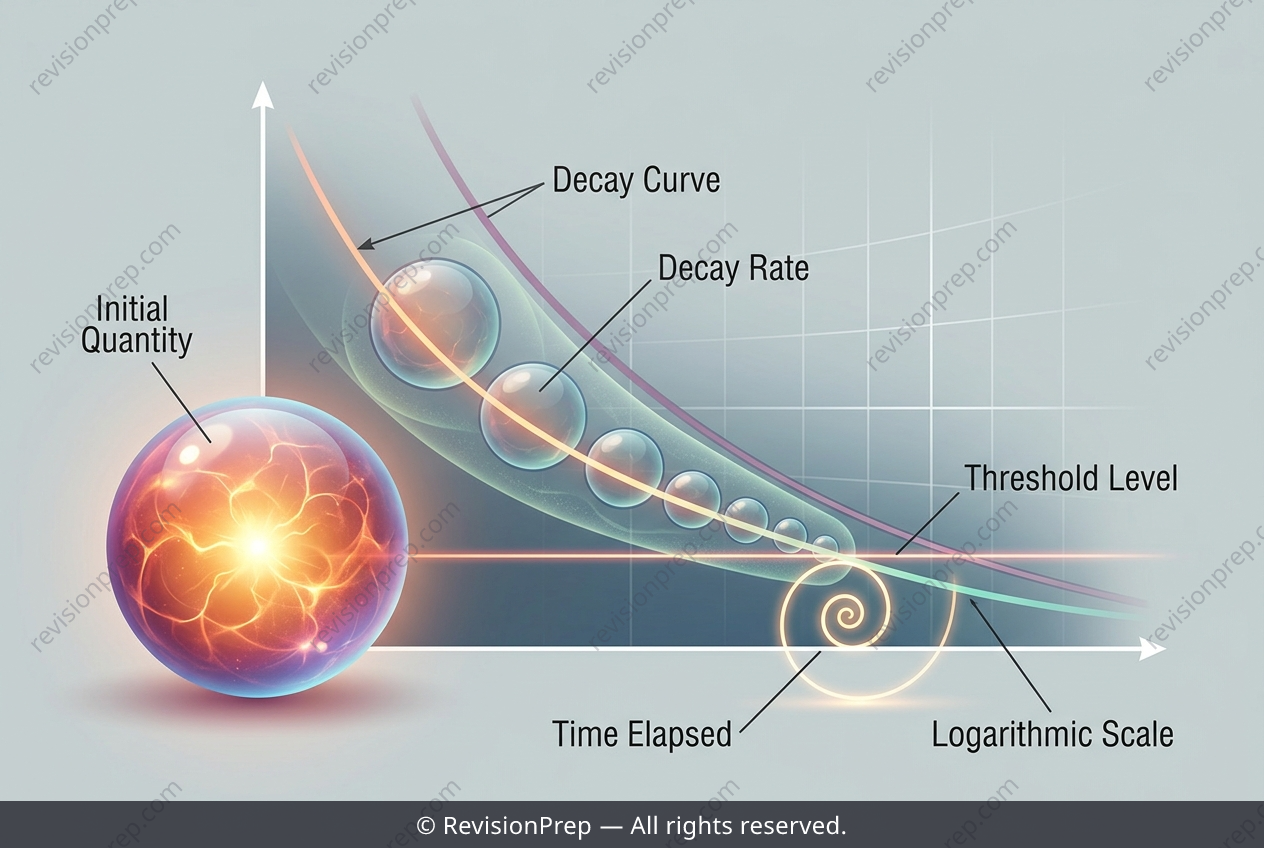
Exponential decay is one of the most practical applications of logarithms you’ll meet in IB Mathematics Extended — it models how quantities shrink by a constant percentage over time, from radioactive substances to medicine leaving the bloodstream. In this question, a 200 mg dose decreases by 18% each hour, which means the amount is multiplied by 0.82 (since 1 − 0.18 = 0.82) every single hour. That repeated multiplication is the engine of the model, and it’s why the amounts after 1, 2, 3, and 4 hours follow a geometric sequence: each term is the previous one times 0.82. The real power of logarithms appears when you reverse the process — instead of finding the amount after a given time, you ask when the amount drops below a threshold, like 50 mg. That requires solving an inequality of the form Aₙ = 200 × (0.82)ⁿ < 50, which means isolating n using logs. Because the base (0.82) is less than 1, its log is negative, so the inequality sign flips — a subtle but crucial step. This same logic extends to finding an unknown decay rate when you’re given a data point, such as knowing 80 mg remains after 6 hours, by taking the sixth root of a fraction. Understanding how the multiplier, exponent, and logarithms connect turns a simple table into a flexible tool for real-world predictions.
Start practising IB questions today
150,000+ IB-styled questions, criteria-mapped and instantly accessible.