
Maths: Testing an Exponential Model's Limits
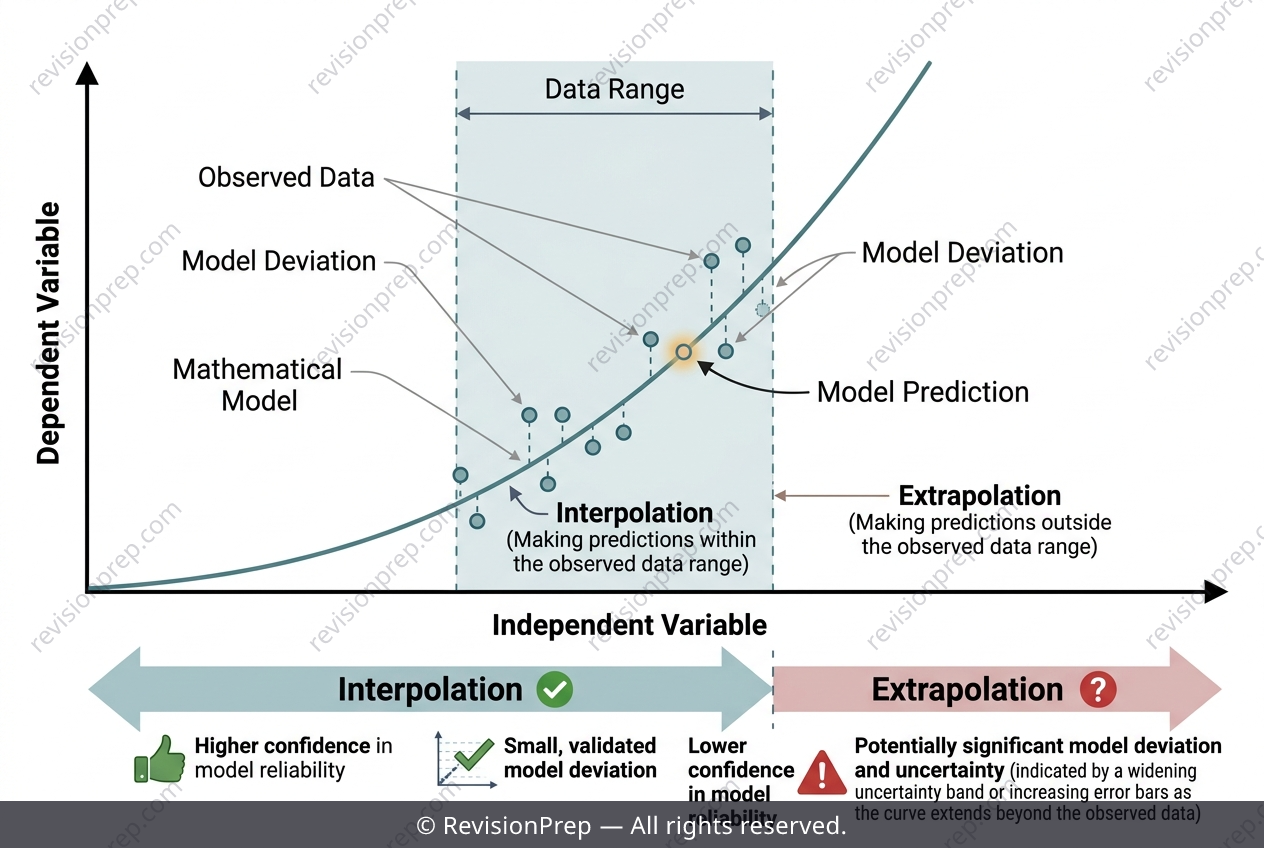
Exponential models like N(t) = 500 · 2^(t/4) are powerful tools for describing rapid growth, but a model is only useful if we know how much to trust it. This topic explores the full lifecycle of a mathematical model: building it from a formula, checking its predictions against real observations, and deciding whether those predictions remain reliable beyond the data we have. The core idea is that a model is not just an equation—it is a claim about the world, and that claim must be tested. The key mechanism here is model validation through percentage error, which compares predicted values to observed ones using the formula |predicted − observed| / observed × 100%. When you plug in times like t = 0, 8, and 16, you get clean predictions from the exponential rule. But the observed counts differ, and those differences reveal how far the model drifts from reality. The final piece is interpolation versus extrapolation: using the model inside its stated domain (0 ≤ t ≤ 24) is safer than extending it to t = 30, where errors compound. Understanding this connection—between formula, error, and domain—turns a simple graph into a critical thinking tool.
Start practising IB questions today
150,000+ IB-styled questions, criteria-mapped and instantly accessible.