
Maths: The Change of Base Formula Explained
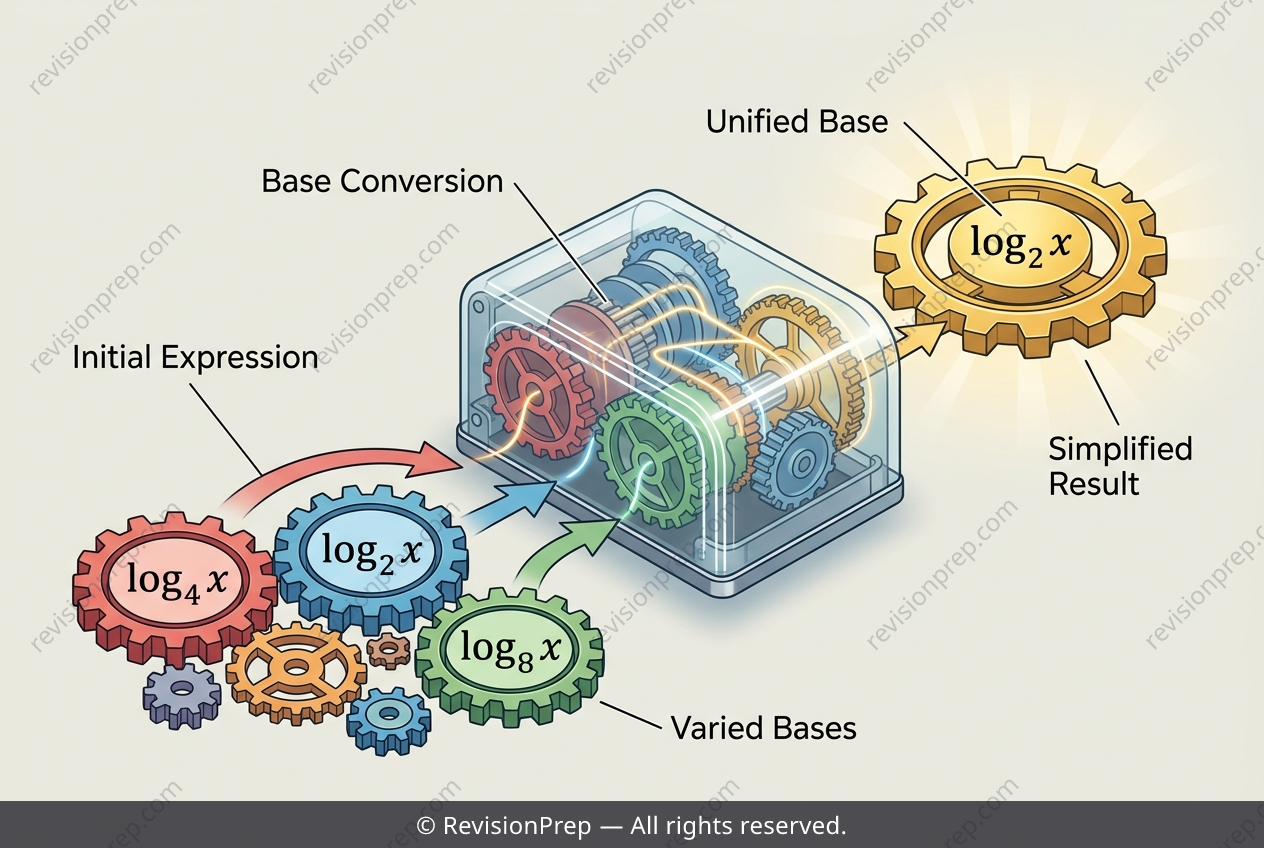
Logarithms with different bases can feel like comparing measurements in different currencies — the numbers change, but the underlying quantity stays the same. The change of base formula is the exchange rate that lets you convert any logarithmic expression into a single, workable base, and this is exactly what makes expressions like E = log₄x + log₂x − log₈x tractable. By rewriting each term as a fraction of log₂x — since 4, 2, and 8 are all powers of 2 — the entire expression collapses into a single constant multiple of log₂x, revealing a clean, linear relationship between E and the logarithm. This transformation is more than a neat trick; it exposes the structure of the problem. Once every term shares a base, addition and subtraction become simple arithmetic on coefficients, and solving equations like E = n reduces to isolating log₂x and exponentiating. Because log₂x is a one-to-one function that ranges over all real numbers as x varies over positive reals, any target value n — no matter how large — will correspond to exactly one positive x. The claim that such equations always have a solution follows directly from this unbounded, continuous nature, making the change of base formula not just a computational tool, but a lens for understanding why logarithmic equations behave the way they do.
Start practising IB questions today
150,000+ IB-styled questions, criteria-mapped and instantly accessible.