
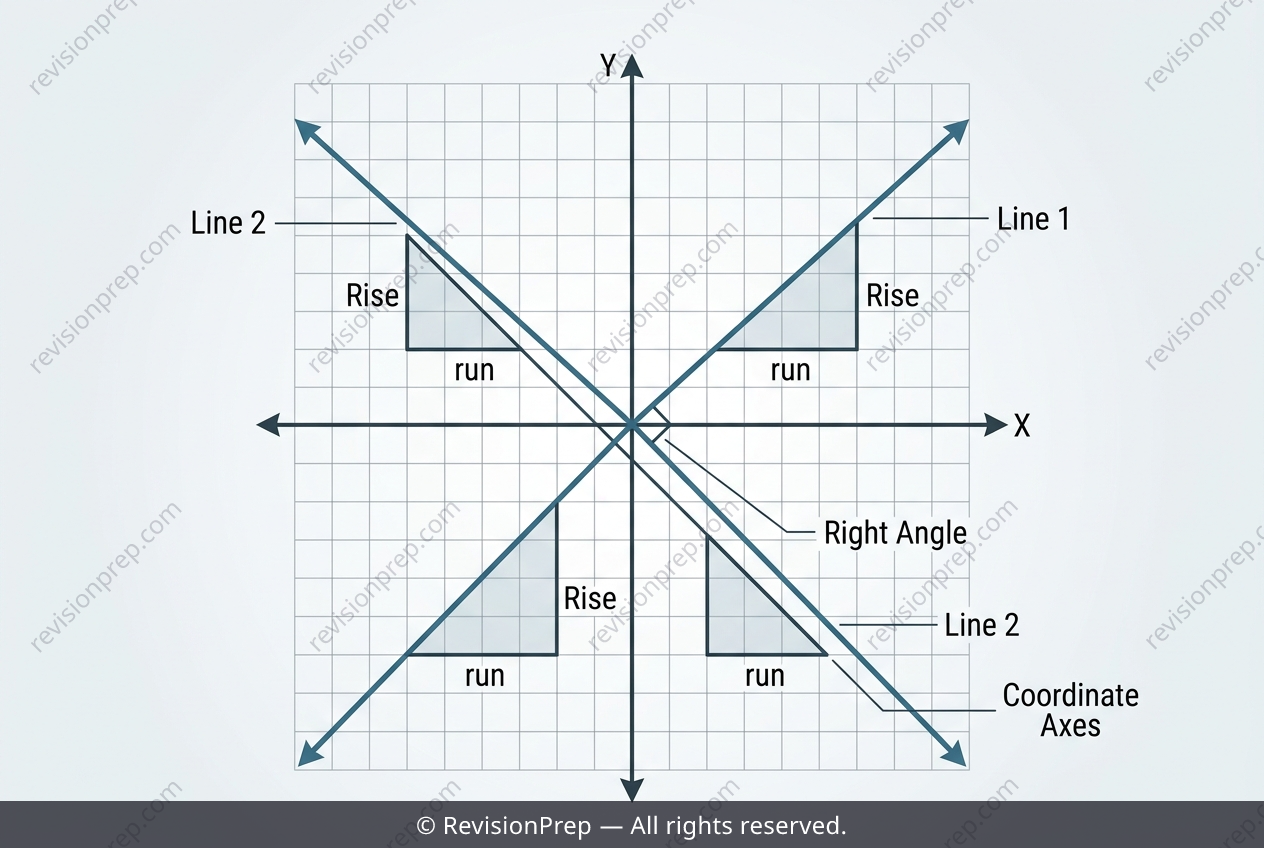
Maths: The Hidden Limit of m₁ × m₂ = –1
Parallel and perpendicular lines are the quiet architects of the world around you—from the crossbars of a window frame to the slope of a ramp meeting a flat surface. At the heart of this topic lies a single, elegant theorem: if two lines are perpendicular, their gradients multiply to –1, meaning each is the negative reciprocal of the other. This rule, expressed as m₁ × m₂ = –1, is a powerful shortcut for deducing unknown slopes, but it carries a hidden condition: it only works when neither line is horizontal or vertical. Why does this matter? Because real-world contexts often test the boundaries of pure mathematics. Consider a wheelchair ramp rising gently over a long horizontal run—its gradient is small and positive. If that ramp meets a sidewalk at a right angle, the theorem instantly suggests the sidewalk’s gradient is the steep negative reciprocal. Yet a physical sidewalk is flat, with a gradient of zero, and multiplying any number by zero never yields –1. This clash between algebraic prediction and physical reality reveals the theorem’s limitation: it describes ideal lines, not practical surfaces. Understanding when the rule applies—and when it breaks down—is what separates a formula user from a mathematical thinker.
Start practising IB questions today
150,000+ IB-styled questions, criteria-mapped and instantly accessible.