
Maths: The Hidden Risk Behind a Perfect Line
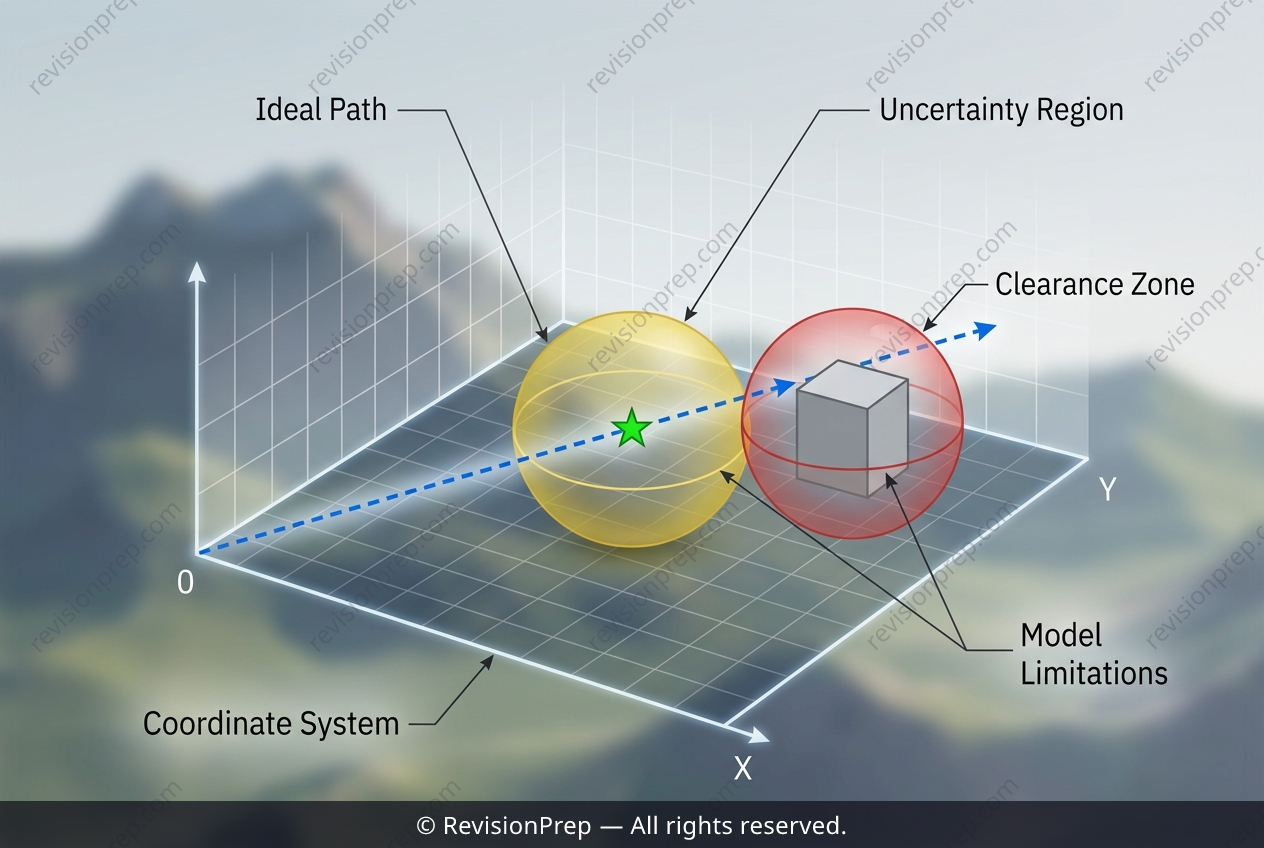
The Cartesian plane turns abstract coordinates into a map of real-world movement, and when you add uncertainty, it becomes a tool for making safe decisions. At its heart, this topic is about geometric modeling: using x and y values to describe a straight-line path, then asking how reliable that path truly is when the input data carries error. The distance formula, d = √((x₂ − x₁)² + (y₂ − y₁)²), gives the exact length of a route, while the gradient m = Δy/Δx defines the line’s direction. Together, they let you test whether a specific point—like a building’s location—falls exactly on that line. But the real insight comes from dimensionality and uncertainty. A 2D model assumes perfect coordinates, yet GPS reports a ±3 m error in each axis, meaning the true position could shift by up to √(3² + 3²) metres. Worse, if a building sits precisely on the flight path, the clearance is zero before any error is even added. The model also ignores altitude entirely, so vertical obstacles remain invisible. This is why geometric modeling isn’t just about plotting points—it’s about understanding how small input errors and missing dimensions can turn a clean line into a risky one.
Start practising IB questions today
150,000+ IB-styled questions, criteria-mapped and instantly accessible.