
Maths: The Logarithmic Logic of the Richter Scale
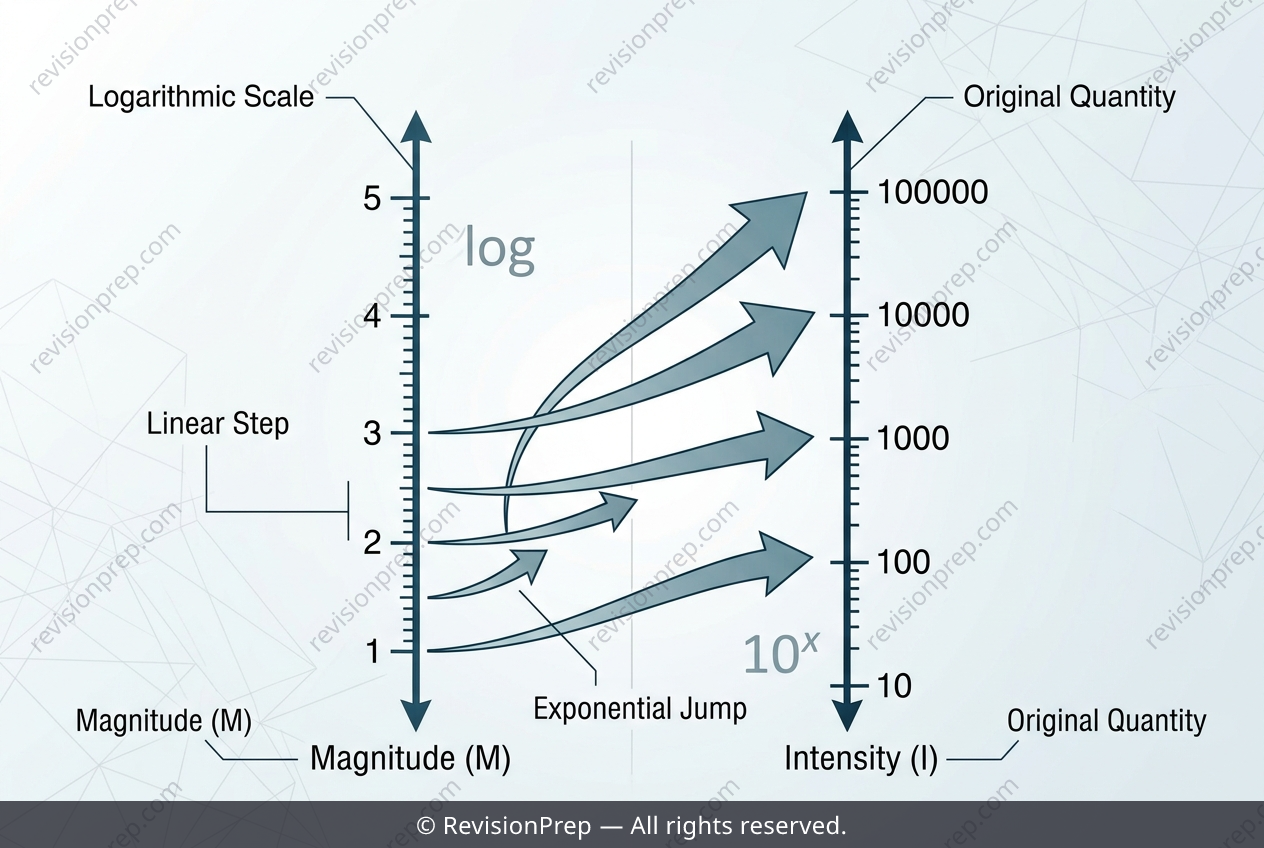
The Richter scale is a perfect example of why logarithms exist: they turn an almost unimaginable range of earthquake intensities into a compact, manageable set of numbers. When a seismologist reports magnitudes like 6.2 and 7.8, those numbers are not intensities themselves—they are base‑10 logarithms of intensity, defined by M = log₁₀ I. This means every single unit increase on the scale corresponds to a tenfold jump in actual ground motion, which is why a difference of 1.6 units is far more dramatic than it sounds. The key relationship flows directly from that definition: since M = log₁₀ I, we can invert it to get I = 10^M. From there, comparing two earthquakes becomes a simple ratio: I₂/I₁ = 10^(M₂ − M₁). This formula reveals the true power of the logarithmic scale—it converts a subtraction of magnitudes into a multiplicative comparison of intensities. Understanding this connection helps you see why dividing magnitudes (like 7.8 ÷ 6.2) is meaningless, and why the scale’s compression can easily mislead non-experts about the real difference in destructive energy.
Start practising IB questions today
150,000+ IB-styled questions, criteria-mapped and instantly accessible.