
Maths: The Square Core Behind a Quadratic Sequence
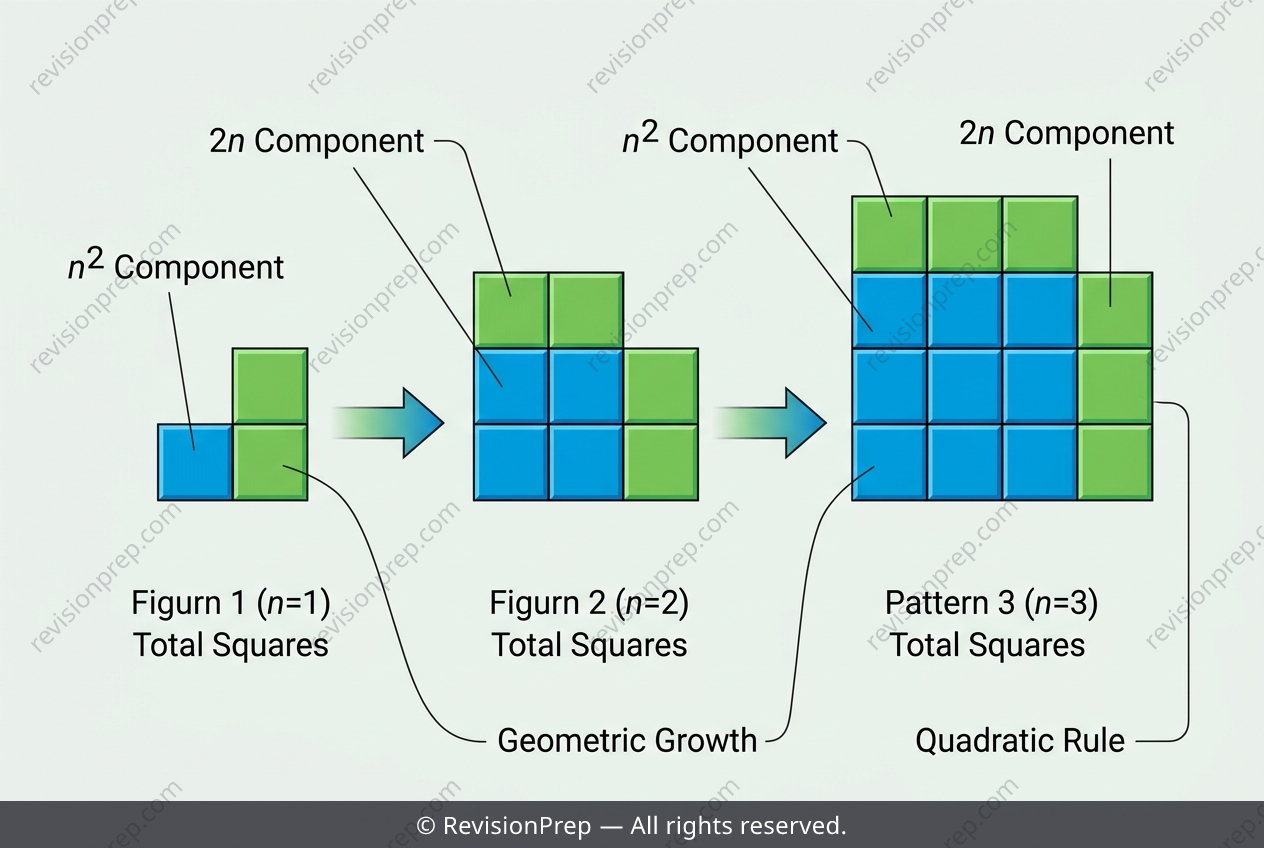
Quadratic sequences often hide in plain sight—especially in patterns that look purely geometric. In this L-shaped arrangement of squares, the first three figures give 3, 8, and 15 squares, and the jump between consecutive terms (5, 7, 9, …) grows by a steady 2. That constant second difference is the fingerprint of a quadratic relationship: when the first differences increase by the same amount each time, the underlying formula must include an n² term. Here, that leads to S = n² + 2n, where the n² captures the solid square core at the heart of each figure, and the 2n accounts for the two arms extending from it. Understanding this connection matters because it links visual structure to algebraic form—a skill that reappears across sequences, series, and even calculus. Once you see that the core grows as an n by n block, the n² term becomes inevitable, not arbitrary. The same reasoning lets you predict future terms, verify the formula, and solve inequalities like finding when S exceeds a given value. By breaking the pattern into its square core and linear arms, you transform a picture into a precise, testable rule—one that works for any figure number, not just the first few.
Start practising IB questions today
150,000+ IB-styled questions, criteria-mapped and instantly accessible.