
Maths: Turning a Pattern into an Algebraic Rule
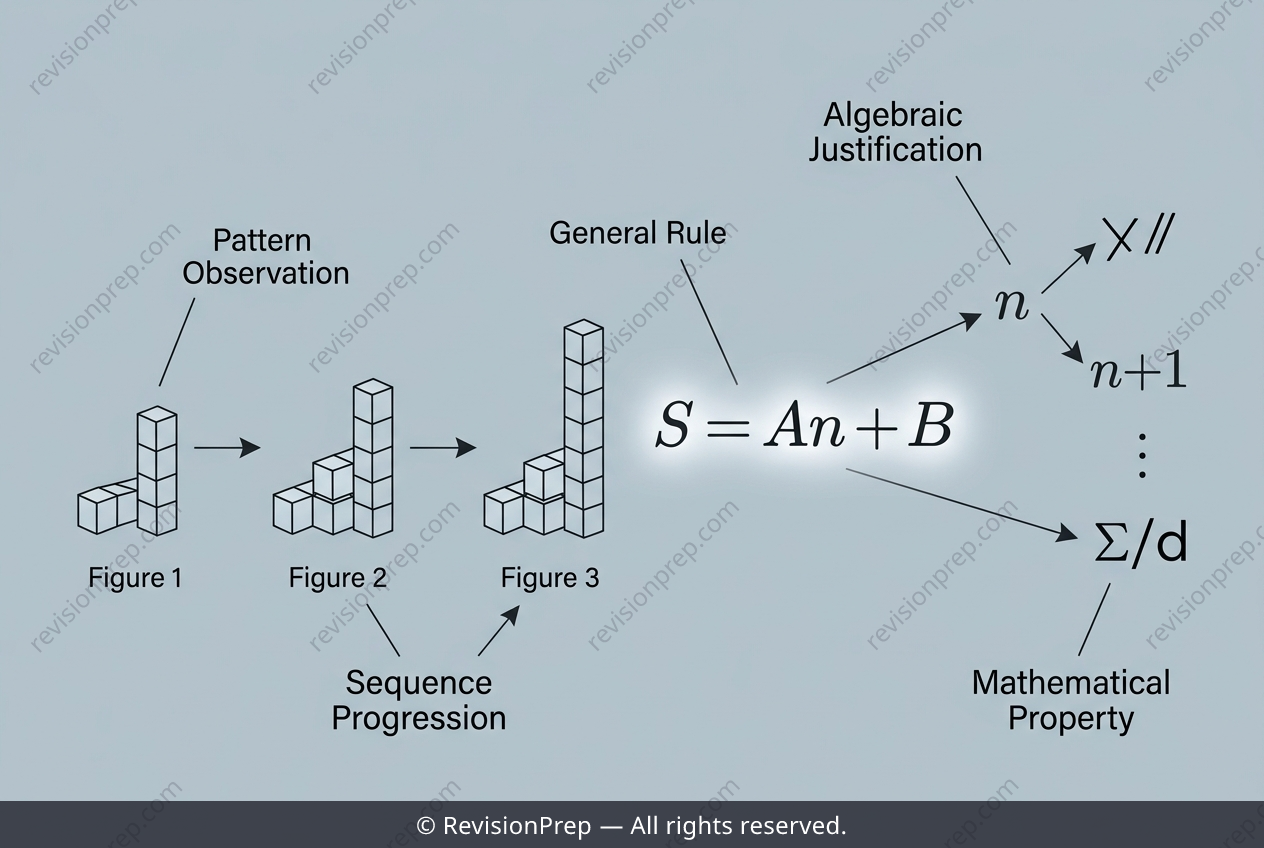
Patterns in mathematics are rarely random—they hide rules that, once uncovered, let you predict any term without drawing every figure. In this L-shape sequence of unit squares, the first few figures show a clear arithmetic progression: 3, 5, 7, 9, and so on. The core idea here is mathematical generalisation: translating a visual pattern into a compact algebraic rule, specifically S = 2n + 1, where n is the figure number and S is the total number of squares. This rule does more than describe what you see—it becomes a tool for reasoning. Why does this matter? Because a single formula connects three big ideas: the constant difference (2) tells you the growth rate, the intercept (1) accounts for the shared corner square in the L-shape, and the expression itself reveals deeper properties. For instance, since 2n is always even, adding 1 guarantees an odd result for every positive n—a proof, not just a guess. Likewise, adding the formulas for consecutive figures, Sₙ + Sₙ₊₁, simplifies to 4(n + 1), showing the sum is always a multiple of 4. This is the power of generalisation: one algebraic statement unlocks structure, prediction, and proof simultaneously.
Start practising IB questions today
150,000+ IB-styled questions, criteria-mapped and instantly accessible.