
Maths: When Different Bases Don't Mean No Solution
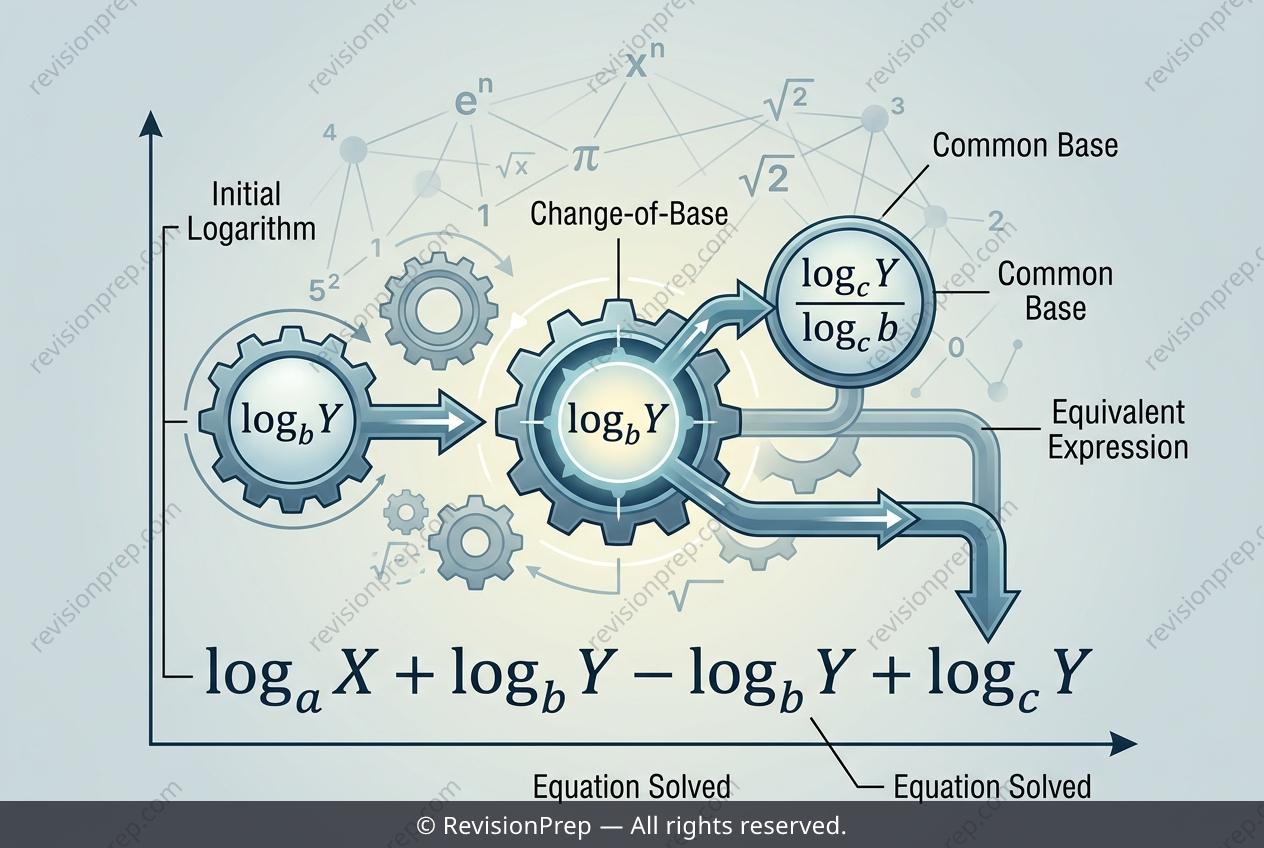
Logarithms often feel like a foreign language, but at their heart, they’re just another way to ask “what exponent gives me this number?” When you see log₂ x, you’re really asking: “2 raised to what power equals x?” This simple idea becomes far more powerful when you learn to switch between different bases—a skill that unlocks solving equations that at first seem impossible. The change-of-base law, logb a = logc a / log_c b, is the key tool here, letting you rewrite any logarithm in terms of another base, often base 2 or 10, to make comparisons and calculations cleaner. In this topic, you’ll see how this law connects seemingly unrelated expressions, like turning log₄ 9 into a fraction involving log₂ 9, because 4 is just 2 squared. That relationship—where one base is a power of another—creates a constant factor that you can manipulate. Once both sides of an equation share the same base, you can drop the logs and solve for x directly, using the power rule to bring exponents down. But beware: different bases don’t automatically mean “no solution.” Sometimes, as with log₂ x = log₄ x, the bases are linked in a way that collapses the equation to a single, surprising value—showing that intuition about “different bases” can mislead you if you don’t apply the change-of-base law carefully.
Start practising IB questions today
150,000+ IB-styled questions, criteria-mapped and instantly accessible.