
Maths: When One Point Becomes Two Intercepts
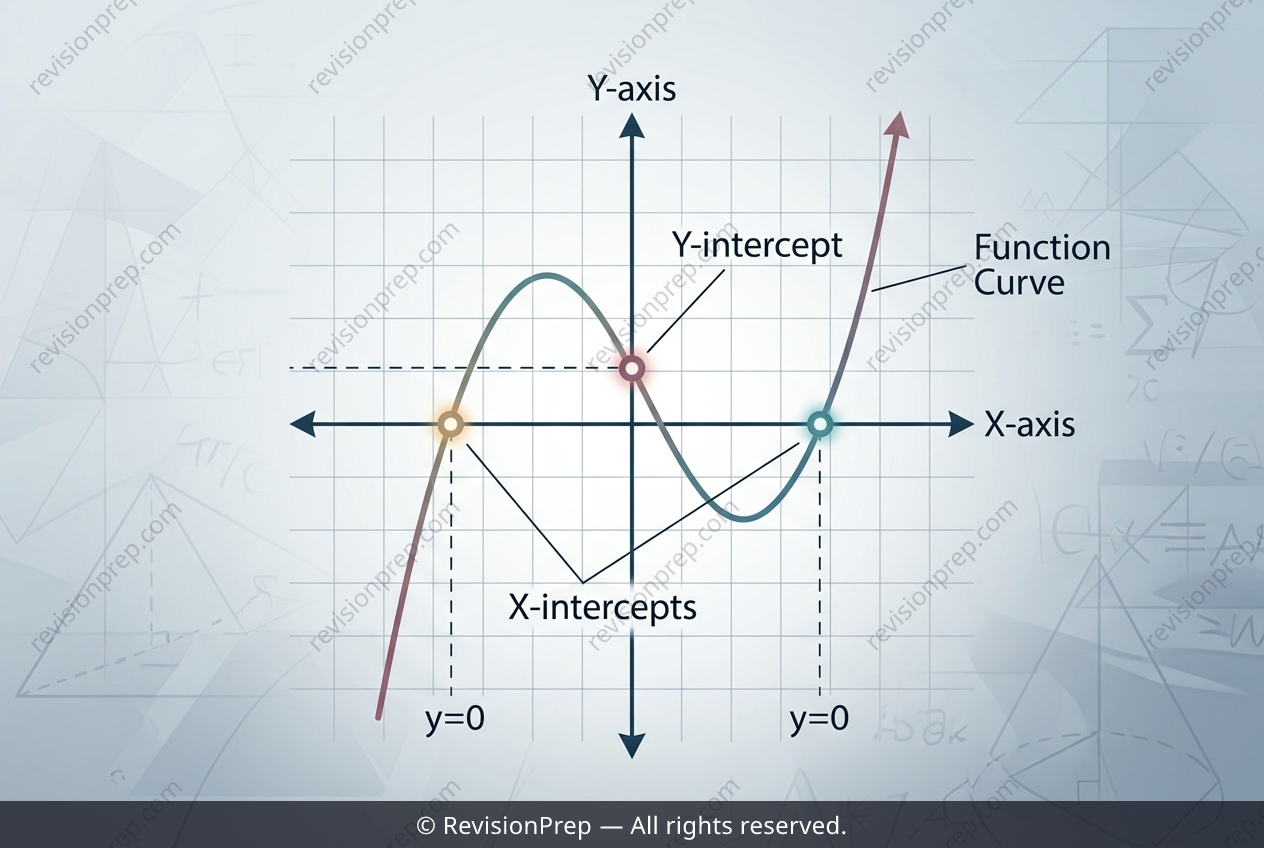
When a function meets the axes, it tells the story of its behaviour in a single glance. For cubic curves like the one modelling a bridge cable’s vibration, the x-intercepts (or roots) mark the moments when displacement returns to zero—instants of equilibrium—while the y-intercept reveals the starting position at time zero. In the equation y = x³ − 2x, setting y = 0 factors neatly into x(x² − 2) = 0, exposing three distinct roots: one at the origin and two symmetric about it. This symmetry is no accident; the absence of a constant term forces the curve through (0, 0), making the y-intercept coincide with one of the roots. Understanding intercepts is foundational for interpreting any graph, whether quadratic, cubic, or exponential. For cubics, the number of x-intercepts can vary (one, two, or three), and each crossing corresponds to a real solution of the equation. Meanwhile, the y-intercept is always found by substituting x = 0—here, that yields zero, but in general it is the constant term. Recognising that a point like (0, 0) can serve dual roles—as both a root and the y-intercept—sharpens your ability to read graphs and connect algebraic structure to visual meaning, a skill essential for modelling real-world oscillations and growth.
Start practising IB questions today
150,000+ IB-styled questions, criteria-mapped and instantly accessible.