
Maths: Why Doubling Time Depends Only on Rate
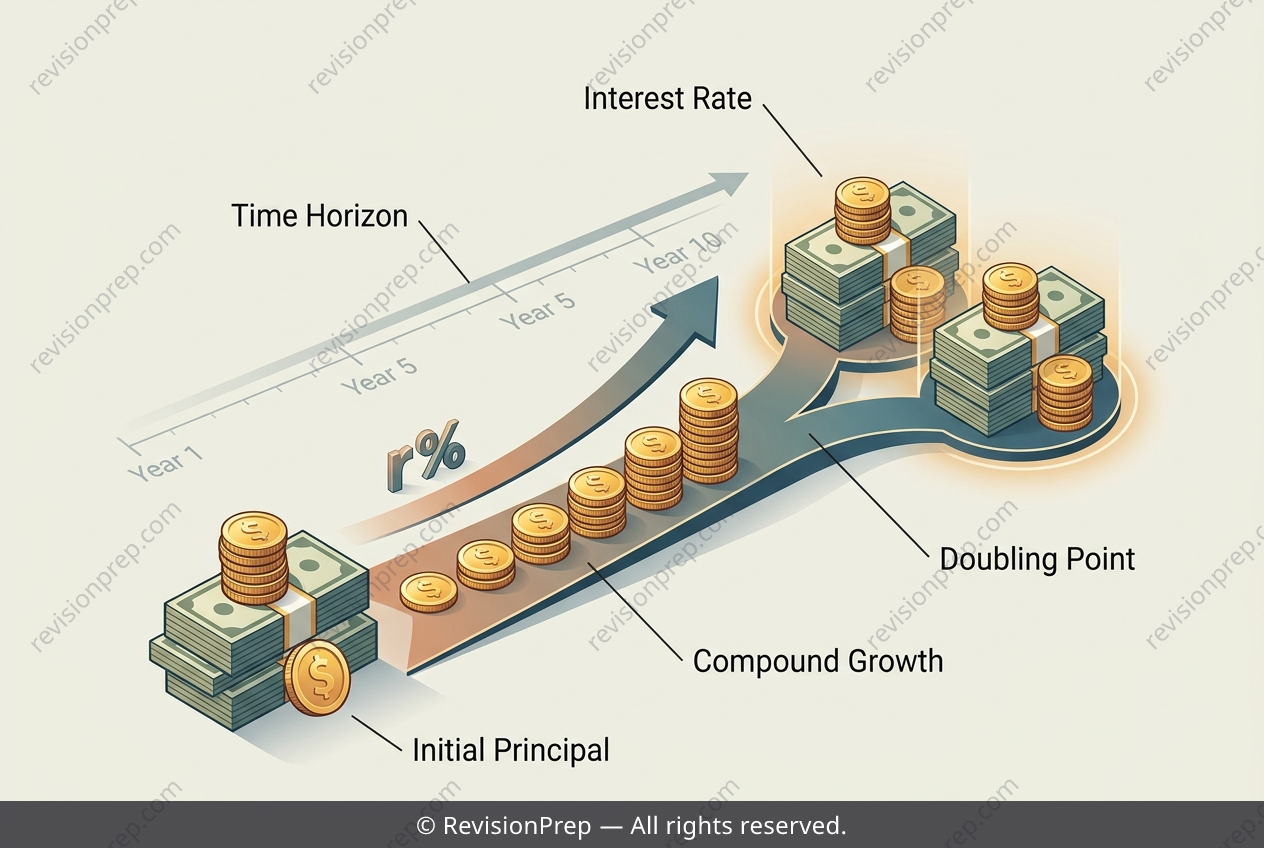
Compound interest is the engine behind long-term financial growth, where interest earns interest and balances rise exponentially rather than linearly. A single deposit grows according to A = P(1 + r)ⁿ, with P the principal, r the annual rate as a decimal, and n the number of years. Because growth compounds, doubling time depends only on the rate, not the amount invested. Two tools capture this relationship. The Rule of 72 offers a quick estimate: doubling time ≈ 72 ÷ r, where r is the percentage rate. The exact doubling time comes from solving (1 + r)ⁿ = 2, giving n = log 2 ÷ log(1 + r). Comparing the estimate with the exact value reveals how closely the shortcut tracks reality, and whether a growth target is genuinely met.
Start practising IB questions today
150,000+ IB-styled questions, criteria-mapped and instantly accessible.