
Maths: Why Quadratic Sequences Involve n²
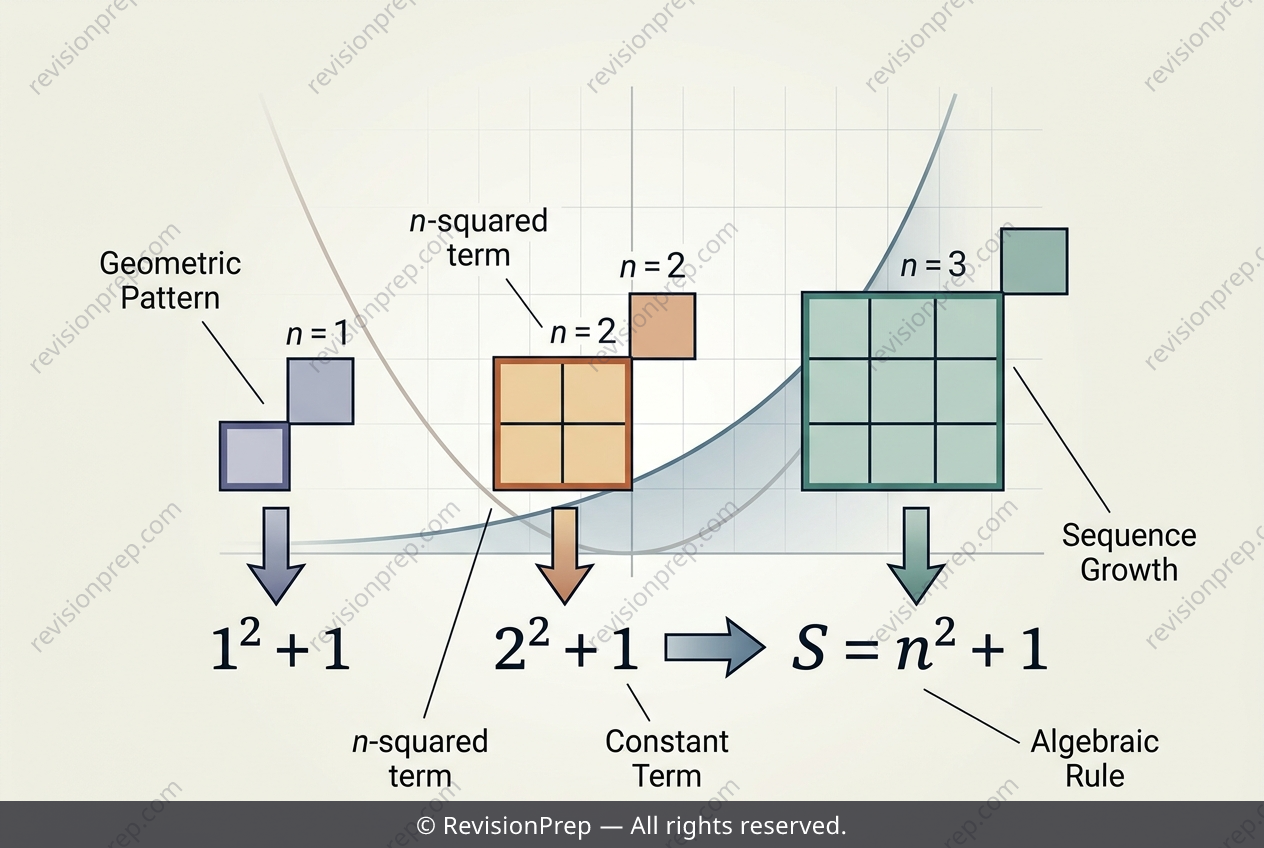
Quadratic sequences appear whenever a pattern grows in two dimensions at once—and the L-shape square pattern is a perfect window into that idea. At first glance, the number of squares in each figure (2, 5, 10, 17) seems to jump by increasing amounts: 3, then 5, then 7. Those first differences aren’t constant, but the second differences are—they stay fixed at 2. That constant second difference is the signature of a quadratic rule, meaning the formula for the nth figure will include an n² term. In fact, the leading coefficient of that n² term is exactly half the second difference, so here it becomes 1, giving a rule of the form S = n² + b. Why does n² appear? Because each figure is built from an n by n square grid with one extra square attached to form the L-shape. As n grows, the area of that grid grows quadratically—doubling the side length quadruples the number of squares. This two-dimensional growth can’t be captured by a linear rule. Understanding this connection between structure, differences, and the formula lets you not only generate future terms but also test whether a specific number like 182 could ever appear—by checking if it fits the quadratic pattern.
Start practising IB questions today
150,000+ IB-styled questions, criteria-mapped and instantly accessible.