
Physics: Clearing an Orbit — What Makes a Planet?
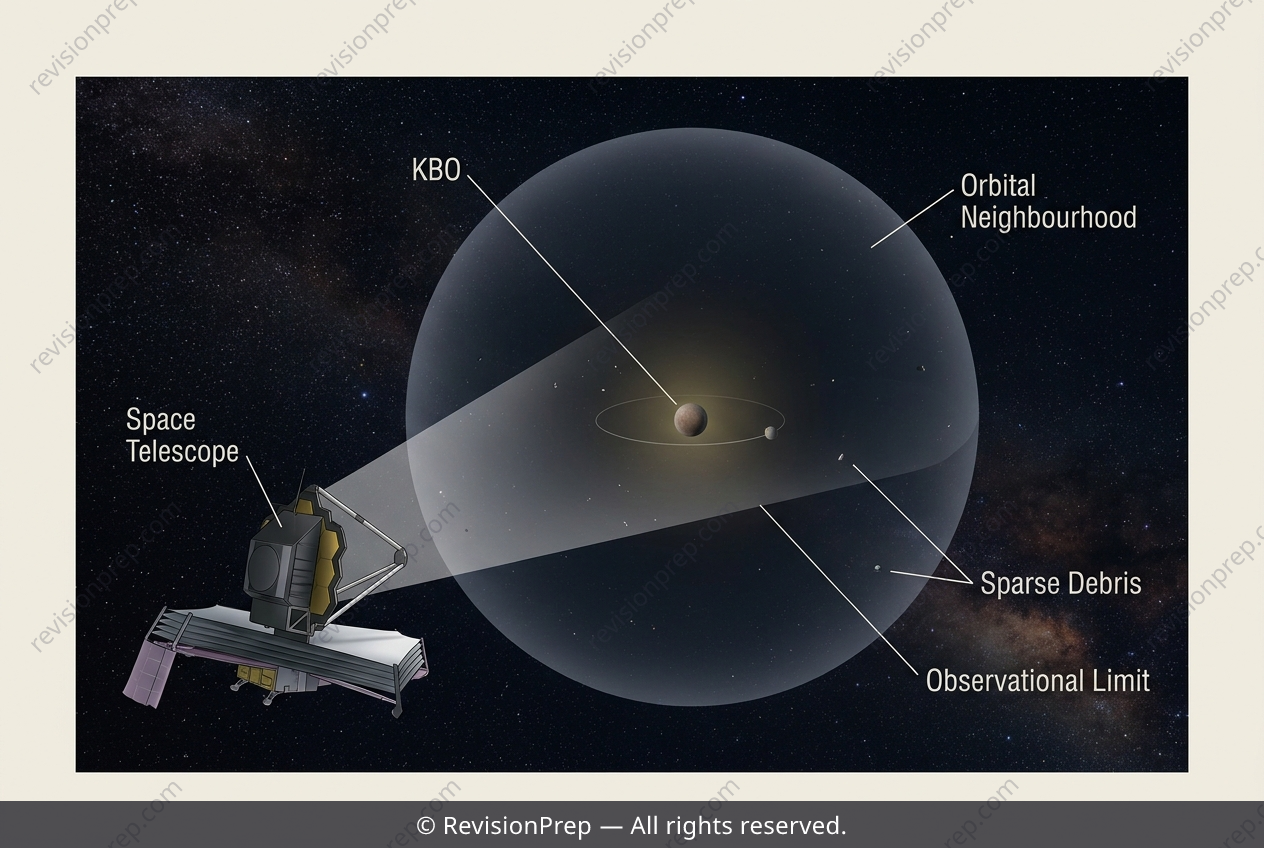
The Solar System is far more than a list of planets—it is a dynamic arena where classification hinges on a single, surprisingly strict rule. The International Astronomical Union (IAU) defines a planet as a body that has “cleared its orbital neighbourhood” of debris, a criterion that separates true planets from dwarf planets and Kuiper Belt objects (KBOs). This definition matters because it forces astronomers to look beyond size or shape and instead measure gravitational dominance—whether an object has swept up or scattered the material along its path. Space-based telescopes like JWST and Hubble are essential for this task, yet they face a profound challenge. A KBO’s orbital neighbourhood spans an enormous volume, while a telescope can only image a tiny fraction of that space in one observation. Faint debris scattered across the full region may remain undetected, creating a false impression of a clear path. This leads to two possible errors: a KBO might be wrongly promoted to planet status (false positive), or a genuine planet’s zone might appear cluttered due to unseen objects, demoting it to dwarf planet (false negative). The farther the object, the worse this bias becomes, as light dims with distance. Thus, the IAU definition is not just a label—it drives how we allocate telescope time and interpret the very structure of our cosmic neighbourhood.
Start practising IB questions today
150,000+ IB-styled questions, criteria-mapped and instantly accessible.