
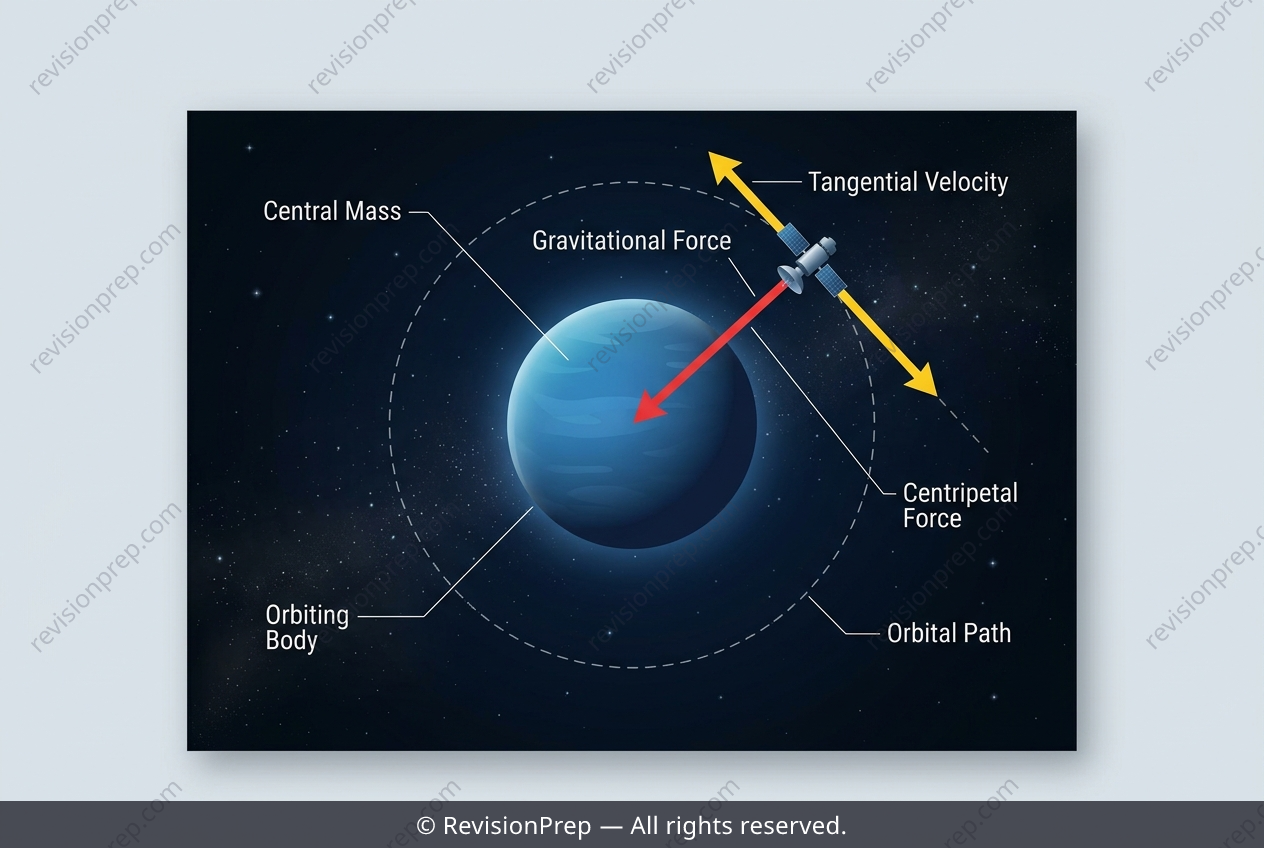
Physics: How Gravity Bends a Probe into Orbit
When a space probe loops around a distant planet like Neptune, it isn’t travelling in a straight line—it’s caught in a constant cosmic tug-of-war between its own forward motion and an invisible pull inward. That pull is the gravitational force, the fundamental interaction that binds moons to planets, planets to stars, and probes to their targets. In orbital mechanics, this force is the sole actor responsible for turning what would otherwise be a straight-line path into a closed, circular loop. The key to understanding orbits lies in how gravity interacts with velocity. For a circular orbit, the gravitational force acts continuously toward the planet’s centre, always perpendicular to the probe’s direction of travel. This perpendicular pull does not speed up or slow down the probe—it only changes its direction, bending its path into a circle. This is the essence of centripetal motion: the inward force (F = mv²/r) exactly matches the gravitational attraction (F = GMm/r²), so the probe neither spirals inward nor escapes outward. Instead, it maintains a steady, curved trajectory, demonstrating how a single force can transform linear inertia into perpetual circular motion.
Start practising IB questions today
150,000+ IB-styled questions, criteria-mapped and instantly accessible.