
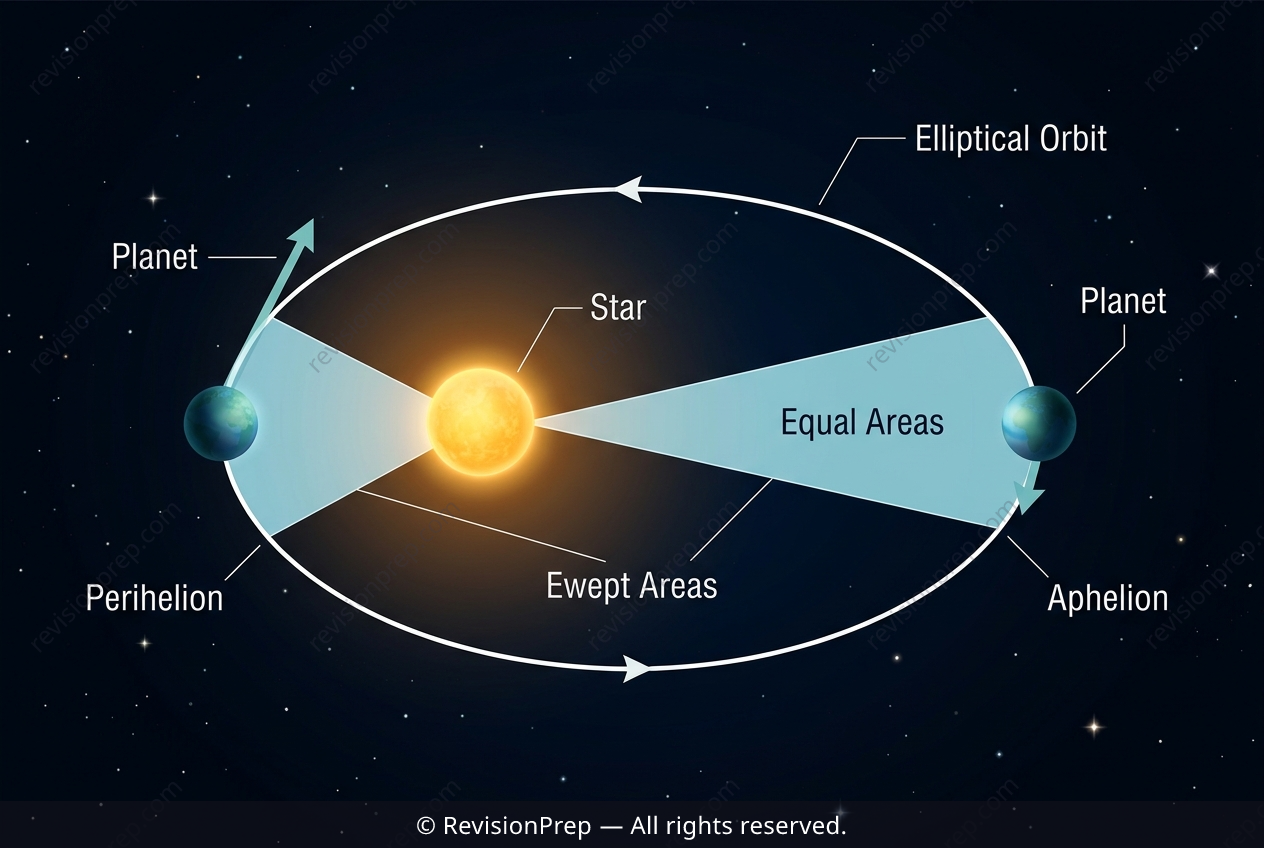
Physics: Kepler's Second Law and Orbital Speed
Kepler’s Second Law of Planetary Motion, often called the Law of Areas, reveals a beautiful symmetry in the chaos of elliptical orbits: a line drawn from a star to its orbiting planet sweeps out equal areas in equal time intervals. This single geometric rule explains why a planet’s speed is not constant—it accelerates as it swings close to the star and slows down as it drifts far away. For any student of physics, this law is a gateway to understanding orbital mechanics, from comets to moons, because it ties together distance, speed, and the invisible grip of gravity. At the heart of this law is the balance between gravitational force and the planet’s inertia. The star sits at one focus of the ellipse, not the centre, so the planet’s distance changes continuously. Near the closest point (perihelion), the gravitational pull is stronger, and to sweep an equal area in the same time as at the farthest point (aphelion), the planet must cover a longer arc—hence a higher orbital speed. This inverse relationship between distance and speed is a direct consequence of angular momentum conservation, and it is what keeps the orbit stable and predictable.
Start practising IB questions today
150,000+ IB-styled questions, criteria-mapped and instantly accessible.