
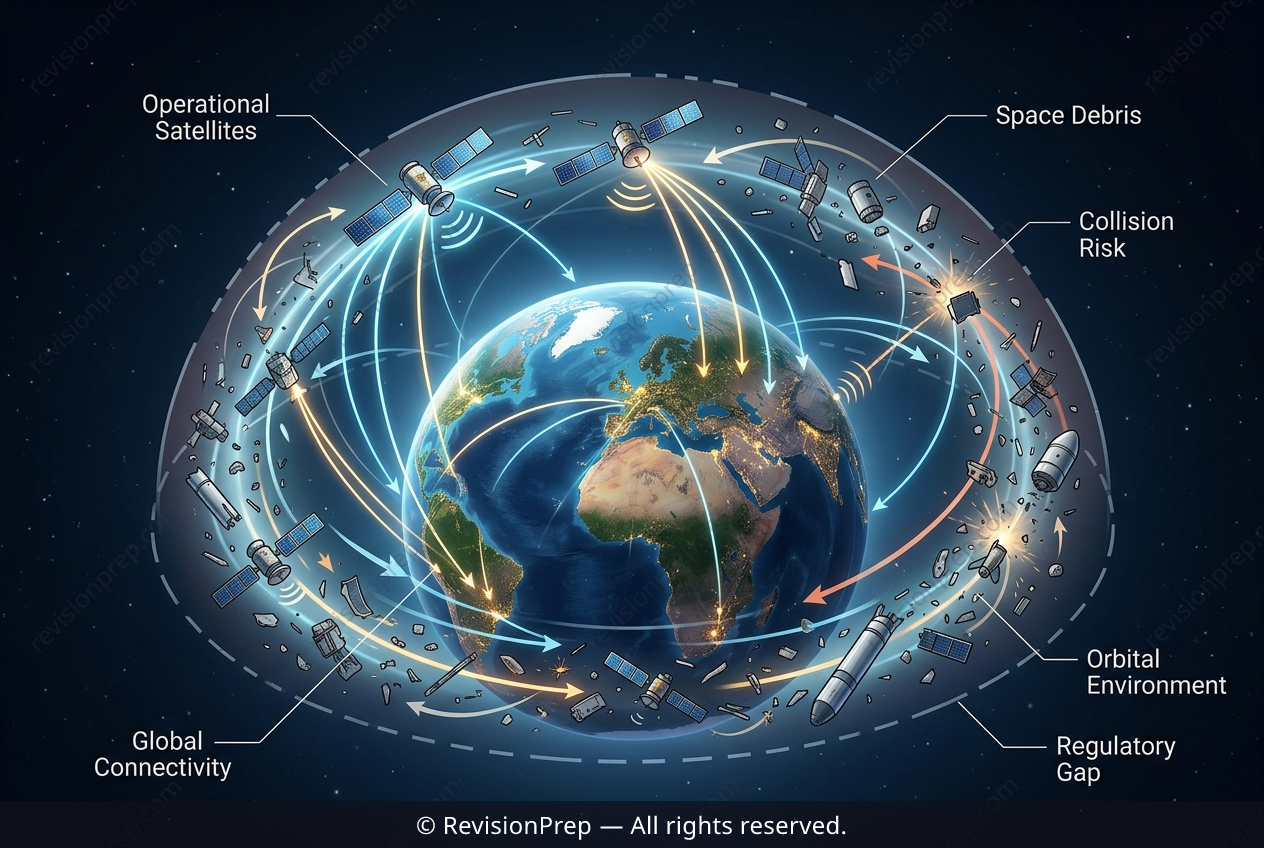
Physics: Orbital Debris and the Kessler Syndrome
Low Earth Orbit is becoming a crowded neighbourhood. Since 2019, programmes like Starlink have launched thousands of satellites to deliver high-speed broadband to remote regions, yet each launch adds to a growing cloud of defunct hardware. Orbital debris management is the discipline of keeping this environment usable—balancing the benefits of global connectivity against the physical risks of operating in space. The core tension lies in collision physics. A single defunct satellite or fragment, travelling at orbital velocities, carries enough kinetic energy to shatter an operational spacecraft on impact. When one collision occurs, it generates thousands of new fragments, each a potential projectile. This cascading effect, known as Kessler syndrome, could render entire altitude bands unusable for generations. International governance, such as the UN’s non-binding UNCOPUOS guidelines, recommends deorbiting within 25 years of end-of-life, but compliance is voluntary. The challenge is that while the physics of debris generation is well understood, the regulatory framework to enforce responsible disposal lags far behind the pace of commercial deployment.
Start practising IB questions today
150,000+ IB-styled questions, criteria-mapped and instantly accessible.