
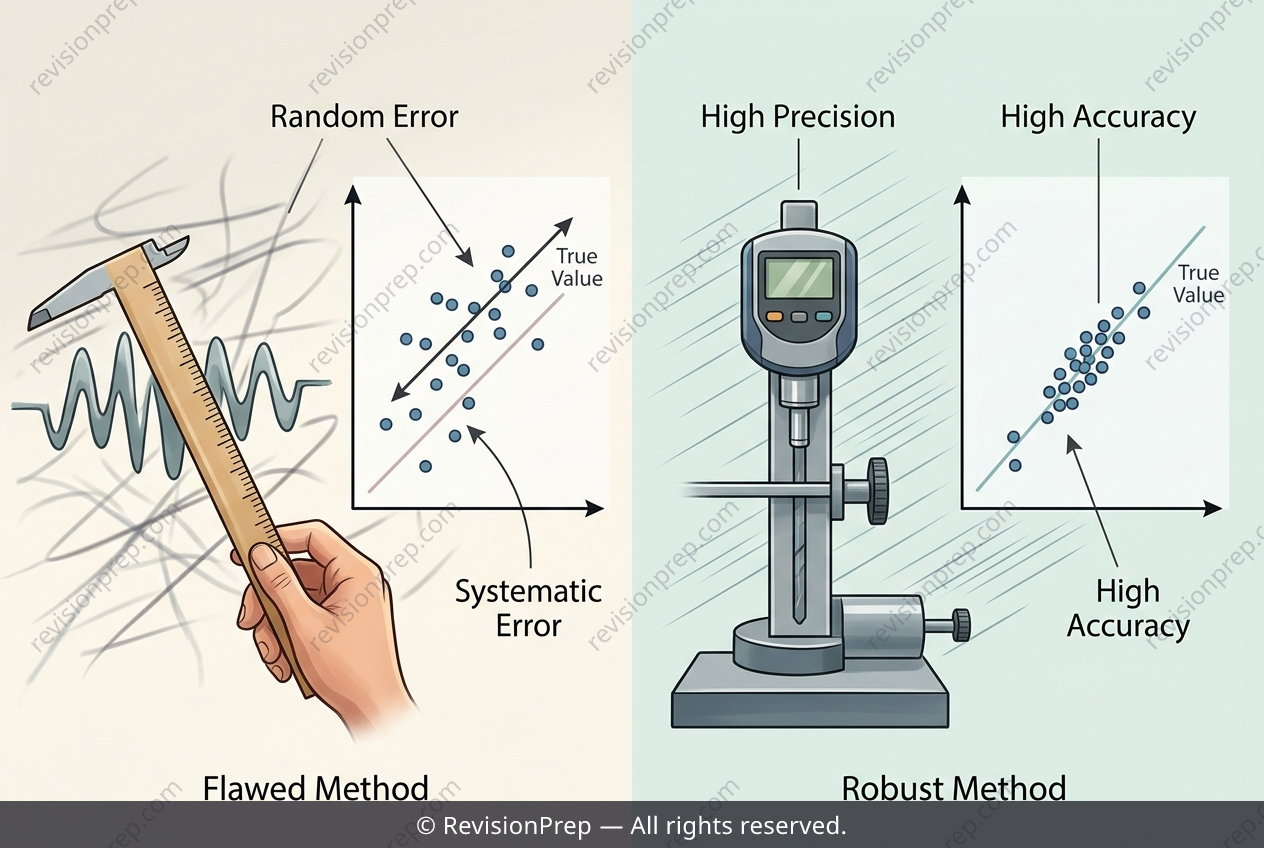
Physics: Random and Systematic Errors in Hooke's Law
Hooke's Law describes how a spring stretches in direct proportion to the force applied to it, expressed as F = kx, where F is the applied force, x is the extension, and k is the spring constant. This linear relationship holds only up to the elastic limit; beyond that point, the spring deforms permanently and no longer obeys the law. Understanding this behaviour matters because real experiments rarely produce perfect data. Measurements are shaped by two distinct types of error. Random errors, such as parallax when reading a ruler by eye, scatter results unpredictably above and below the true value. Systematic errors, such as a ruler misaligned with the spring's axis, shift every reading in the same direction by a similar amount. These ideas connect directly to precision — how closely repeated measurements agree with each other — and accuracy — how close a measurement lies to the true value. A spring may be precisely measured yet still inaccurate if a systematic flaw runs through every reading.
Start practising IB questions today
150,000+ IB-styled questions, criteria-mapped and instantly accessible.