
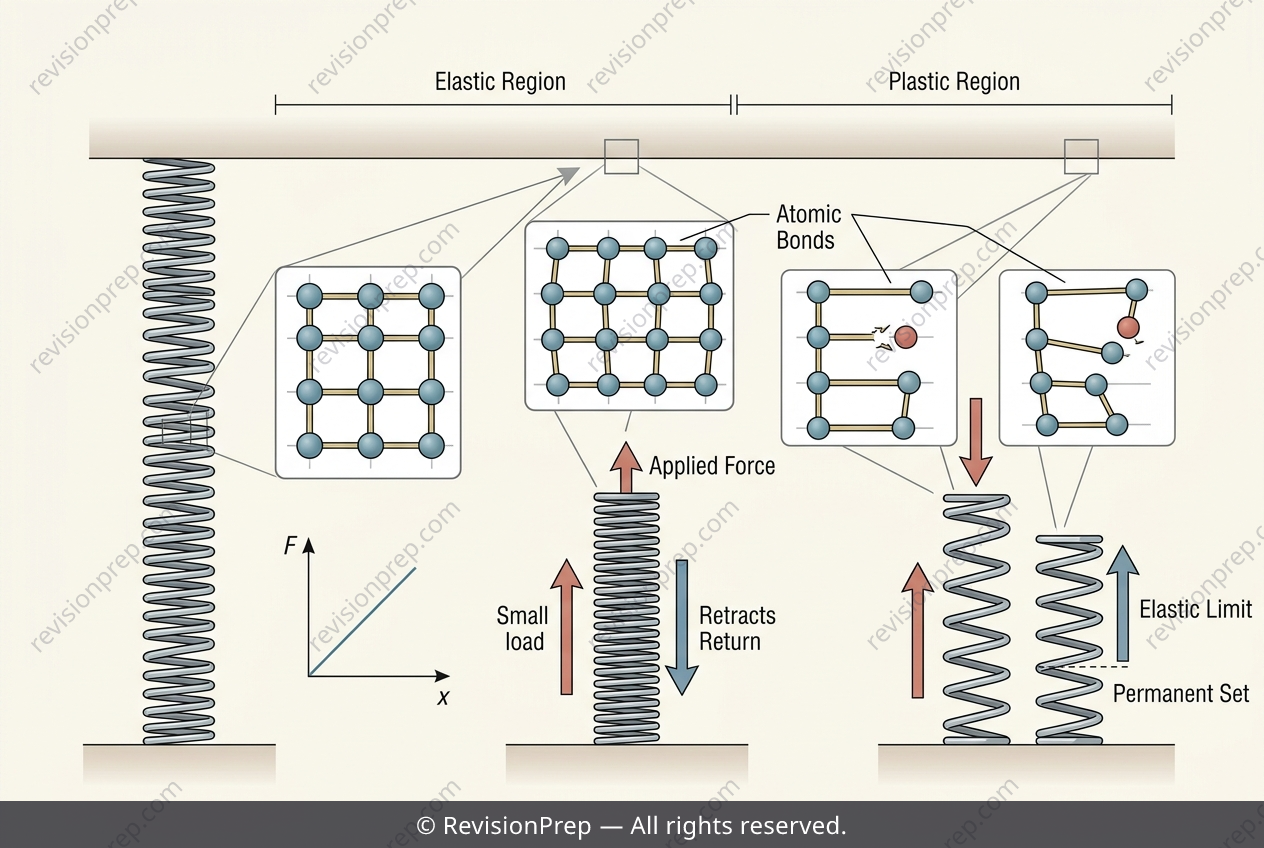
Physics: Where Elasticity Ends and Plasticity Begins
Hooke's Law describes one of the simplest and most useful relationships in physics: for many springs, the extension is directly proportional to the applied force, provided the force stays below the elastic limit. This is written as F = kx, where F is the applied force, x is the extension, and k is the spring constant, a measure of stiffness. The idea matters because it links what we observe on a macroscopic scale — a spring stretching and returning to its natural length — to the microscopic world of interatomic bonds. These bonds behave like tiny springs: small loads pull atoms slightly from their equilibrium separation, and the interatomic forces pull them back once the load is removed. Beyond the elastic limit, bonds are stretched so far that atomic planes slide past each other, forming new permanent arrangements. This plastic deformation means the material no longer returns to its original length, revealing why elasticity and plasticity are distinct behaviours of the same material.
Start practising IB questions today
150,000+ IB-styled questions, criteria-mapped and instantly accessible.