
Physics: Reading Alien Atmospheres with Light
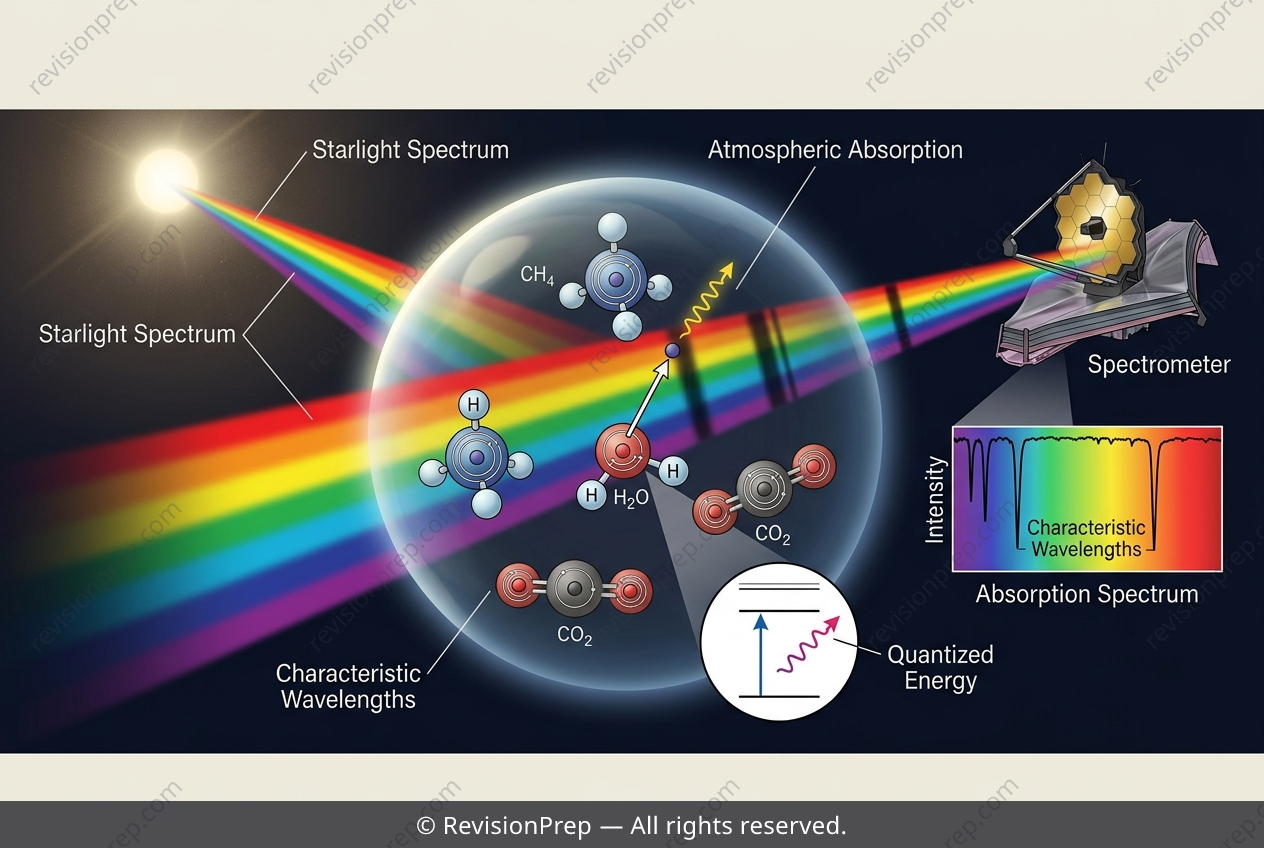
Every atom and molecule carries its own unique set of quantized energy levels — like a fingerprint written in light. When starlight passes through an exoplanet’s atmosphere during a transit, photons with energies exactly matching the gap between two levels are absorbed, removing those specific wavelengths from the transmitted beam. The result is a dark-line absorption spectrum, a pattern of missing colours that corresponds precisely to the gases present. This is the core mechanism behind transit spectroscopy: by comparing the observed absorption lines with laboratory reference spectra of gases like O₂, CH₄, H₂O, and CO₂, scientists can identify which molecules exist in a distant world’s atmosphere. Why does this matter? Because these spectral fingerprints are our only remote window into the chemistry of alien skies. The simultaneous detection of O₂ and CH₄, for instance, could hint at biological activity, making absorption spectroscopy a key tool in the search for habitable worlds. Yet the signal is extraordinarily faint — only a sliver of starlight grazes the atmosphere — so the technique demands long observation times and large telescopes to overcome a low signal-to-noise ratio. Understanding how quantized energy levels translate into characteristic absorption lines connects the microscopic physics of atoms to the macroscopic question of life beyond Earth.
Start practising IB questions today
150,000+ IB-styled questions, criteria-mapped and instantly accessible.