
Physics: Relativity — Why GPS Clocks Need Correction
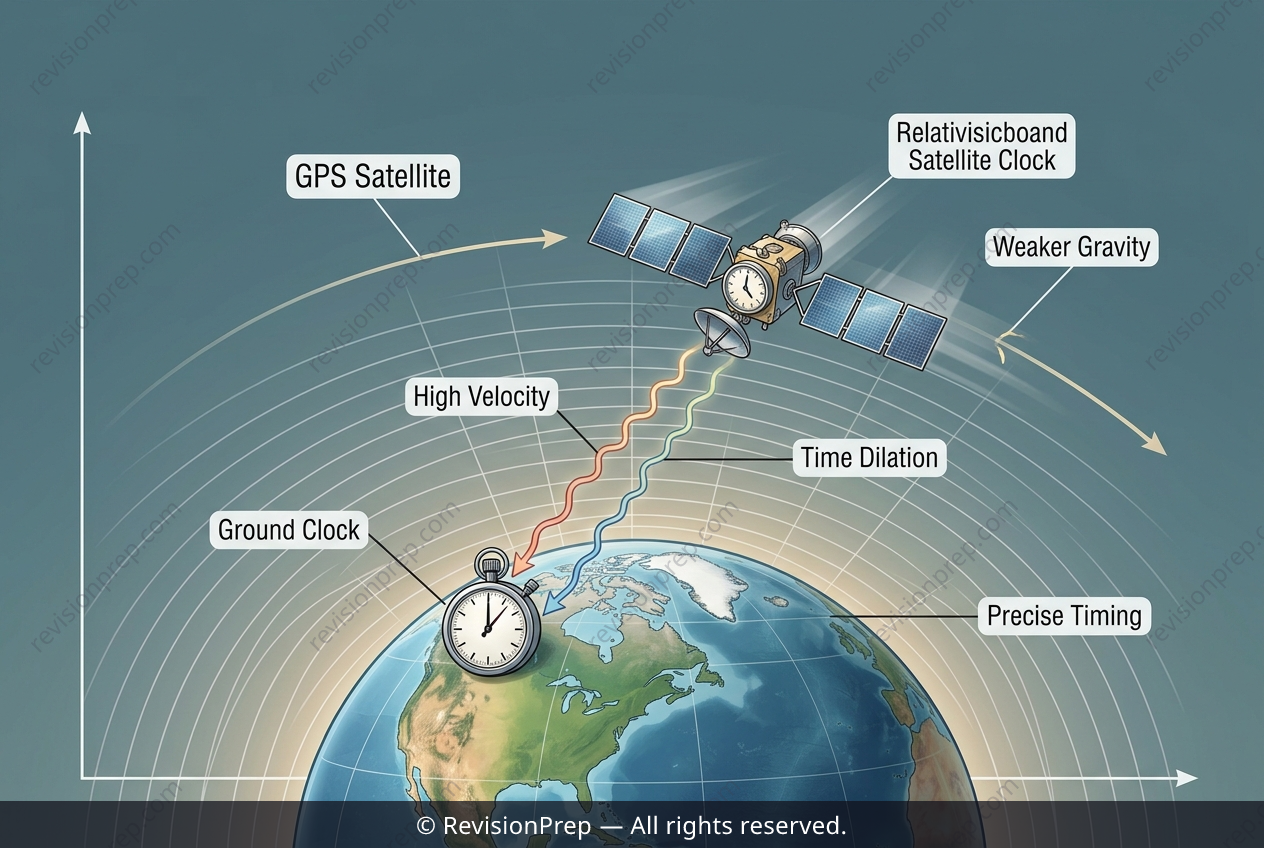
GPS satellites are the quiet workhorses of modern navigation, but their astonishing accuracy depends on a subtle twist in our understanding of time. At the heart of this system lies relativistic time dilation—the idea that time itself is not absolute, but flows differently depending on speed and gravitational strength. For a satellite orbiting at roughly 20,200 km above Earth, two competing effects come into play: special relativity slows its onboard atomic clock because the satellite moves at high speed relative to the ground, while general relativity speeds it up because the satellite experiences weaker gravity than we do at the surface. The net result is a small but critical drift in the clock’s rate. Without correcting for this drift, the timing errors would compound, throwing off the triangulation calculations that turn satellite signals into precise positions. The correction is not just a theoretical nicety—it is the difference between a GPS that works and one that would mislead you by kilometres. The same principle also reminds us that the system is fragile: GPS signals are electromagnetic waves, and they can be blocked by buildings, bent by the ionosphere, or jammed entirely. Understanding how relativity shapes time, and how real-world interference shapes signals, reveals why GPS is both a triumph of physics and a technology with practical limits.
Start practising IB questions today
150,000+ IB-styled questions, criteria-mapped and instantly accessible.