
Physics: The Environmental Cost of Space Exploration
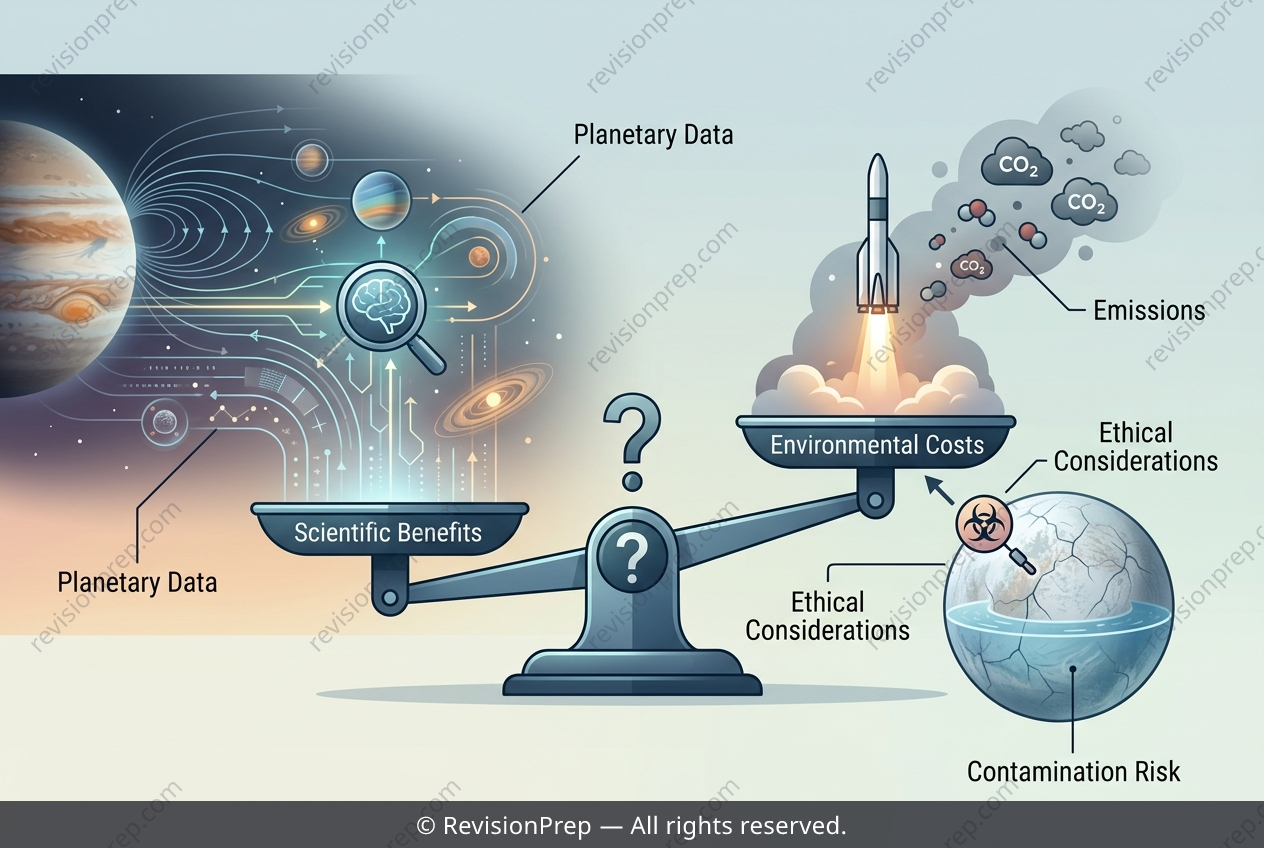
Space exploration pushes the boundaries of human knowledge, but every launch carries a hidden price tag written in emissions and orbital debris. When NASA’s Juno probe burned roughly 500 tonnes of propellant to escape Earth’s gravity, that single ignition released thousands of tonnes of CO₂ — a stark reminder that our quest to understand the cosmos also warms our own atmosphere. Beyond the immediate carbon footprint, spent rocket stages and mission hardware join a growing cloud of space junk, while the risk of contaminating pristine worlds like Europa — with its suspected subsurface ocean — raises ethical stakes that no telescope can resolve. Yet the scientific payoff is equally profound. Juno’s in-situ measurements of Jupiter’s magnetic field and deep atmospheric composition — water abundance, ammonia, isotope ratios — are impossible to replicate from Earth, because magnetic field mapping and direct sampling require physical presence, not remote observation. These data constrain models of planetary formation and migration, explaining why Earth sits in the habitable zone today. The connection is clear: the environmental cost of exploration buys knowledge that reframes our own planetary story, forcing us to weigh short-term damage against long-term understanding.
Start practising IB questions today
150,000+ IB-styled questions, criteria-mapped and instantly accessible.