
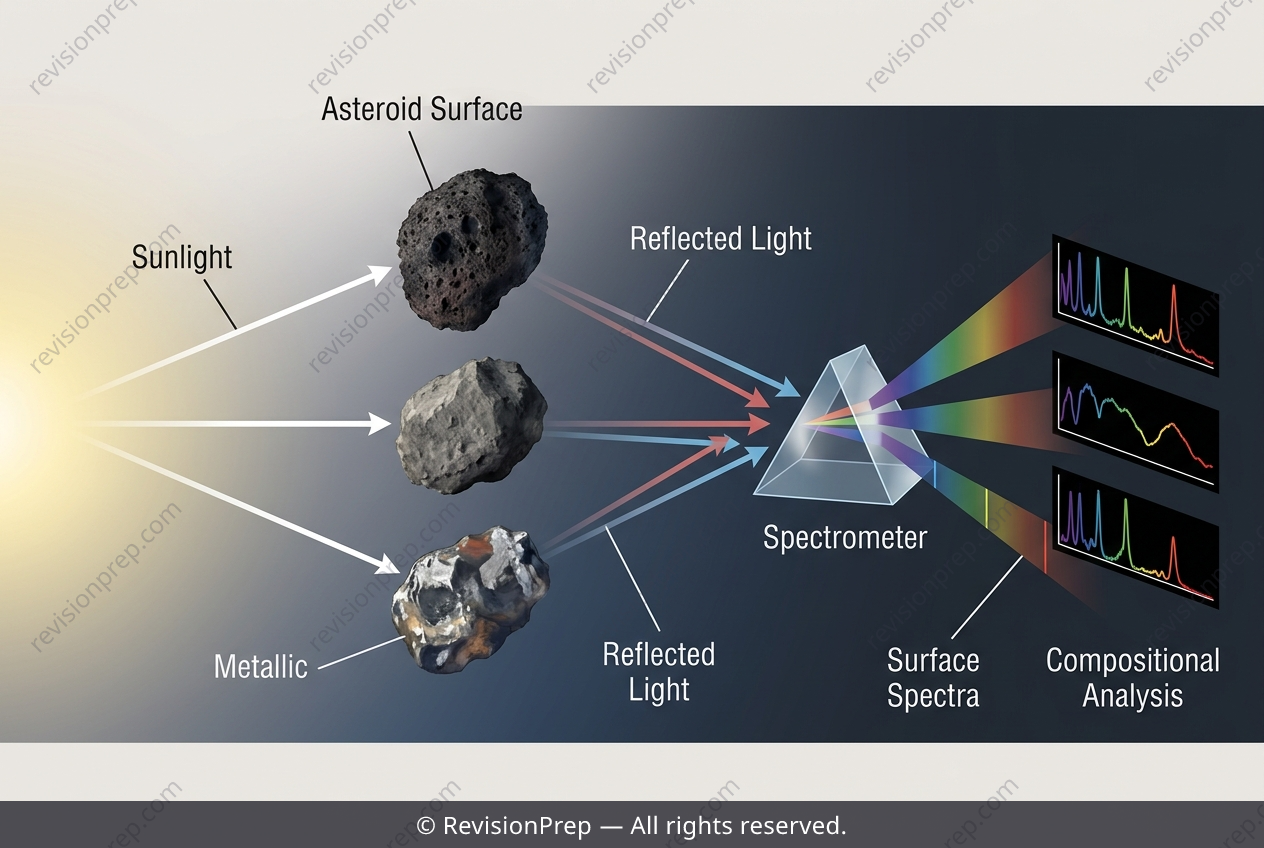
Physics: The Spectral Fingerprints of Asteroids
When we look up at the night sky, the points of light we see are more than just distant suns—they are chemical fingerprints waiting to be decoded. In astrophysics, the core tool for this is spectroscopic analysis, which breaks down the light reflected or emitted by a celestial body into its component wavelengths. Since every element and compound absorbs and emits light at specific, unique wavelengths, the resulting spectrum acts as a barcode for the object’s surface composition. For planets, moons, and asteroids, this allows us to determine what they are made of without ever touching them, transforming our understanding of the Solar System’s formation and evolution. Nowhere is this more evident than in the Main Asteroid Belt, where these rocky remnants are broadly sorted into three distinct compositional families based on their spectral signatures. The most common are the C-type, or carbonaceous, asteroids, which dominate the outer Belt and are rich in carbon compounds and silicates, reflecting a primitive, unaltered composition. Closer to the Sun, the S-type (silicaceous) asteroids show a mix of silicate minerals with nickel-iron, indicating partial melting and differentiation. Finally, the M-type (metallic) asteroids are largely composed of nickel-iron metal, likely the exposed cores of ancient, shattered protoplanets. By connecting these spectral classes to their physical materials, we can trace the thermal history and internal structure of the early Solar System, linking the light we observe to the very building blocks of planets.
Start practising IB questions today
150,000+ IB-styled questions, criteria-mapped and instantly accessible.