
Forces and Motion: The MYP 5 Physics Core You Can't Skip
F=ma, W=mg, circular motion and terminal velocity — the five ideas examiners test again and again.
Quick facts
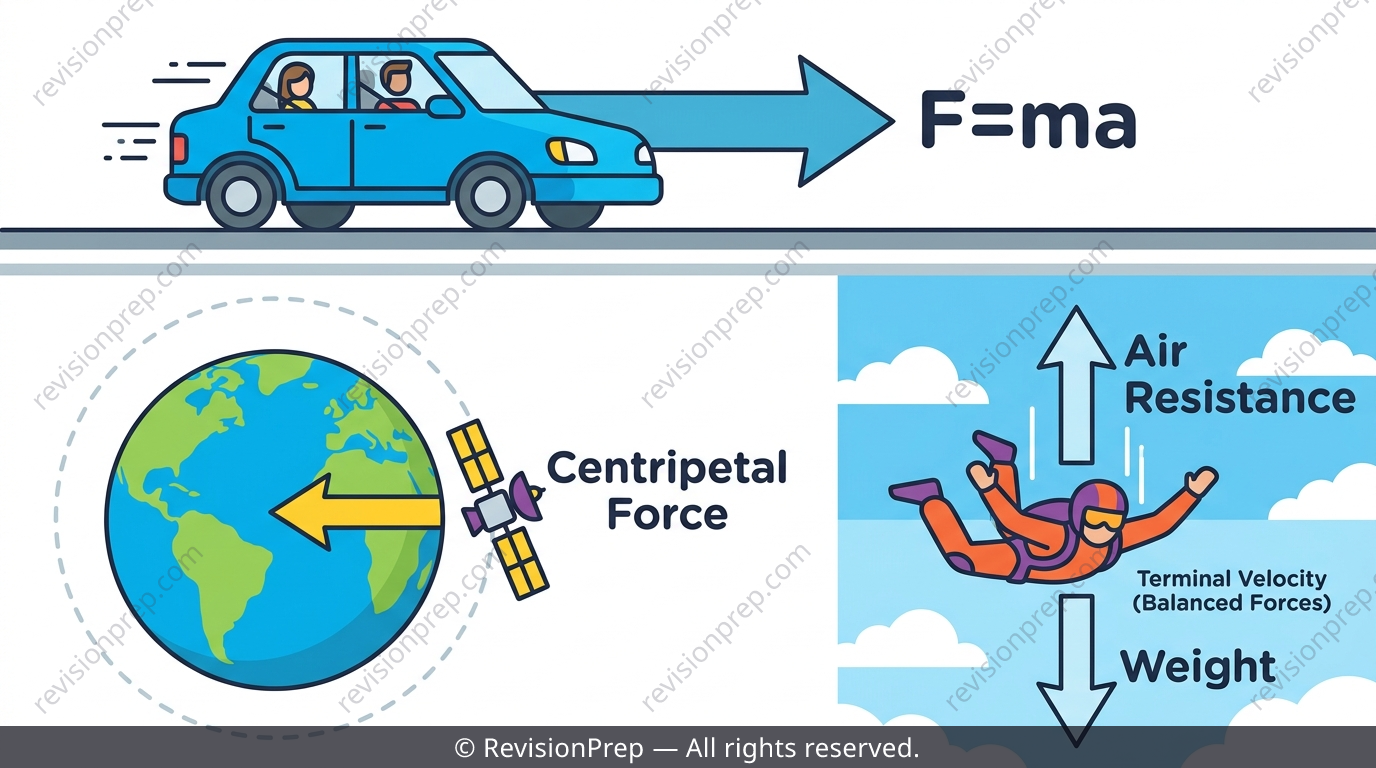
Every IB MYP 5 physics paper leans hard on forces and motion, and almost every structured question mixes a calculation with an explanation — so half-understanding or costs marks twice over. This teaser pulls out the five ideas that show up most: Newton's second law as the engine behind all motion, the mass-versus-weight trap that catches nearly every gravity question, centripetal force in circular motion, friction and air resistance driving terminal velocity, and motion graphs as numerical data rather than pictures. Get these five solid and you can handle Criterion A knowledge checks and Criterion C evaluation tasks with the same toolkit. Each section below is a fast refresher — the full revision note has the worked examples, common mistake fixes and formula derivations in complete depth.
What you’ll be able to do
Newton's Second Law: The Engine Behind Every Motion Question
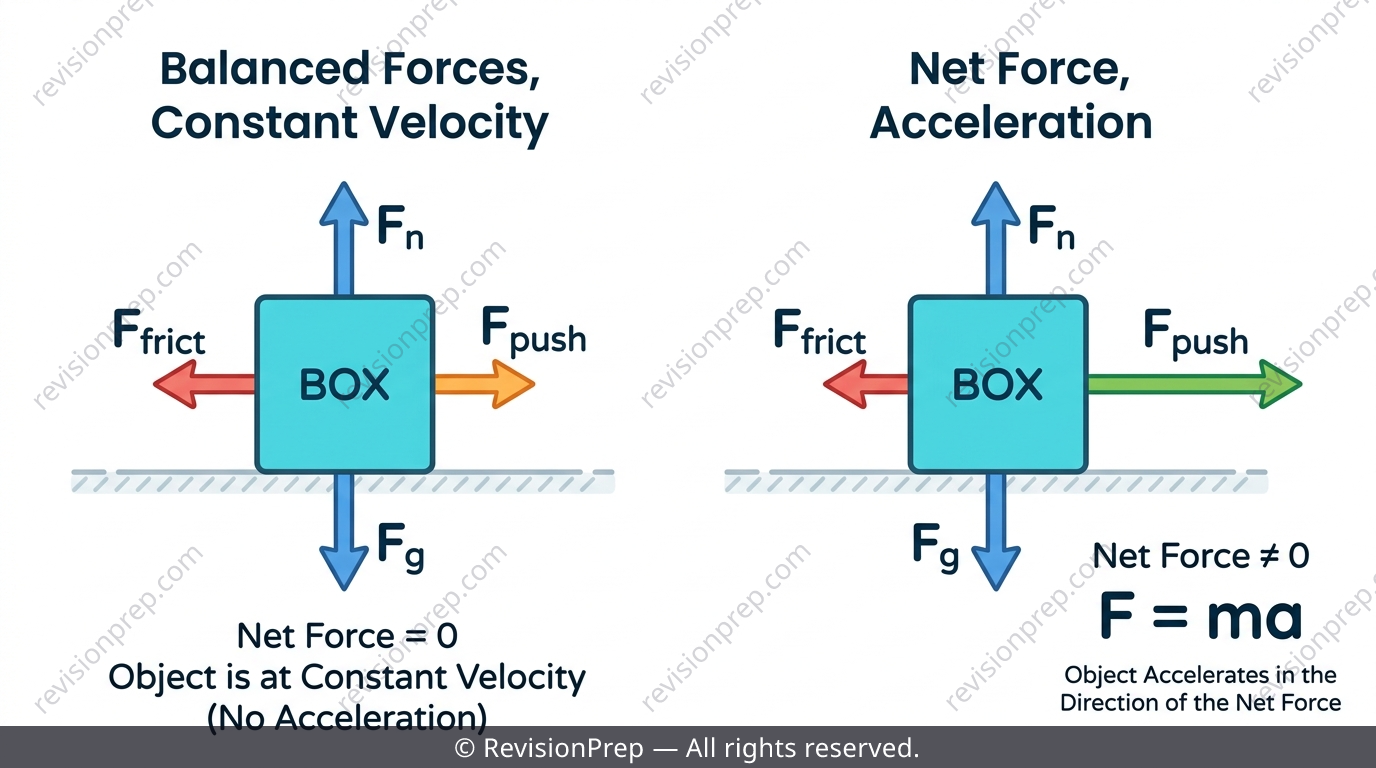
Everything in this unit traces back to one relationship: forces change motion, and quantifies exactly how much. A net, unbalanced force always produces acceleration — but moving doesn't mean a force is currently pushing in the direction of travel; it could be slowing down, turning, or coasting under balanced forces. Once you can read a situation and identify whether forces are balanced or unbalanced, every other topic in this unit becomes an application of the same idea.
Exam tip
Before calculating anything, ask: is the object speeding up, slowing down, or changing direction? That tells you where the net force points.
Common mistake
Assuming an object moving at constant velocity must have a force acting in its direction of motion — balanced forces mean zero net force, not zero force.
Mini summary
Net force causes acceleration; balanced forces mean no change in velocity.
Mass vs Weight: The Trap Examiners Love
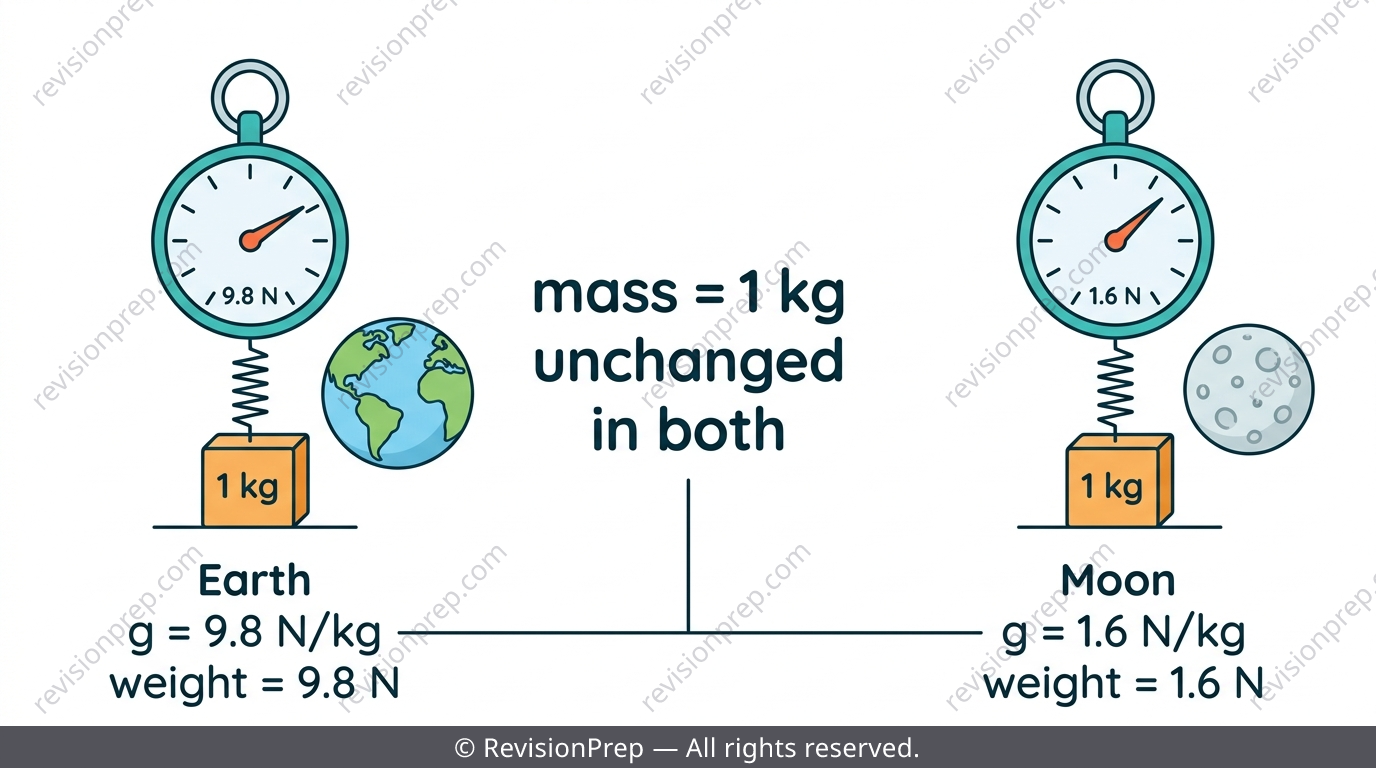
Mass measures how much matter something contains, stays the same everywhere, and is measured in kilograms. Weight is the force gravity exerts on that mass, measured in newtons, and it changes with the local gravitational field strength — which is why an astronaut's weight drops on the Moon while their mass stays identical. Confusing the two costs marks on almost every planet or gravity question, so always keep mass in kg and finish weight calculations in N.
Exam tip
For 1-mark 'state the formula' questions, write symbolically rather than a sentence — it's faster and matches the mark scheme exactly.
Common mistake
Plugging mass in grams straight into , or giving a weight answer in kg instead of N.
Mini summary
Mass is invariant; weight depends on gravitational field strength and is measured in newtons.
Circular Motion: Why Turning Is Still Accelerating
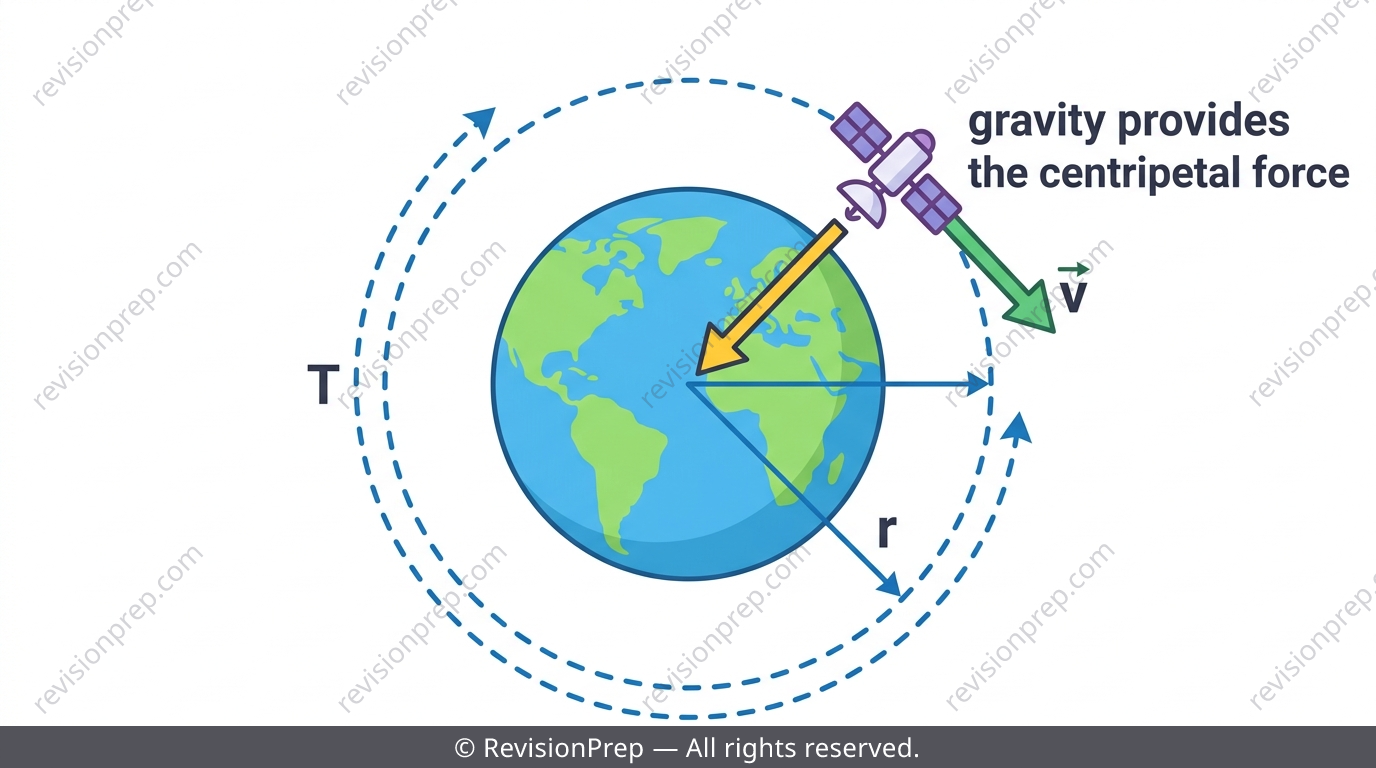
An object going around a circle at steady speed is still accelerating because its velocity's direction keeps changing. By Newton's second law that acceleration needs a net force, which always points toward the centre — this is called centripetal force, but it isn't a new force, just a role played by tension, gravity, friction or a normal force. Speed relates to the circle by , and the force needed follows , growing fast with speed and shrinking with a bigger radius.
Exam tip
Identify which real force is providing the centripetal pull — string tension, gravity on a satellite, friction on tyres — and label your diagram with that name, not 'centripetal force' as an extra arrow.
Common mistake
Drawing centripetal force as an extra arrow alongside gravity or tension on a free-body diagram, instead of naming the real force that plays that role.
Mini summary
Centripetal force is the name for whichever real force points toward the centre and keeps the object turning.
Friction, Air Resistance and Terminal Velocity
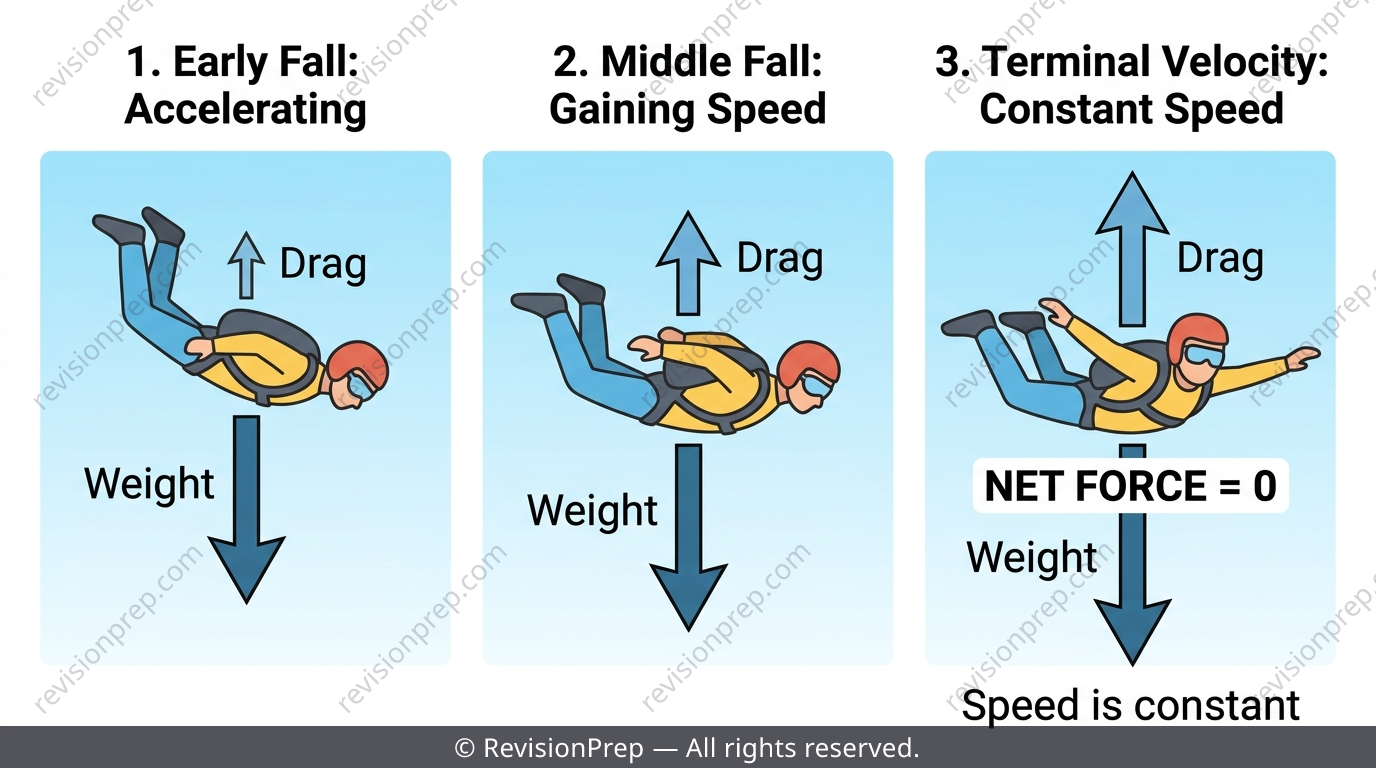
Friction opposes relative motion between two surfaces in contact, while air resistance (a form of drag) opposes motion through a fluid like air. Both forces convert kinetic energy into heat, and both grow bigger the faster something moves — which is exactly why a falling object eventually stops accelerating and reaches terminal velocity, the point where drag balances weight.
Mini summary
Terminal velocity occurs when air resistance grows to equal weight, making the net force zero.
Motion Graphs: Reading Gradient and Area Like Data
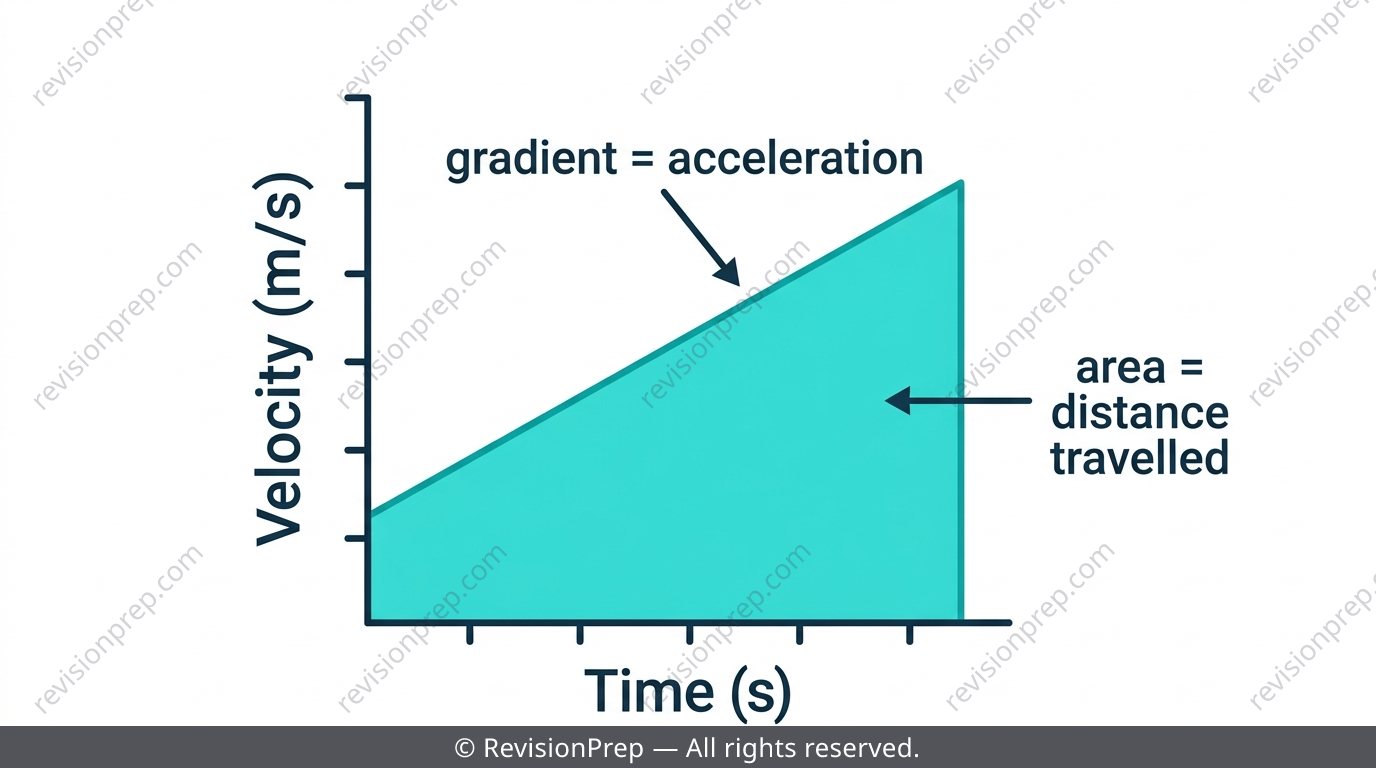
Motion graphs are the visual record of everything forces produce — they are data, not decoration. Gradient and area on displacement-time and velocity-time graphs each carry specific physical meaning, and examiners expect you to extract numerical values from them, not just describe shapes.
Exam tip
Before answering a graph question, state explicitly what the gradient and the area under the curve represent for that specific graph type — this earns marks even before you calculate a number.
Mini summary
Always read gradient and area as numerical quantities, not just visual features.
Quick formula sheet
Practice questions
- Define centripetal force in your own words.
- Calculate the weight of a 2 kg object on Earth, given g = 9.8 N/kg.
- State the equation linking gravitational field strength to a pendulum's length and period.
- A car of mass 1000 kg goes around a bend of radius 50 m at 20 m/s. Calculate the centripetal force needed.
- A satellite orbits Earth in a circle of radius 7.0 × 10⁶ m, completing one orbit every 6000 s. Calculate its orbital speed.
- Explain why an object moving at constant speed around a circle is still accelerating.
- A graph of T² against L passes through the origin and through (0.20 m, 0.80 s²) and (1.00 m, 4.00 s²). Use the gradient to find g.
- Explain why Mercury and Mars can have the same gravitational field strength despite being different sizes.
- A rock is launched vertically upward at 20 m/s and returns to the ground after 4.08 s. Show that the acceleration due to gravity is approximately 9.8 m/s².
Frequently asked questions
What is the difference between mass and weight?+
Mass is the amount of matter in an object, measured in kg, and never changes. Weight is the force gravity exerts on that mass, measured in N, and depends on the local gravitational field strength g, so it changes from planet to planet.
Why does an object moving in a circle at constant speed still accelerate?+
Velocity is a vector, so even if speed stays the same, its direction constantly changes as the object turns — and any change in velocity is an acceleration.
Is centripetal force a separate force acting on an object?+
No. Centripetal force is just the name for whichever real force — tension, gravity, friction, or a normal force — happens to point toward the centre and keep the object turning.
How do you find gravitational field strength using a pendulum?+
Plot T² against L for a swinging pendulum; the gradient of that straight-line graph equals 4π²/g, so g = 4π² divided by the gradient.
What causes terminal velocity?+
As a falling object speeds up, air resistance increases until it becomes equal in size to weight. At that point the net force is zero, so the object stops accelerating and falls at a constant terminal velocity.
What do gradient and area on a motion graph actually represent?+
On a velocity-time graph, the gradient gives acceleration and the area under the line gives distance travelled — examiners expect these read as numerical values, not just described as shapes.