
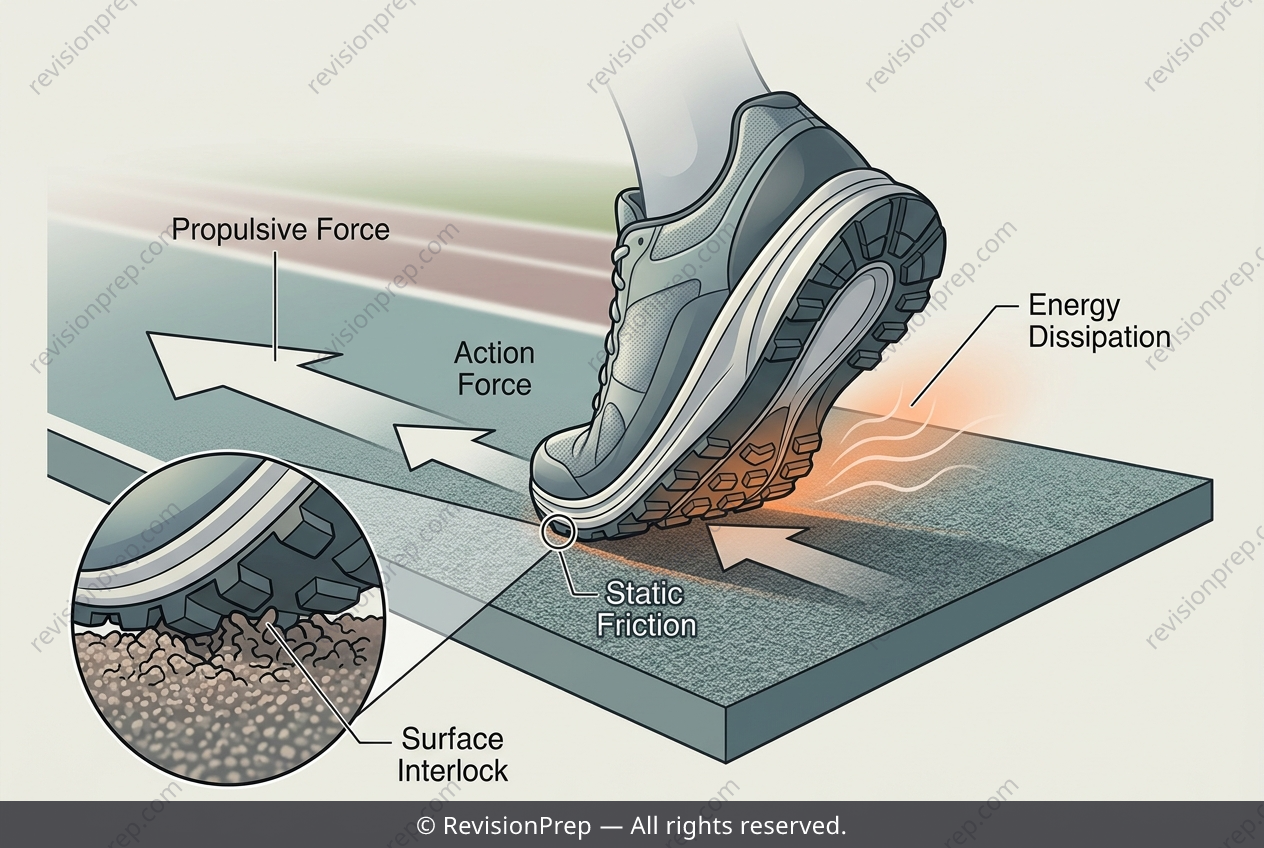
Physics: Why Friction Helps You Run but Costs Energy
Friction is rarely just a brake. In a 400 m race, the friction between a shoe sole and the track is what lets a runner push backward and be driven forward, since the ground's reaction force depends on how much grip the sole provides. A larger friction force means the foot can transmit a bigger backward push without slipping, so the track returns a larger forward force and the runner accelerates more strongly, consistent with F = ma. Yet friction is also dissipative. Every stride that grips the surface also meets resistance, and the muscular energy spent overcoming it accumulates over 400 m. Deep lugs may sharpen acceleration, but the fatigue athletes report in the final 100 m shows the cost: more energy per step, less left for the finish. Friction therefore acts as both propulsive and dissipative, and shoe design becomes a trade-off between grip and endurance rather than a simple maximisation problem.
Start practising IB questions today
150,000+ IB-styled questions, criteria-mapped and instantly accessible.