
Physics: Why One Scale Can't Fit the Solar System
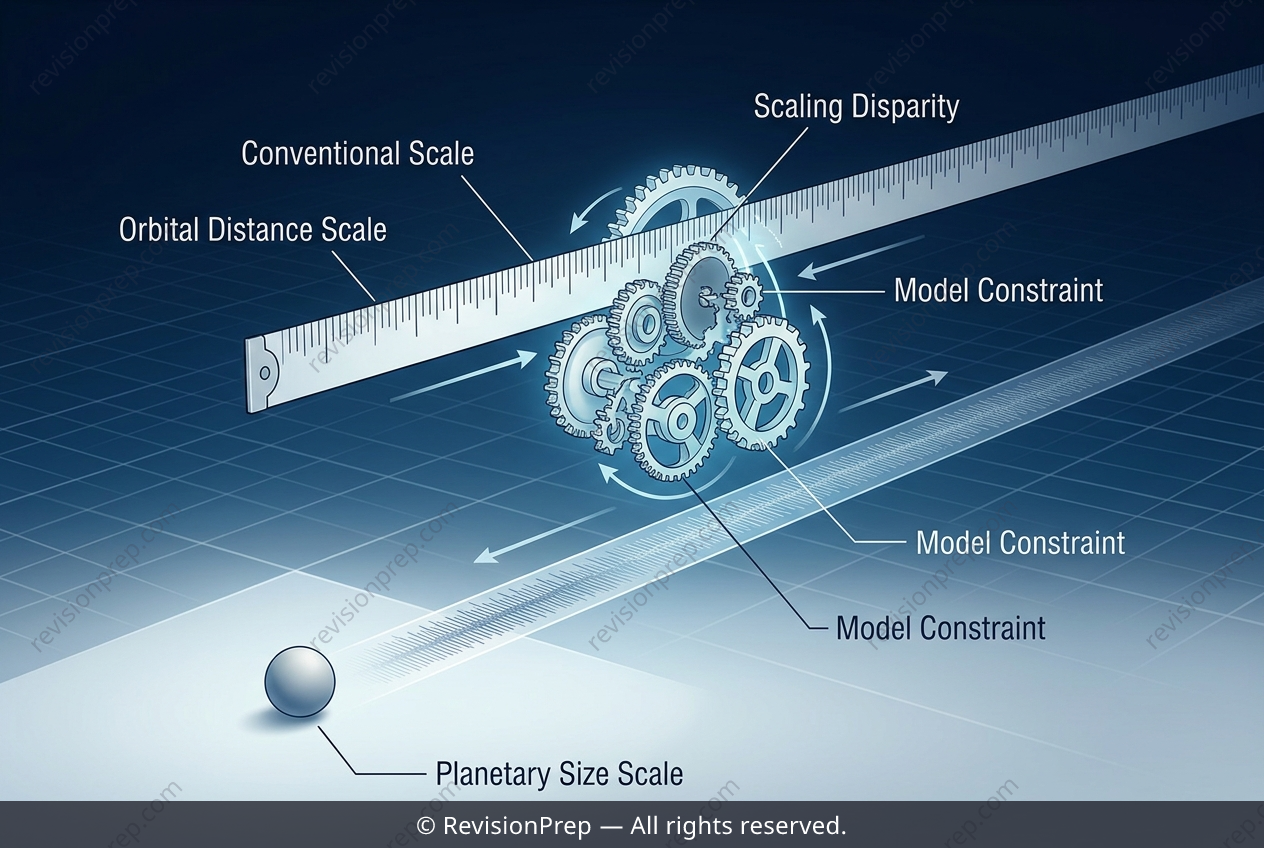
When we picture the Solar System, we often imagine a neat, compact diagram where planets sit close together, clearly visible against the dark backdrop of space. But the moment you try to build a physical model using a single, uniform scale, that tidy picture collapses. The core concept here is the limitation of uniform scaling—the idea that one fixed ratio cannot simultaneously represent both the sizes of planets and the vast distances between them without distorting our perception of reality. This matters because our intuition about space is fundamentally wrong. At a 1:10 billion scale, Earth becomes a 1.3 mm marble, while Jupiter is a 14 cm sphere—a dramatic size difference of roughly 100 times. Yet the orbital radii stretch to 15 m and 78 m respectively. The key relationship is the ratio of orbital radius to planet diameter: for Earth, that ratio is enormous, meaning the planet is effectively invisible against the empty distance. The model fails not because the numbers are wrong, but because the human eye cannot register a 1.3 mm object 15 m away. This disconnect between planetary size and orbital separation—where Jupiter’s bulk is lost across a 63 m gap—reveals why a single scale factor cannot capture the Solar System’s true structure.
Start practising IB questions today
150,000+ IB-styled questions, criteria-mapped and instantly accessible.