
When a Quadratic Model Meets Reality
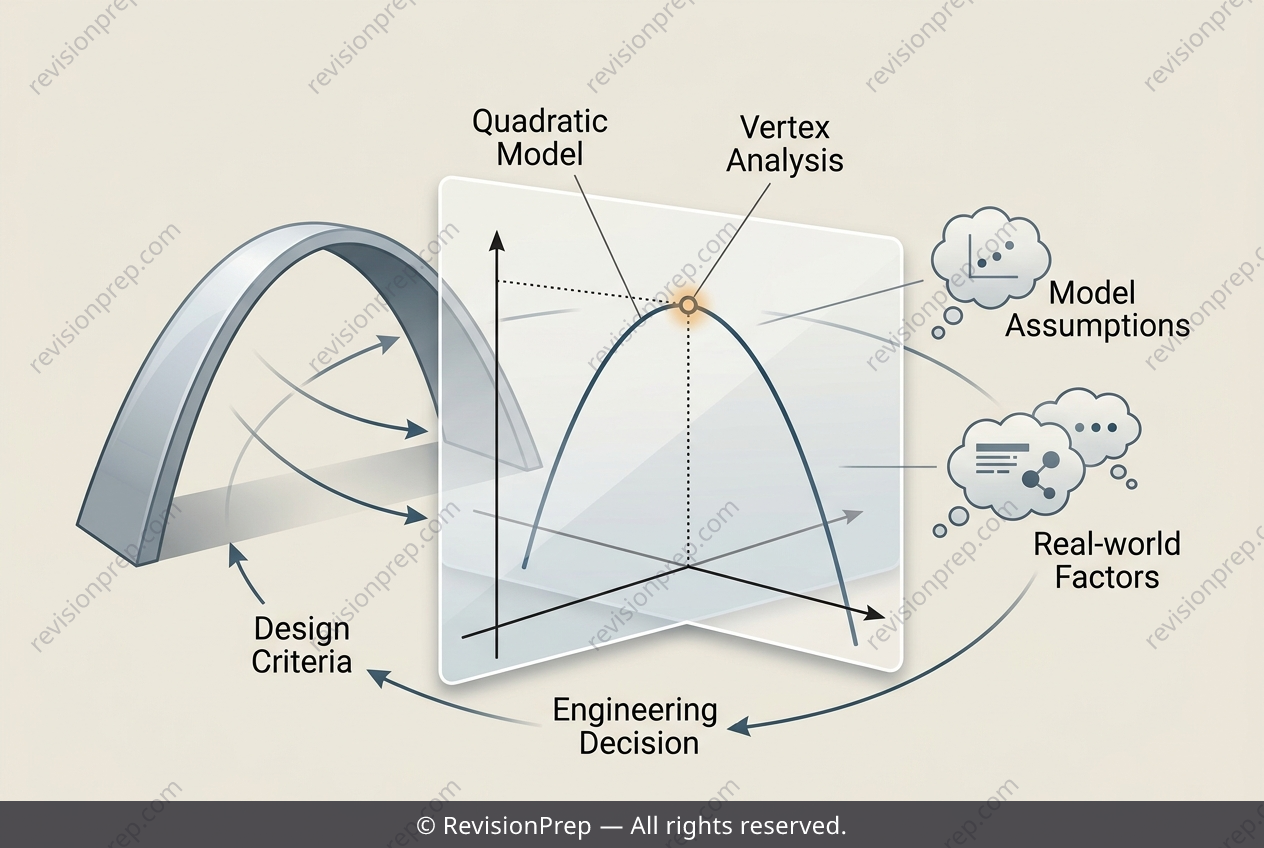
Quadratic functions are far more than abstract parabolas on a page—they are the precision tools behind real-world engineering design. In this case, a satellite dish’s cross-section is modelled by y = -0.02x² + 1.2x, where y is the depth and x is the horizontal distance from the left edge. The core concept here is not just plotting a curve, but using its vertex—found via x = -b/(2a)—to locate the exact point of maximum depth, and then evaluating whether that point meets a design specification. What makes this topic powerful is the connection between algebraic structure and physical constraints. The negative coefficient of x² guarantees a downward-opening parabola, meaning the vertex gives the dish’s deepest point. But the model’s usefulness depends on its assumptions: perfect symmetry and a rigid, uniform material. In reality, manufacturing flaws or thermal deformation can shift that vertex or reduce the true depth, breaking the signal-focusing requirement. By analysing these assumptions, you move from calculation to critical evaluation—seeing how a simple quadratic equation carries hidden limitations that an engineer must question before trusting its predictions.
Start practising IB questions today
150,000+ IB-styled questions, criteria-mapped and instantly accessible.