
Organic Chemistry: Atom Economy & Green Chemistry in Aspirin Synthesis
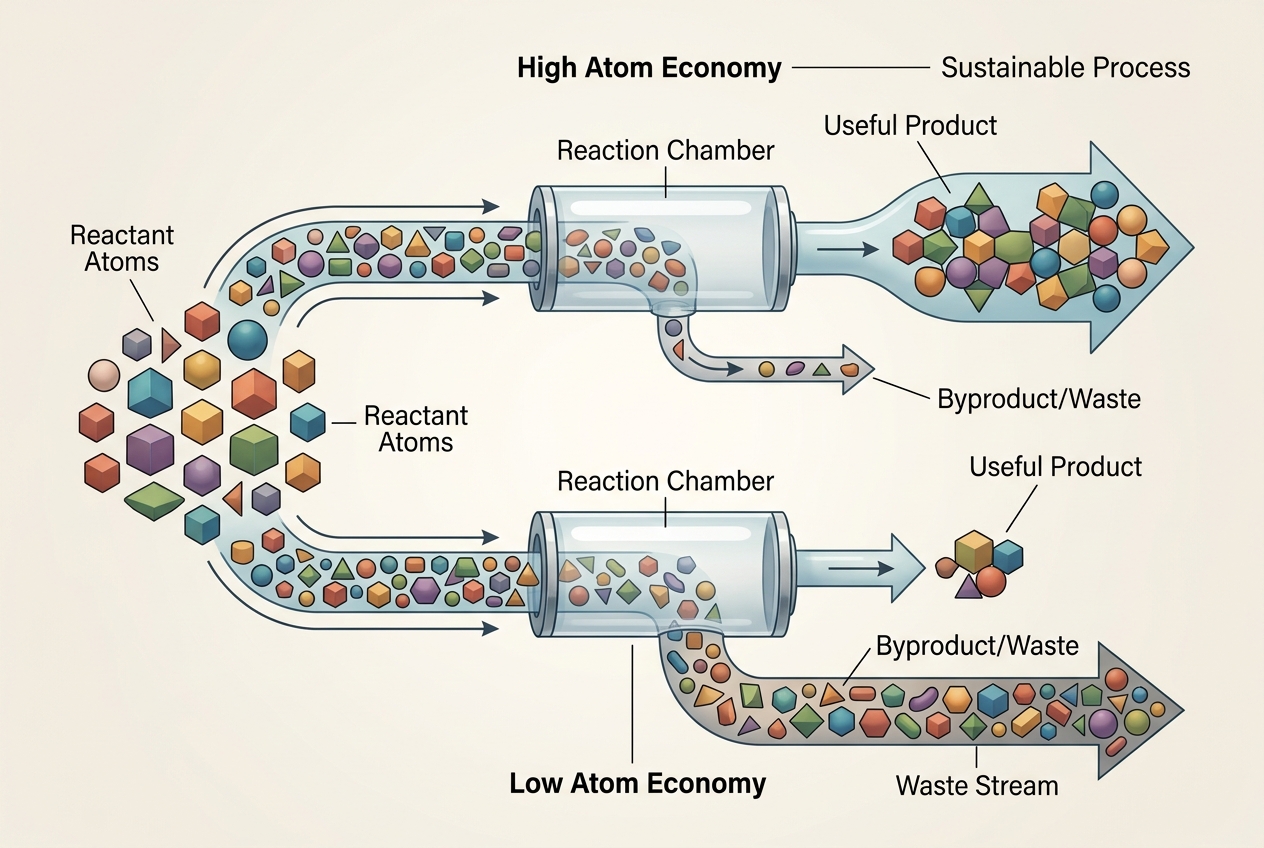
In green chemistry, atom economy measures how efficiently a chemical reaction uses its starting materials. It is calculated as the percentage of the total molar mass of all reactants that ends up in the desired product. A higher atom economy means fewer atoms are wasted as by-products, making the process more sustainable and cost-effective—especially important for industrial production where waste disposal and resource efficiency directly impact environmental and economic viability. The formula for atom economy is simple: (molar mass of desired product ÷ total molar mass of all reactants) × 100%. For example, in the synthesis of aspirin (molar mass 180 g/mol), comparing two routes reveals how this metric guides choice. Route A uses reactants with a combined molar mass of 216 g/mol, while Route B has an atom economy of only 68%. By applying the formula, you can see how Route A incorporates a greater proportion of reactant atoms into aspirin, producing less waste per mole of product. This direct relationship between atom economy, waste generation, and industrial suitability is central to evaluating synthetic routes.
Start practising IB questions today
150,000+ IB-styled questions, criteria-mapped and instantly accessible.