
Physics: Alpha vs Gamma: Radiation's Healing-Harm Divide
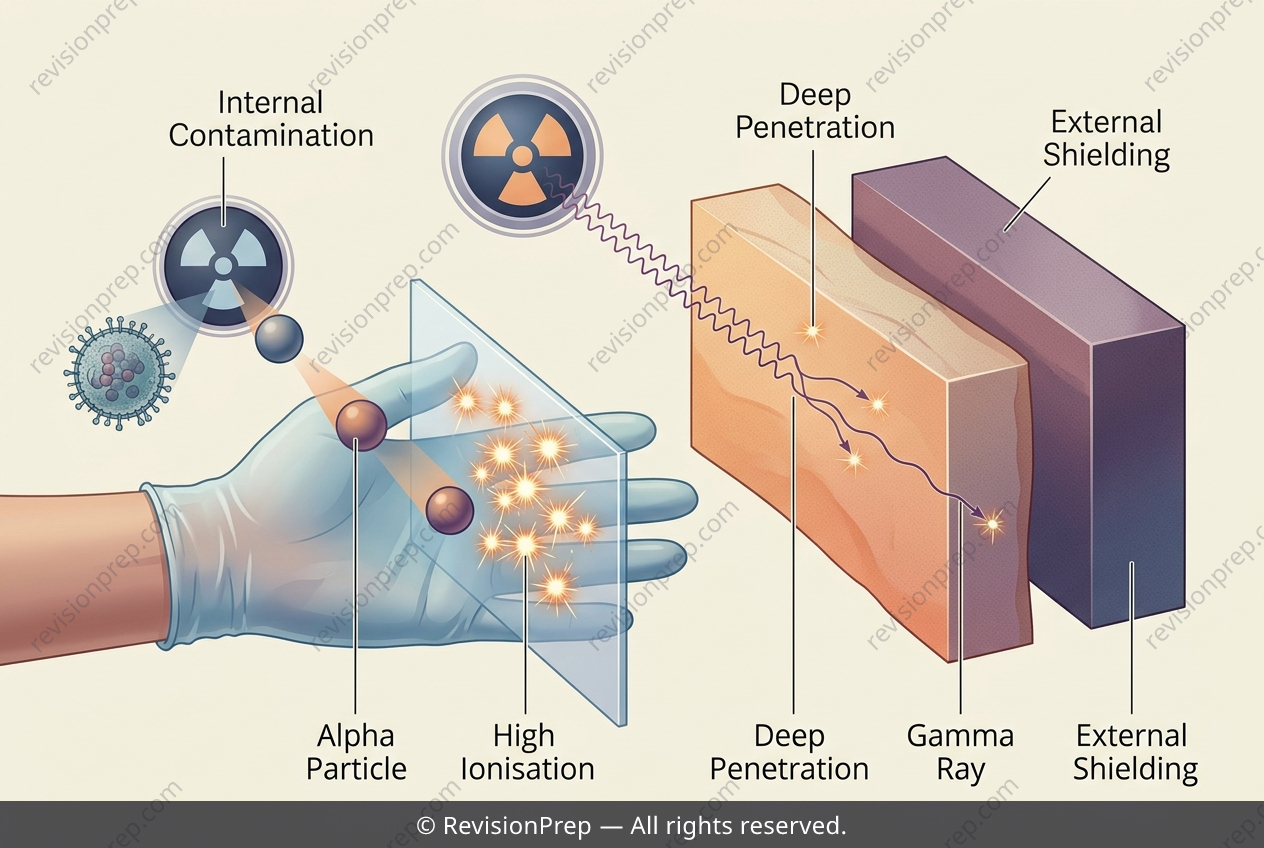
When we talk about ionising radiation, we are really talking about a transfer of energy so powerful it can strip electrons from atoms, breaking molecular bonds and altering living tissue. The core concept here is that different types of radiation interact with matter in fundamentally different ways—a property that dictates whether they are a tool for healing or a hidden hazard. This differential interaction is governed by a trade-off between penetrating power and ionising density: the more massive and highly charged a particle is, the more aggressively it ionises, but the sooner it runs out of energy and stops. This balance is beautifully illustrated in medicine. Gamma rays, being massless photons, have immense penetrating power, allowing them to pass through the body’s surface and deposit energy at a deep-seated tumour. In contrast, alpha particles—heavy, doubly charged helium nuclei—are incredibly ionising but travel only a few centimetres in air and cannot even cross the dead layer of skin. This means they are perfect for delivering a lethal, concentrated dose to localised bone cancer cells, yet utterly useless for reaching deep tissue. The same property that makes alpha radiation a precise surgical tool externally becomes a severe internal threat: if inhaled or ingested, its intense ionising power is unleashed directly on living organs, which is why contamination control, not just lead shielding, is paramount.
Start practising IB questions today
150,000+ IB-styled questions, criteria-mapped and instantly accessible.