
Physics: Atomic Models, Radiation & Medical Therapy
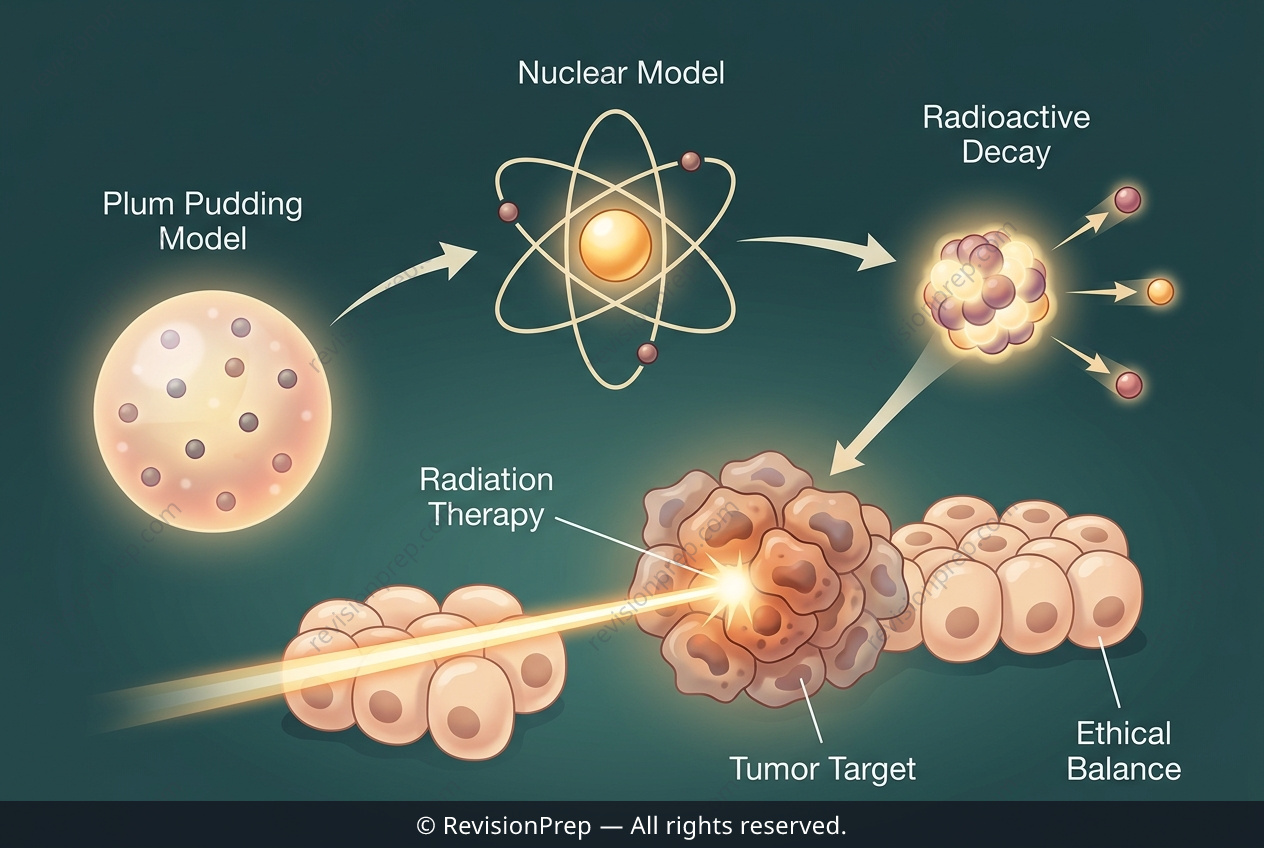
The story of the atom is one of continuous refinement, driven by experiment and the courage to overturn established ideas. It begins with J.J. Thomson’s 1897 “plum pudding” model, which envisioned the atom as a diffuse, positively charged sphere with negatively charged electrons embedded throughout—like plums in a pudding. This model, though later proven incomplete, was a crucial step in establishing that atoms have internal structure. It was replaced by the nuclear model, born from Rutherford’s gold foil experiment, which revealed that nearly all of an atom’s mass and all of its positive charge are concentrated in a tiny central nucleus, leaving the rest as largely empty space. This shift in understanding was not merely academic. It laid the groundwork for Marie Curie’s isolation of radioactive elements like radium, which spontaneously emit ionising radiation. Scientists realised this radiation could penetrate tissue and deposit energy locally, destroying cells in its path. This mechanism became the foundation of radiation therapy, where radium sources are placed directly adjacent to tumours to deliver a concentrated dose of ionising radiation. The ethical application of this power hinges on a delicate balance: the significant benefit of destroying cancerous cells and halting disease progression must be weighed against the unavoidable damage to surrounding healthy tissue, as ionising radiation does not discriminate perfectly between the two.
Start practising IB questions today
150,000+ IB-styled questions, criteria-mapped and instantly accessible.