
Physics Comparative Planetology: Mars vs Earth
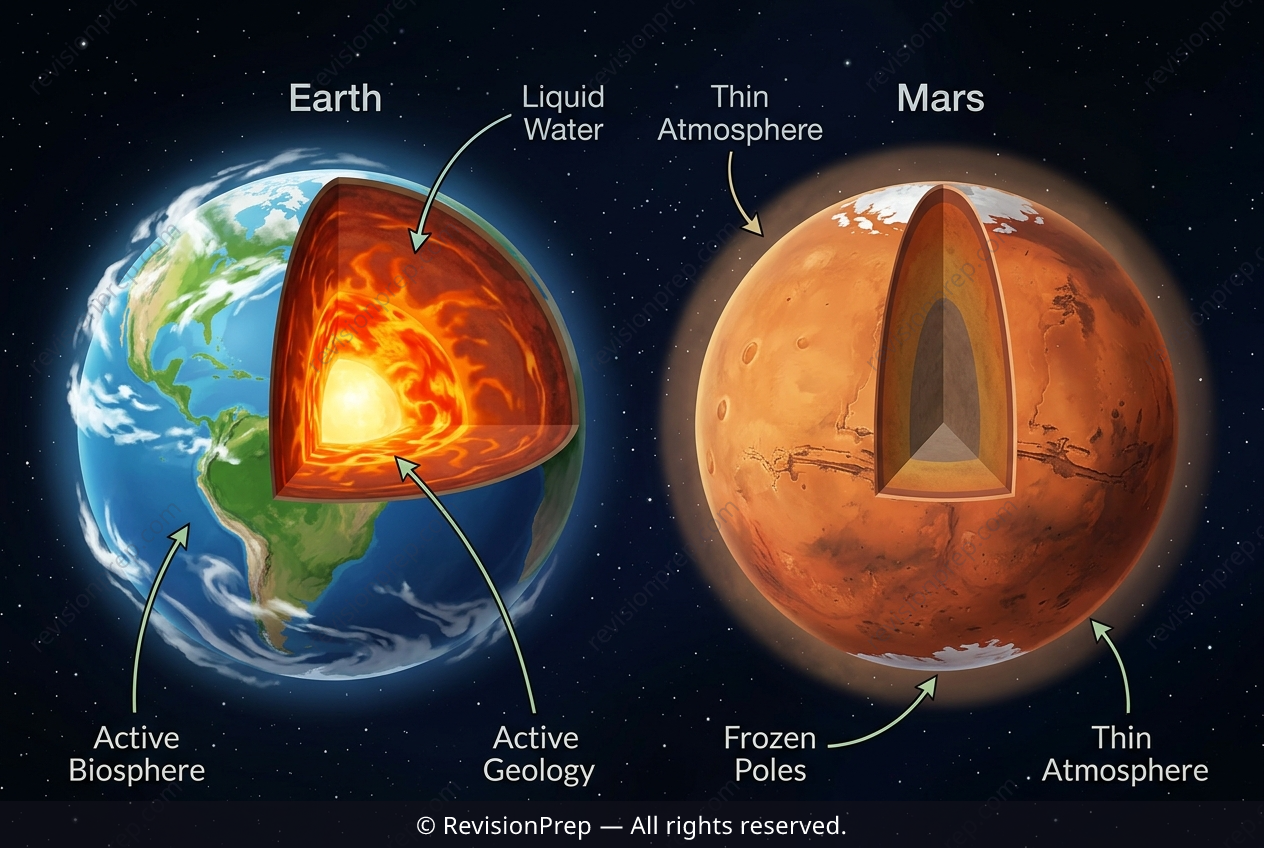
When we look up at the night sky, the planets of our Solar System appear as scattered points of light, yet they are worlds with wildly different personalities. The core concept here is comparative planetology—the study of planets by comparing their features to understand how they formed and evolved. By placing Earth side-by-side with its neighbours, we begin to see that our home is not the "default" planet, but rather an extreme outlier shaped by specific physical conditions. The fourth planet from the Sun, a rocky world often called the "Red Planet," offers a striking contrast to Earth. Its surface is rusted with iron oxide, giving it that signature hue, but the differences run far deeper. While Earth boasts a thick, nitrogen–oxygen atmosphere that supports liquid oceans and life, this neighbour has a whisper-thin atmosphere dominated by carbon dioxide. Because it is roughly half Earth’s diameter, its gravitational pull is only about 38% of ours—too weak to hold onto a substantial atmosphere or stable liquid water, which exists there only as ice. These linked factors—size, gravity, atmospheric composition, and water state—are not isolated facts; they form a causal chain. A smaller mass leads to weaker gravity, which leads to a thinner atmosphere, which in turn prevents liquid water from persisting. Understanding these relationships is the essence of comparative planetology: by measuring how one planet deviates from another, we reveal the underlying physical laws that govern all worlds, including our own.
Start practising IB questions today
150,000+ IB-styled questions, criteria-mapped and instantly accessible.