
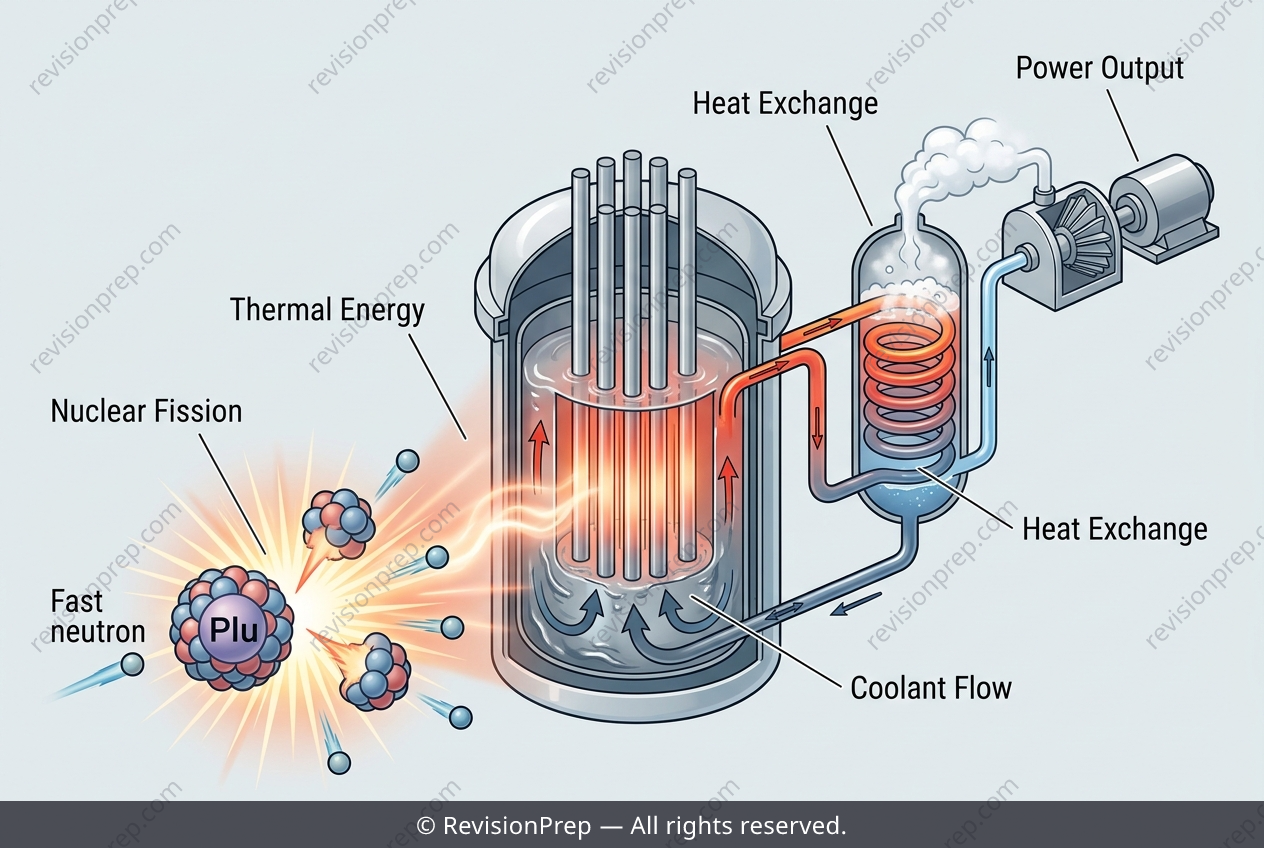
Physics: Converting Nuclear Energy into Power
Nuclear energy conversion is the process by which the mass of heavy nuclei is transformed into usable thermal power—and in a fast reactor, this happens at an extraordinary scale. In this Physics SL topic, we explore how a Generation IV lead-cooled fast reactor (LFR) harnesses fast neutrons to fission plutonium-239 within a mixed oxide fuel, releasing about 210 MeV per event. The core idea is that each fission converts a tiny amount of mass into a large, concentrated burst of energy, which then must be managed as heat. What makes this concept compelling is the chain of calculations that links microscopic physics to macroscopic engineering. From the mass of plutonium in the fuel, you use Avogadro’s number and molar mass to find the number of nuclei, then multiply by the fission energy per nucleus to get total energy released. Dividing by time gives power. But that power doesn’t just vanish—most of it becomes thermal energy that the coolant must carry away. Here, the specific heat capacity of liquid lead and the permitted temperature rise (550 K minus 400 K) determine the heat removal rate via Q̇ = ṁcΔT. Comparing this removal rate to the thermal power generated reveals whether the cooling system is sufficient—a critical real-world safety check for reactor design.
Start practising IB questions today
150,000+ IB-styled questions, criteria-mapped and instantly accessible.