
Physics: Electrical Circuit Safety: Fuses, Current, and Power in Practice
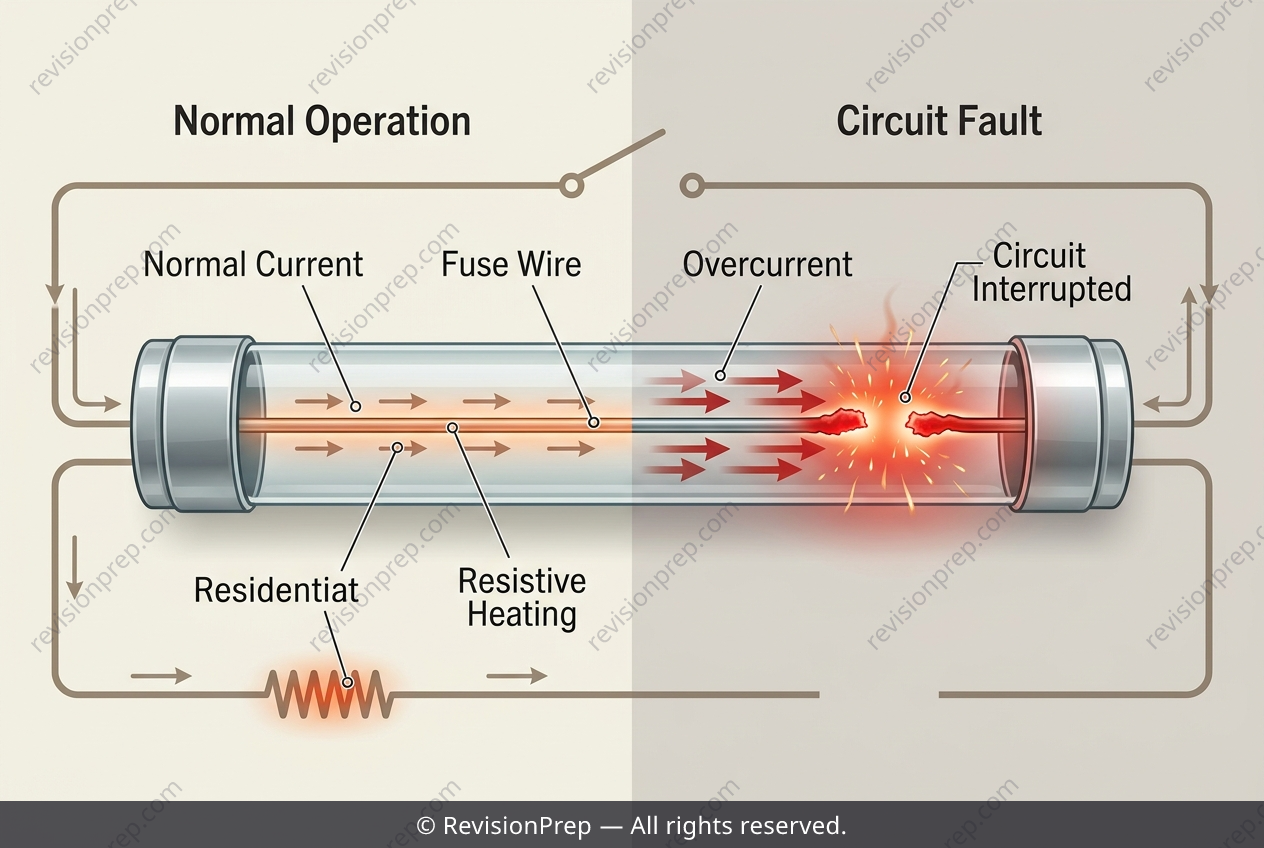
Electrical circuits only become useful when we can control the energy flowing through them—and that control hinges on three tightly linked quantities: voltage, current, and resistance. In a mains circuit, voltage pushes charge around the loop, current is the rate at which that charge flows, and resistance opposes the flow. The relationship between them is captured by Ohm’s law, V = IR, but for safety, the more critical expression is the power dissipated in a component: P = I²R. This formula reveals a hidden danger: if current rises even slightly, the heating effect in wires and devices grows with the square of that current, quickly turning a minor fault into a fire hazard. That is why overcurrent protection exists. A fuse is a deliberately weak link—a thin wire with a known melting point. Under normal operation, the current stays below the fuse’s rated value, and the wire simply carries the load. But when a fault causes current to surge, the increased power dissipation (again, P = I²R) heats the fuse wire past its melting point. The wire melts, physically breaking the circuit and stopping the flow of charge entirely. Choosing the correct fuse rating is therefore a balancing act: it must be high enough to allow the appliance’s normal operating current, yet low enough to trip quickly during a fault. This single component connects the physics of resistance, current, and thermal energy to the practical goal of protecting both people and equipment.
Start practising IB questions today
150,000+ IB-styled questions, criteria-mapped and instantly accessible.