
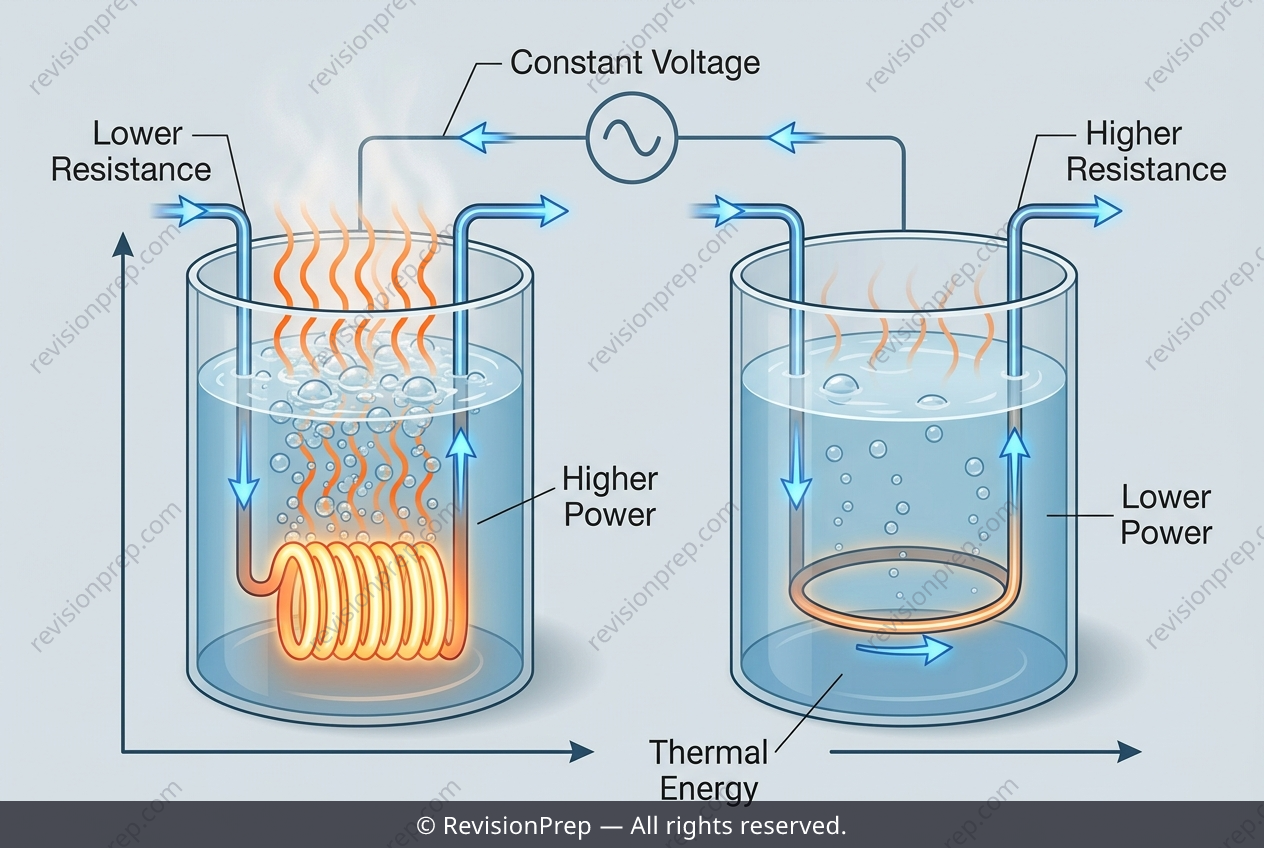
Physics: Electrical Power, Voltage, and Resistance in Magnetic Fields
When a current flows through a resistive material, the electrical energy carried by the moving charges is continually converted into thermal energy—this is the fundamental principle behind electric kettles, heaters, and filament bulbs. In a kettle, the heating element’s resistance is the key property that controls how much power is drawn from a fixed mains voltage. The relationship between power (P), voltage (V), and resistance (R) is captured by the formula P = V²/R, which reveals that power is not simply proportional to resistance, but inversely proportional to it when voltage stays constant. This inverse relationship is the heart of the concept: if you double the resistance while keeping the voltage the same, the current is halved (by Ohm’s law, I = V/R), and since power depends on the square of the current times resistance, the net effect is that power is exactly halved. Understanding this connection matters because it explains why manufacturers can design heating elements with different resistances to achieve different heating rates—and why a simple change in resistance has a predictable, non-linear impact on energy dissipation. The formula also highlights that voltage is the driving force, while resistance acts as a limiting factor, making the interplay between these three quantities essential for analysing real-world electrical devices.
Start practising IB questions today
150,000+ IB-styled questions, criteria-mapped and instantly accessible.