
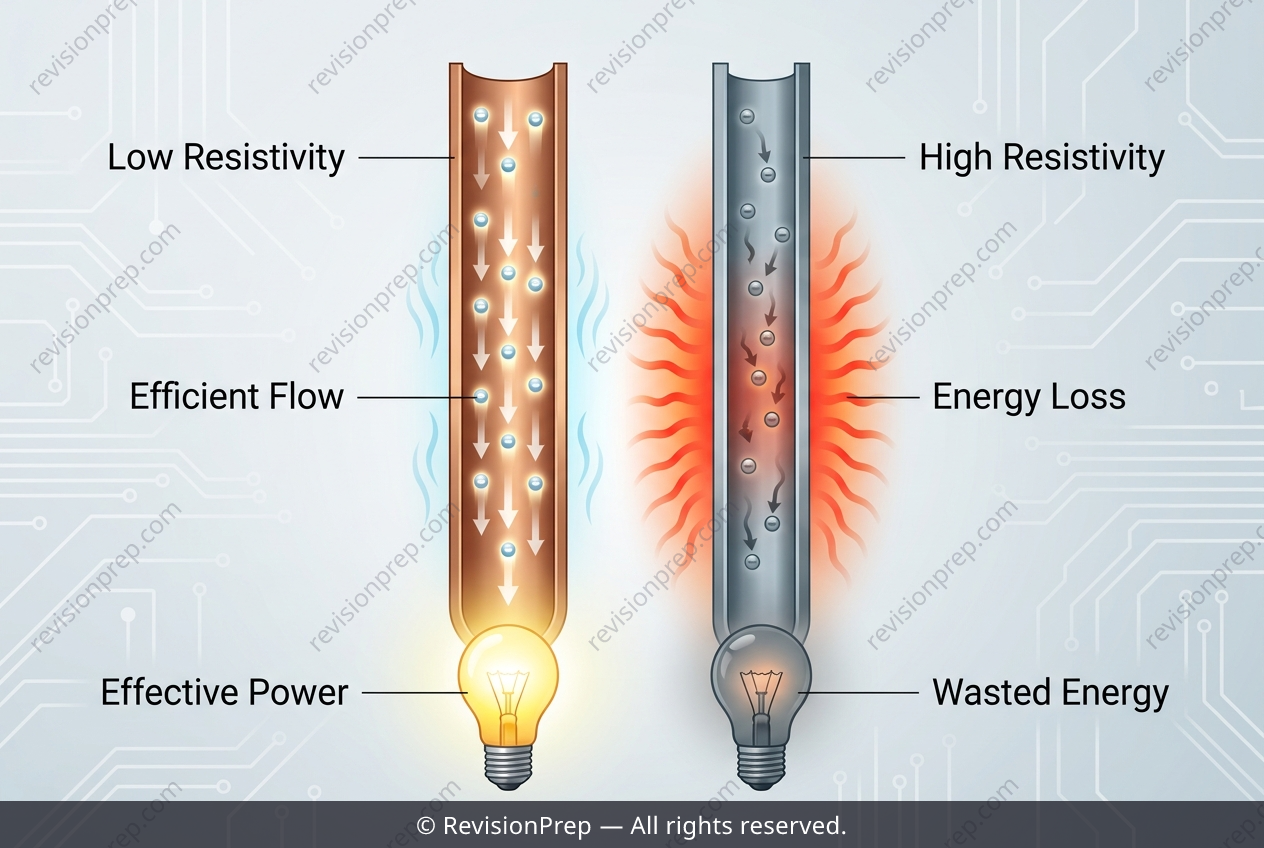
Physics: Electrical Resistivity and Conductivity with Copper vs Steel Wiring
When electricity flows through a wire, it encounters resistance—a measure of how strongly the material opposes the flow of charge. This opposition arises from collisions between moving electrons and the fixed atoms of the conductor, converting some electrical energy into heat. The intrinsic property that quantifies this opposition for a given material is its resistivity (ρ), which relates to resistance (R) through the formula R = ρL/A, where L is the wire’s length and A is its cross-sectional area. Lower resistivity means lower resistance for the same dimensions, so less energy is wasted as thermal dissipation for a given current (I), as described by P = I²R. This concept matters far beyond textbook calculations: it dictates the efficiency and safety of the electrical infrastructure we use daily. Copper’s resistivity is roughly six times lower than steel’s, meaning copper wires deliver the same power to a device while generating significantly less heat. This not only reduces the risk of overheating in household circuits but also lowers the total energy drawn from power stations, cutting electricity bills and the environmental footprint of generation. Understanding resistivity therefore connects atomic-level material properties to real-world societal choices—why we mine, refine, and install copper in our homes rather than cheaper alternatives.
Start practising IB questions today
150,000+ IB-styled questions, criteria-mapped and instantly accessible.