
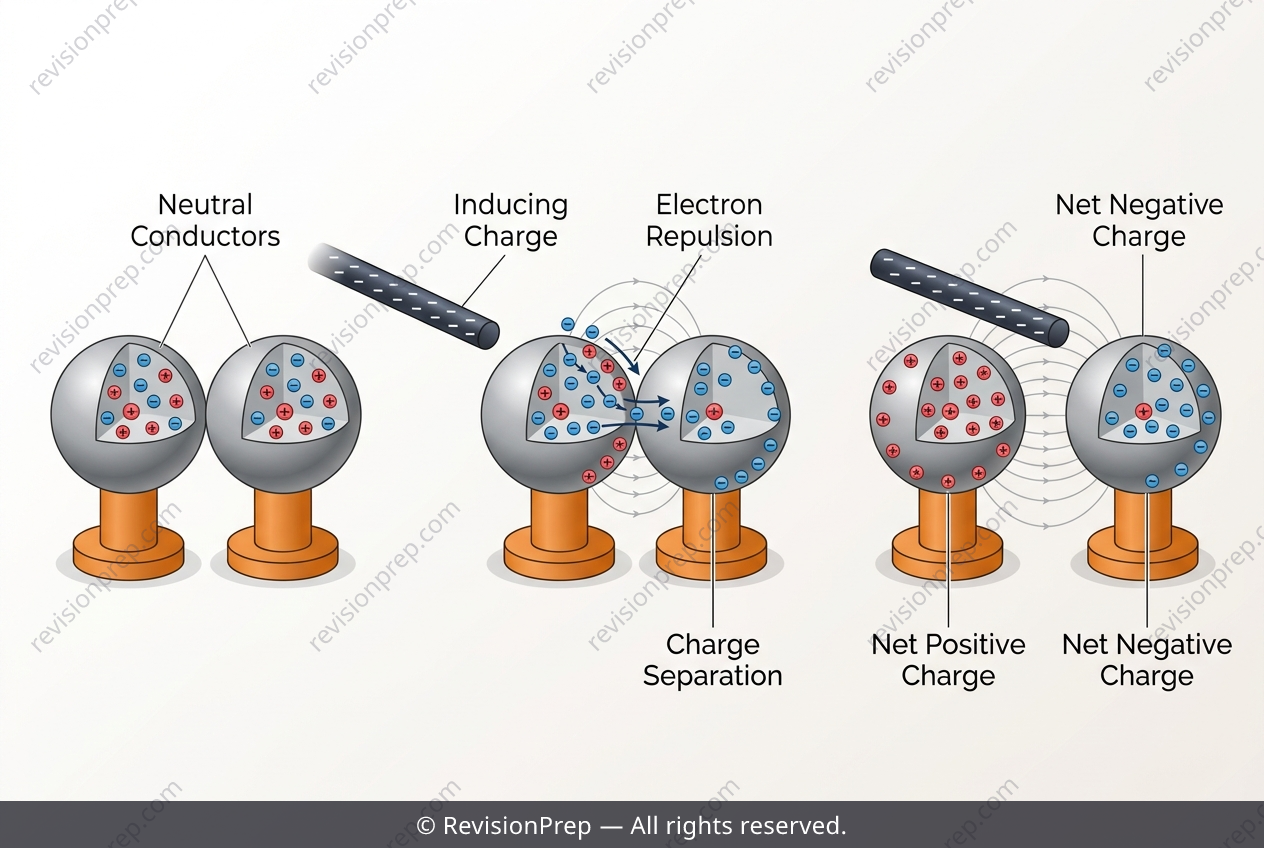
Physics: Electrostatic Induction: Charge Distribution in Conducting Spheres
Charging by electrostatic induction is the process of redistributing electric charge within a material without direct contact with a charged object—a fundamental mechanism that underpins everything from photocopiers to lightning safety. In this classic two-sphere setup, a negatively charged rod never touches the conductors, yet it sets in motion a precise dance of electrons that leaves each sphere with an opposite, net charge. The key lies in the repulsive force the rod exerts on free electrons. When the rod approaches sphere A, electrons are driven across the contact point into sphere B, leaving A with a deficit (positive) and B with an excess (negative). Crucially, the total charge remains zero—conservation of charge holds—but the separation of charges is what creates the lasting effect. The insulating stands are not incidental; they block any path to the ground, ensuring the redistributed electrons cannot leak away. Without this isolation, the system would simply neutralise, and no net charge would survive separation. Understanding this mechanism reveals how charge can be moved and trapped, turning a neutral object into a charged one through geometry and insulation alone.
Start practising IB questions today
150,000+ IB-styled questions, criteria-mapped and instantly accessible.